Deputy PM urges international community to press New Delhi to immediately restore Indus Water Treaty After Chenab, India disrupts water flow in River Jhelum Water commissioner takes up river flows fluctuation with India.
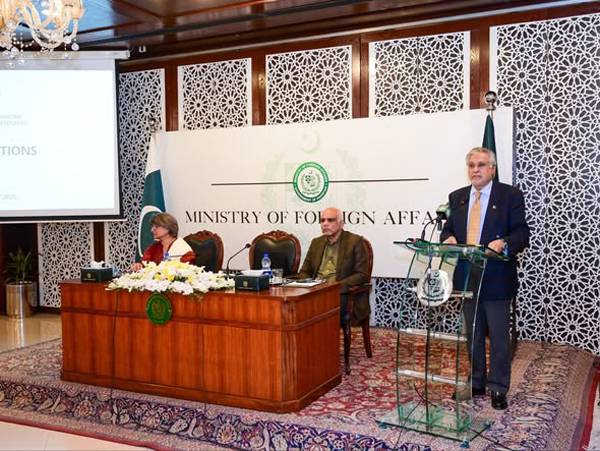
ISLAMABAD – Deputy Prime Minister Ishaq Dar on Friday urged the international community to call on India to immediately restore the Indus Water Treaty, halt the weaponization of water and refrain from undermining the peace and stability of South Asia.
Addressing the diplomatic corps in Islamabad, he voiced serious concerns over the manipulation of water flow of Chenab River by India.
He mentioned that India has released the water without any prior notification or any data or information sharing with Pakistan as required under the Indus Water Treaty.
He said India’s manipulation of water prompted our Indus Water Commissioner to write a letter to his Indian counterpart seeking clarification on the matter as provided under the treaty. Ishaq Dar said India’s recent action clearly exemplifies the weaponization of water to which Pakistan has been consistently drawing attention of the international community.
He highlighted that India’s manipulation of water at a critical time of our agriculture cycle directly threatens the lives and livelihoods as well as food and economic security of our citizens. He said we expect India to respond to the queries raised by Pakistan’s Indus Water Commissioner, refrain from any unilateral manipulation of the river flows and fulfill all its obligations in letter and spirit under the Indus Water Treaty.
The Deputy PM regretted that India has consistently attempted to undermine the treaty in a systematic manner. He said India’s construction of hydropower projects such as Kishanganga and Ratle involves design structures that blatantly violate the treaty’s technical specifications. He said India continues to build illegal dams in sheer disregard of the treaty obligations. With building of dams, Indian capacity to store and manipulate water is also increasing which endangers Pakistan’s security, economy and livelihoods of its people.
Ishaq Dar pointed out that India has also halted sharing the advance information, hydrological data and joint oversight required by the treaty which has exposed Pakistan to floods and drought. He said such illegal and irresponsible Indian conduct has all the potential to trigger a humanitarian crisis in Pakistan. He said the ongoing water manipulation by India contravenes international human rights and international humanitarian law while hindering progress on Sustainable Development Goals on Poverty and Hunger.
He said if India was allowed to violate treaty and its obligations with impunity, it amounts to setting a dangerous precedent. The Deputy PM also drew attention to the Indian subversion of the treaty’s own dispute resolution mechanism. He said India is refusing to participate in the Court of Arbitration and the neutral expert’s proceedings. Ishaq Dar reiterated that Indus Water Treaty is a binding legal instrument that has made an invaluable contribution to peace and stability of South Asia. He urged the international community to take notice of India’s continued disregard of a bilateral treaty and counsel India to act responsibly in accordance with international law and established norms. The Deputy PM said belligerent statements coming from the Indian leadership clearly demonstrate India’s intentions and designs to weaponize water aimed at inflicting harm on Pakistan and its people.
He made it clear that Pakistan remains committed to peaceful resolution of disputes and issues with India but will not compromise on its existential water rights of its people.
Also, Pakistan has officially taken up the issue of extraordinary dip in Chenab River flows with India, as satellite imagery indicated a marked reduction in the surface area of the Baglihar reservoir, followed by a visible increase, suggesting a rapid drawdown and subsequent refilling.
Pakistan’s Commissioner for Indus Waters has taken up an extraordinary drop in Chenab River flows with India, seeking an explanation under the Indus Waters Treaty after data showed the river at Marala plunged far below historical levels before stabilizing in recent days, the Ministry of Water Resources said.
Reportedly, after disruptions in the Chenab River, the Jhelum River is also experiencing disrupted flows due to the abrupt holding and releasing of water by Indian authorities. According to an internal report, on December 14, the inflows and outflows of the Jhelum River at Mangla stood at 5,000 and 33,000 cusecs, respectively.
However, inflows decreased to 3,300 cusecs on December 15 and remained at that level until December 19, while outflows remained at 33,000 cusecs.
Pakistan’s Commissioner for Indus Waters has raised the issue with his Indian counterpart, requesting detailed data on the mid-December reduction that officials say coincided with changes observed at India’s Baglihar hydropower reservoir, Ministry of Water Resources said.
Monitoring by the Punjab Irrigation Department shows that Chenab flows fell sharply between December 10 and December 16, at times dropping to 870 cusecs, a fraction of the typical mid-December range recorded over the past decade, the Ministry said.
Satellite imagery reviewed by Pakistani authorities indicated a marked reduction in the surface area of the Baglihar reservoir on December 8, followed by a visible increase by December 13, suggesting a rapid drawdown and subsequent refilling. This reduction followed by increase in the surface area of Baglihar reservoir leads to believe that India has emptied Baglihar reservoir followed by its refilling. According to the Indus Waters Treaty, India cannot empty the dead storage of the reservoirs of the run-of-river hydroelectric plants developed on the Western Rivers, the Ministry said.
However, river conditions began improving on December 17, when flows rose steadily and re-entered the historical range, the Ministry said. By early morning, discharge had climbed to 6,399 cusecs, signaling a recovery from the mid-month shock. Data through December 19 show flows fluctuating within expected seasonal limits at Marala, easing immediate concerns over water availability downstream.
The Ministry of Water Resources said continuous monitoring remains in place, with real-time data shared between the Punjab Irrigation Department and the Pakistan Commissioner for Indus Waters to track any renewed volatility. While authorities say the immediate situation has stabilized, Pakistan underscored the need for transparency and timely information-sharing to prevent future disruptions.
Meanwhile, the UN Experts have raised strong objections on India’s unilateral actions of May 7 inside Pakistan, asserting that the use of force by India violated the principles of the United Nations Charter.
In a report on India-Pakistan war, the UN experts said Indian attacks targeted civilian areas, mosques were affected and several civilians were killed and wounded.
The UN experts said that Pakistan informed the Security Council that it reserved the right to self-defence under Article 51.
They said India failed to provide credible evidence that Pakistan was involved at the state level in the Pahalgam attack.
The UN experts emphasized that there is no recognized right for unilateral military force under the pretext of counterterrorism.
They warned that India’s actions posed the risk of escalating into a major conflict.
They termed the Indian actions a grave violation of Pakistan’s sovereignty and the principles of non-interference.
The UN Special Rapporteurs have also endorsed Pakistan’s stance on Indus Waters Treaty. They expressed deep concern over India’s declaration to hold in abeyance the Indus Waters Treaty.
They noted that any obstruction or threat to the flow of water affects the fundamental rights of millions of people in Pakistan. The rights to water, food, employment, health, environment and development are directly impacted by this decision. The UN special experts emphasised that interference with transboundary water rights must be avoided.
They said water cannot be used as a tool for political or economic pressure.
The special experts’ report recognized that no party can unilaterally suspend the Indus Waters Treaty, emphasizing the treaty remains in effect unless both governments mutually terminate it through a new agreement.
The special experts’ report also referred to the Indian refusal to participate in arbitration and challenging the scope of the Indus Waters Treaty.
The UN experts demanded India to fully honour the Indus Water Treaty and refrain from violating Pakistan’s rights. They said India should take concrete steps to prevent human rights violations and damages arising from the obstruction of water.
The UN Special Rapporteurs also sent a questionnaire to the Modi government, raising key questions including the evidence of Indian allegations. They also inquired about India’s intentions regarding a peaceful resolution to Jammu and Kashmir dispute.
India did not respond to any of the questions.
Due to the lack of response, the UN Special Experts released the report.