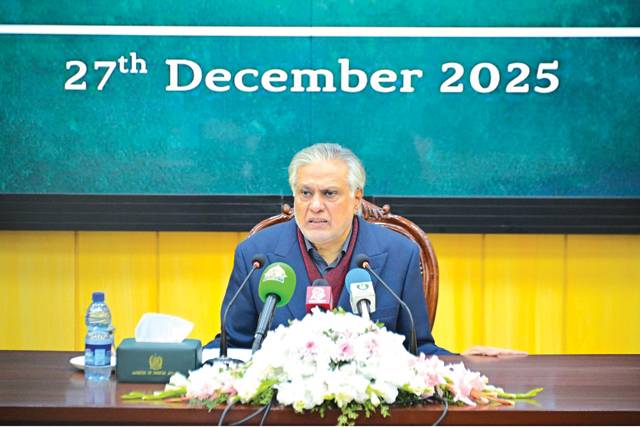
ISLAMABAD – Deputy Prime Minister and Foreign Minister Ishaq Dar yesterday said that Pakistan, once portrayed as diplomatically isolated, has re-emerged as a confident, influential and respected member of the international community due to the dynamic, proactive and principled policies of the incumbent government.
Speaking at a yearender news conference to present the annual performance and achievements of the Ministry of Foreign Affairs, the DPM said Pakistan’s firm, consistent and forward-looking positions on key regional and global issues have earned international recognition and appreciation across various global forums.
He added that the country’s diplomatic, political and economic standing has significantly improved, and acknowledged the role of the national media in effectively projecting Pakistan’s narrative to the world.
Recalling the situation at the time the government assumed office, Dar said Pakistan was widely described as a diplomatically isolated state. “Today, however, Pakistan’s role is acknowledged and valued within the comity of nations,” he stated, underscoring the transformation achieved through sustained diplomatic engagement.
Referring to the four-day armed confrontation with India, the DPM said the notion of Indian hegemony and its self-proclaimed status as a net security provider in the region was put to the test and decisively disproved. He noted that following the Pulwama incident, when India levelled baseless allegations against Pakistan, the Ministry of Foreign Affairs responded proactively and responsibly, ensuring a strong and effective defence of the country’s position.
Dar reiterated that Pakistan has consistently acted with restraint and responsibility in the face of Indian aggression, maintaining its commitment to peace. He added that Pakistan’s robust nuclear and missile capabilities have strengthened the country’s defence and ensured its security.
Highlighting the government’s economic vision, he said the focus now was on transforming Pakistan into an economic power, noting that economic strength would enable the country to play a leading role within the Muslim Ummah (nation).
He said Pakistan was endowed with vast natural resources, including minerals, precious stones and gas, and pointed to growing foreign investment, citing projects such as Reko Diq as examples of renewed international confidence.
Referring to the recent visit of the President of the United Arab Emirates, Dar said the UAE wad expected to acquire shares in the Fauji Group, which would help settle a $1 billion liability, while discussions are also underway regarding the rollover of an additional $2 billion loan.
He expressed gratitude to Saudi Arabia, the UAE and China for their continued support in ensuring Pakistan’s financial stability through loans and other assistance.
On the Jammu and Kashmir dispute, the DPM reiterated that lasting peace in South Asia is impossible without a just resolution of the issue. He said Pakistan has consistently opposed India’s illegal actions in Indian Illegally Occupied Jammu and Kashmir and has once again successfully highlighted the matter at the international level.
He noted that the UN Security Council has discussed human rights violations in the occupied territory and stressed that a plebiscite, in line with UNSC resolutions and involving the Kashmiri people, remains the only viable solution.
On the Indus Waters Treaty, Dar said Pakistan was actively pursuing the matter at relevant international forums, including the OIC, the Permanent Court of Arbitration and the United Nations, adding that recent developments and reports have been favourable to Pakistan’s position.
Describing the improvement in relations with Bangladesh as a major diplomatic breakthrough of the year, he said his visit to Dhaka involved extensive and meaningful engagements with the country’s leadership, including meetings with the chief executive, foreign minister, advisers, political leaders and student representatives. “A positive environment of goodwill has been created, and following the February elections, we intend to further strengthen engagement,” he said.
On relations with the United States, Dar observed that bilateral ties have historically experienced fluctuations. He said that while engagement was limited during the previous US administration, relations under the current leadership are moving in a positive direction, particularly in the areas of trade, investment and counter-terrorism cooperation.
He lauded the role of US President Donald Trump’s administration in facilitating a ceasefire between Pakistan and India, adding Pakistan nominated President Trump for the Nobel Peace Prize on June 11 in recognition of his efforts toward regional peace. He said President Trump had repeatedly referred to the downing of Indian fighter jets during the crisis.
Expressing satisfaction over bilateral trade with the United States reaching $13.28 billion, the DPM
said Pakistan currently enjoys the lowest tariff rates in South Asia for exports to the US market.
Dar also highlighted Pakistan’s active diplomatic engagement across the globe, including high-level participation and meetings with counterparts from Türkiye, OIC member states, China, the European Union, ASEAN, the United Nations, the Shanghai Cooperation Organisation and Russia. He said numerous agreements covering economic cooperation, defence and investment were signed, significantly expanding Pakistan’s global outreach.
He reaffirmed Pakistan’s principled stance on Gaza and its consistent support for a just resolution of the Palestine issue, emphasizing the country’s commitment to peace and international law.
Outlining the core principles of Pakistan’s foreign policy, the DPM said dialogue, engagement, regional stability, economic cooperation and the pursuit of peace remain its fundamental pillars, all firmly aligned with national interests.
Commenting on protests staged by Pakistan Tehrik-e-Insaf supporters in the United Kingdom, Dar termed them provocative and unacceptable, particularly in light of reported threats of violence. He stressed it was the responsibility of the UK government to prevent such incidents and said Pakistan had rightly issued a formal demarche on the matter.
He also expressed concern over the Taliban authorities’ failure to take concrete and effective action against terrorist groups operating from Afghan territory and carrying out attacks inside Pakistan.
Dar said it was unfortunate that India continued to obstruct the effective functioning of SAARC – undermining regional cooperation and collective progress.
Deputy Prime Minister Ishaq Dar said on Saturday that Pakistan’s international standing has improved as a result of its principled, proactive, and result-oriented diplomacy during the outgoing year.
He was speaking at his year-end briefing in Islamabad. Talking about South Asia, Ishaq Dar said Pakistan’s victory in the four-day conflict with India has sent a strong message to the world, puncturing India’s claim of being the net security provider in the region. He said Pakistan never requested anyone for a ceasefire. He added that Pakistan gave a befitting response to Indian aggression, shooting down seven Indian fighter jets and successfully neutralizing almost all incoming drones.
Regarding the Jammu and Kashmir dispute, the Deputy PM said Pakistan has been raising the issue and will continue to do so at all international forums. He stressed that there can be no lasting peace in the region without a just resolution of the Kashmir issue. He said the dispute can only be resolved through a UN-brokered plebiscite, in accordance with the wishes of the Kashmiri people.
Dar said Pakistan’s relations with Bangladesh are on a positive trajectory. He recalled receiving a very warm welcome during his visit to Dhaka. He added that bilateral engagement with Sri Lanka and Nepal is also on an upward trajectory.
Speaking about the Middle East, Ishaq Dar said Pakistan enjoys cordial and brotherly relations with all Gulf countries. He said Saudi Arabia and the United Arab Emirates have always supported Pakistan in difficult times. He noted that Pakistan has concluded a strategic mutual defence agreement with Saudi Arabia, reflecting the strong ties between the two countries. He added that Türkiye also holds a special place in Pakistan’s diplomacy.
Referring to the United States and the European Union, the Deputy Prime Minister said Pakistan’s diplomacy has demonstrated a proactive approach by turning challenges into opportunities. He said Islamabad is positively engaging with Washington in diverse fields, including trade, investment, and counterterrorism. He said bilateral trade between Pakistan and the United States has crossed thirteen billion dollars, which is a positive sign for economic relations.
He said Pakistan, along with other Muslim countries, successfully engaged with US President Donald Trump on the issue of Palestine, particularly regarding the bloodshed being committed by Israel in Gaza.
Ishaq Dar further said Pakistan is proactively engaging with the European Union and expressed hope that the GSP Plus status will continue in the future.
Talking about Central Asia, he said Pakistan is engaging with Central Asian states, which have immense potential for connectivity, trade, transport, and energy cooperation.
Regarding China, Ishaq Dar said Pakistan enjoys exemplary and ideal relations with Beijing. He said the two countries are iron brothers, and their partnership and cooperation in diverse fields are strengthening with each passing day.
The Deputy Prime Minister also highlighted Pakistan’s proactive engagement at multilateral forums, including the United Nations, the Organisation of Islamic Cooperation, the Economic Cooperation Organization, and the Shanghai Cooperation Organisation. He said Pakistan will host the ECO and SCO summits in 2027.
Ishaq Dar said Pakistan is a nuclear and missile power, but now it is time to transform the country into an economic power as well. He emphasized the need to utilize Pakistan’s abundant natural resources and said efforts must be made to explore hydrocarbons to strengthen the national economy. He noted that many countries, including the United States, Saudi Arabia, and China, have shown strong interest in Reko Diq and in tapping Pakistan’s mineral resources.
Responding to a question regarding Afghanistan, Ishaq Dar said Afghan soil should not be used against Pakistan, which is our only demand from the Afghan authorities.