Washington/Islamabad – A fragile ceasefire between the United States and Iran came under severe strain on Sunday as US President Donald Trump accused Tehran of a “total violation” after reported attacks on vessels near the Strait of Hormuz, while simultaneously confirming that American negotiators would return to Islamabad for another round of high-stakes talks. The day’s developments underscored the volatility of a conflict now in its eighth week, with diplomacy and escalation unfolding in parallel and the global economy watching closely.
In a series of strongly worded statements, Trump accused Iran of breaching the ceasefire agreement by opening fire on ships attempting to pass through the Strait of Hormuz — one of the world’s most critical energy corridors.
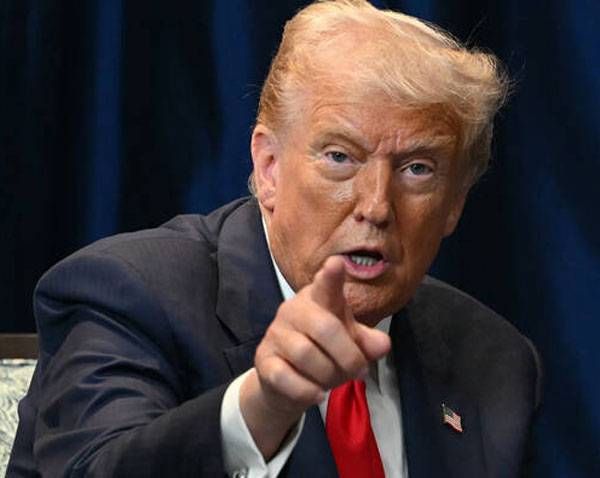
Trump warned that Washington could escalate military action if Tehran failed to accept US terms. He renewed a stark threat to target Iran’s infrastructure, including power plants and bridges, should negotiations fail. At the same time, he confirmed that a U.S. delegation would arrive in Islamabad on Monday evening for renewed negotiations — a move seen as a last-ditch effort to salvage diplomacy before the ceasefire expires later this week.
Despite the aggressive rhetoric, Trump also described ongoing contacts as “very good conversations,” suggesting that backchannel diplomacy remains active even as tensions rise.
“Iran decided to fire bullets yesterday in the Strait of Hormuz — A Total Violation of our Ceasefire Agreement! Many of them were aimed at a French Ship, and a Freighter from the United Kingdom. That wasn’t nice, was it?”, he questioned.
The United States president Trump said Iran recently announced that they were closing the Strait, which is strange, because our BLOCKADE has already closed it.
“They’re helping us without knowing, and they are the ones that lose with the closed passage, $500 Million Dollars a day! The United States loses nothing. In fact, many Ships are headed, right now, to the U.S., Texas, Louisiana, and Alaska, to load up, compliments of the IRGC, always wanting to be “the tough guy!” We’re offering a very fair and reasonable DEAL, and I hope they take it because, if they don’t, the United States is going to knock out every single Power Plant, and every single Bridge, in Iran.
“NO MORE MR. NICE GUY! They’ll come down fast, they’ll come down easy and, if they don’t take the DEAL, it will be my honor to do what has to be done, which should have been done to Iran, by other Presidents, for the last 47 years. IT’S TIME FOR THE IRAN KILLING MACHINE TO END! President DONALD J. TRUMP said.
However, Iran rejected new peace talks with the United States, its state news agency reported on Sunday.
Iran’s official IRNA news agency cited no specific source in its report that Iran had rejected the talks.
“Iran stated that its absence from the second round of talks stems from what it called Washington’s excessive demands, unrealistic expectations, constant shifts in stance, repeated contradictions, and the ongoing naval blockade, which it considers a breach of the ceasefire,” IRNA wrote.
The White House did not immediately respond to a request for comment on Iran’s rejection of the talks.
However Iranian official news agency IRNA on Sunday night quoting top officials said, “Iran’s absence from the second round of talks stems from what it called Washington’s excessive demands, unrealistic expectations, constant shifts in stance, repeated contradictions, and the ongoing naval blockade, which it considers a breach of the ceasefire”.
Iranian officials responded with a mix of defiance and conditional openness to talks. Senior figures, including Parliament Speaker Mohammad Bagher Ghalibaf, acknowledged limited progress in earlier negotiations but emphasized that major differences remain.
“We are still far from the final discussion,” Ghalibaf said, pointing to unresolved disputes over Iran’s nuclear programme and control of the Strait of Hormuz.
Tehran also made it clear that it would not participate fully in negotiations while the U.S. naval blockade of Iranian ports remains in place. Iranian media reports indicated that no delegation would travel to Pakistan under current conditions, highlighting a fundamental deadlock: Washington demands concessions first, while Tehran insists on the lifting of restrictions.
Iran further rejected U.S. demands regarding its stockpile of enriched uranium, calling any transfer or surrender a “non-starter,” reinforcing the depth of disagreement between the two sides.
At the centre of Sunday’s crisis was the Strait of Hormuz, a narrow but vital waterway through which roughly one-fifth of global oil supplies normally pass.
After briefly announcing its reopening on Friday — a move that sent oil prices sharply down and boosted global markets — Iran reversed course within hours. By Saturday and Sunday, the strait was effectively closed again, with Iranian forces reportedly turning back vessels and firing on ships attempting passage.
At least two ships reported being fired upon, and maritime tracking data showed almost no movement through the strait by Sunday.
Iran justified its actions by linking the strait’s status to the U.S. blockade. Officials argued that as long as Iranian shipping remains restricted, other nations cannot expect free passage.
“It is impossible for others to pass… while we cannot,” Iranian leadership signalled, framing the closure as both a strategic and retaliatory measure.
The Islamic Revolutionary Guard Corps (IRGC) also issued warnings that any unauthorised transit through the strait could be treated as hostile, further escalating risks for commercial shipping.
Friday’s brief reopening triggered one of the steepest single-day declines in oil prices and boosted stock markets worldwide, reflecting hopes of de-escalation. However, the rapid reversal has reintroduced volatility, with analysts warning of renewed price spikes when markets reopen.
Gulf stock markets reacted cautiously on Sunday, reflecting investor uncertainty. The situation remains fluid, with traders closely monitoring both military developments and diplomatic signals.
Amid rising tensions, Islamabad has once again emerged as a key diplomatic hub. Pakistan has been actively facilitating talks between Washington and Tehran, hosting the first round of negotiations last week.
Security in the Pakistani capital was visibly tightened on Sunday in anticipation of the U.S. delegation’s arrival. Roads were sealed, movement restricted, and heavy police and military deployments were observed in key areas, particularly near venues linked to previous talks.
The upcoming negotiations are expected to focus on two primary issues: Iran’s nuclear programme and the future status of the Strait of Hormuz.
Beyond the strait, the broader Middle East conflict continued to simmer on Sunday.
Meanwhile, despite a separate ceasefire between Israel and Lebanon, violence has not fully subsided. Incidents involving UN peacekeepers, including fatalities and injuries, were reported, highlighting the fragile nature of the truce.
Iran’s Supreme Leader issued a warning that the country’s military was prepared to inflict “new bitter defeats” on its enemies, signalling readiness for continued confrontation if diplomacy fails.
Sunday’s developments revealed a pattern of conflicting signals and rapid reversals that have characterised the crisis in recent days.
The Strait of Hormuz itself became a symbol of this volatility: declared open, then conditionally open, and finally closed again within a short span.
Analysts suggest that miscommunication, strategic signalling, and domestic political pressures on both sides have contributed to the instability.
In Washington, Trump faces mounting pressure ahead of upcoming midterm elections, with high fuel prices and inflation affecting voters.
In Tehran, leadership appears determined to avoid appearing weak while maintaining leverage in negotiations.
The two-week ceasefire, brokered with international mediation, is set to expire early Wednesday, adding urgency to the diplomatic efforts.
Both sides have accused each other of violations. The United States points to attacks on shipping, while Iran cites the ongoing naval blockade as a breach of the agreement.
Without a breakthrough in talks, the risk of renewed large-scale military action remains high.
As Sunday drew to a close, the situation remained finely balanced between diplomacy and escalation.
On one hand, the confirmation of new talks in Islamabad suggests that both sides still see value in negotiation. On the other, continued military threats, shipping disruptions, and hardline positions indicate that a peaceful resolution is far from guaranteed.