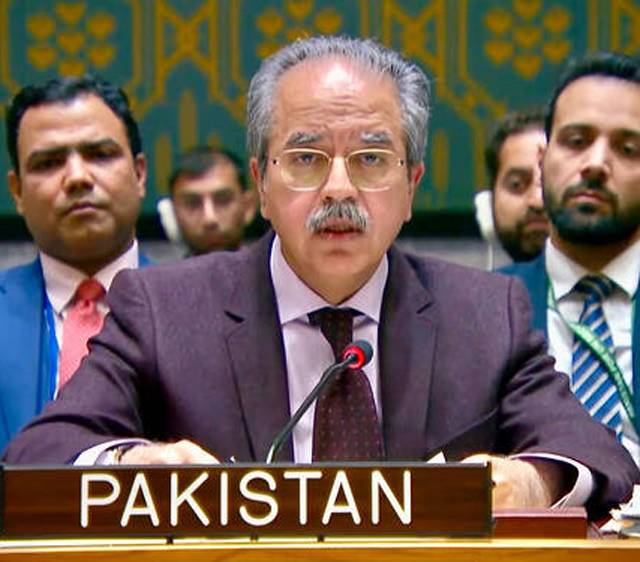
UNITED NATIONS – As International Criminal Court’s first trial of a Libyan war criminal suspect begins, Pakistan told the UN Security Council on Friday that a Libyan-led political process remains the only path towards lasting peace.
“While Pakistan is not a party to the (1988) Rome Statute (which established the ICC in 2002), we remain committed to the objective of credible and impartial accountability for serious crimes,” Ambassador Asim Iftikhar Ahmad, permanent representative of Pakistan to the UN, said during a discussion on ‘Libya (ICC)’
The legitimacy and credibility of international accountability mechanisms can only be sustained through the uniform application of international law and adherence to principles of fairness and impartiality, he said.
The prosecution of Khaled Mohamed Ali El Hishri on charges of war crimes and crimes against humanity stems from the ICC’s investigation into crimes in Libya after the fall of Libyan leader Muammar Gaddafi in 2011. Noting the surrender of El Hishri to the ICC, the Pakistani envoy underscored the need for cooperation between the Court and the Libyan authorities for the implementation of Security Council resolution 1970 (2011), which referred the situation in Libya to the ICC, as the Council took measures directed at the Libyan regime, including a travel ban and asset freezes for Gaddafi and his associates, and an arms embargo.
Reaffirming Pakistan’s steadfast support for Libya’s sovereignty, independence, territorial integrity and national unity, he said that consistency, objectivity, and non-selectivity were essential for strengthening confidence in the international justice system. “We encourage continued constructive engagement between the Office of the (ICC) Prosecutor and all relevant Libyan institutions in a manner that is fully respectful of Libya’s judicial sovereignty, national institutions, and legitimate concerns,” Ambassador Asim Ahmad emphasized.
“National ownership and capacity-building should remain central to all accountability effort
Pakistan, he added, supports all Libyan-led initiatives aimed at preserving judicial unity, upholding the rule of law, and strengthening constitutional oversight.
Briefing the 15-member Council on ICC’s work in Libya, its Deputy Prosecutor Nazhat Shameem Khan said recent judicial proceedings, including the confirmation hearing of Ali El Hishri, have brought victims “some measure of justice, of healing”, while urging stronger cooperation to secure arrests and advance accountability for war crimes, crimes against humanity and abuses against migrants.
We know from those women who have given their voice to this case, and from so many Libyans in The Hague with us this week, that simply to hear these accounts being put to Mr. El Hishri in a court of law has brought some measure of justice,” Nazhat Shameem Khan said via video-link.
At her briefing to the Council in November 2025, Ms. Khan said El Hishri’s arrest by German authorities, which paved the way for the first trial on the situation in Libya, marked a major step forward in long-delayed efforts to bring about accountability for crimes committed in the North African nation.
Recalling that she had addressed the Pre-Trial Chamber earlier this week at the opening of El Hishri’s hearing, Ms. Khan reminded the Council on Friday that he stands accused of 17 counts of war crimes and crimes against humanity, principally in Mitiga Prison, including in the women’s section. This week, victims’ accounts described “being suspended from the ceiling, dragged by their hair”, raped and beaten until they bled.
Expressing regret that she was unable to join the Council in person to present her report “due to the non-issuance of a US visa required for my travel”, she told the Council that the Court’s Libya Unified Team “is on the ground in many locations, collecting a wide range of information and evidence”, under the legal framework provided by Council resolution 1970 (2011).