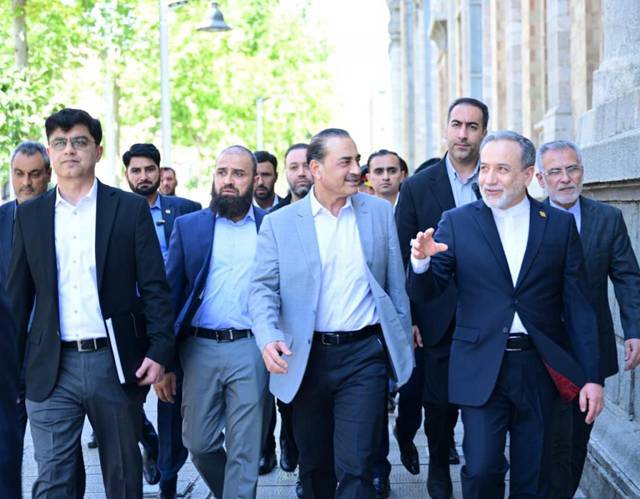
Washington/Islamabad/Tehran – Pakistan, US and Iran said on Saturday that progress had been made in talks on ending almost three months of war. Iran said it was focused on finalising a memorandum of understanding, or MOU, after its top officials met Pakistan Army Chief Asim Munir.
US President Donald Trump is “50/50” on whether to agree a deal with Iran or resume strikes, Axios reported Saturday, adding that he says he will likely decide by Sunday (today).
Axios reporter Barak Ravid says he spoke with Trump on the phone, who told him that there is a “solid 50/50” split on whether he will be able to make a “good” deal or else “blow them to kingdom come.” Trump said he would only accept a deal that covers issues like uranium enrichment and the fate of Iran’s existing stockpile, Axios reports, but it notes that those issues are unlikely to be resolved in any detail in what it says is the Memorandum of Understanding being discussed, which would end the war and trigger more detailed negotiations.
The US president added that he would meet with his top aides, envoys Steve Witkoff and Jared Kushner, as well as Vice President JD Vance later today to discuss the talks.
“I think one of two things will happen: either I hit them harder than they have ever been hit, or we are going to sign a deal that is good,” Trump said.
“Some people would much rather have a deal and others would rather resume the war,” he says. He rejected assertions that Israeli PM Benjamin Netanyahu is “worried” about a potential deal, but said the prime minister is “torn.”\Also, Pakistan’s Field Marshal Syed Asim Munir, NI (M), HJ, COAS & CDF concluded a short but highly productive official visit to Iran on Saturday. During the visit, the Field Marshal held high-level engagements with Iranian leadership as part of ongoing mediation efforts aimed at promoting de-escalation and constructive engagement, amidst the regional tensions that have simmered after the ceasefire on 8th April, 2026.
According to a press release issued by the Inter-Services Public Relations (ISPR), the Field Marshal called on Dr Masoud Pezeshkian, President of Iran, Mohammad Bagher Ghalibaf, Speaker of the Iranian Parliament, Abbas Araghchi, Foreign Minister of Iran and Eskandar Momeni, Interior Minister of Iran. The discussions remained focused upon expediting the consultative process underway to support peace and stability in the region and to reach to a conclusive agreement.
The engagements were held in a positive and constructive environment and contributed meaningfully towards the mediation process. “The intensive negotiations over the last twenty four hours have resulted in encouraging progress towards a final understanding,” the ISPR said.
US President Donald Trump on Saturday told CBS News that Washington and Tehran are “getting a lot closer” to an agreement to end the war between the two countries.
Without providing details about the agreement, Trump said “every day it gets better and better.”
“I can’t tell you before I tell them, right?” Mr. Trump told CBS News in a phone interview.
He said that the final agreement will prevent Iran from obtaining a nuclear weapon, adding that he “wouldn’t even be talking about it” otherwise, noting that the deal would also result in Iran’s enriched uranium being “satisfactorily handled.” “I will only sign a deal where we get everything we want,” he said. CBS News reported that Trump is still mulling proposals and has not made up his mind yet, adding that he is consulting with advisers and talking to foreign leaders, including leaders from Saudi Arabia and other Gulf countries.
Iran and Pakistan submit a revised proposal to the United States to end the war and reopen the Strait of Hormuz, two Pakistani sources familiar with the negotiations tell Reuters. A US response to the proposal is expected by tomorrow, the sources say.
The deal is “fairly comprehensive,” a Pakistani official involved in the negotiations tells Reuters.
“It is never over till it is done,” the official says. Trump told the BBC’s US partner CBS News he had seen a draft agreement with Iran. When asked whether it was good enough, he said: “I don’t know, I can’t tell you that.”
The Iranian leadership appreciated Pakistan’s sincere and constructive role in facilitating dialogue and promoting peaceful settlement of regional issues.
Upon arrival, the Field Marshal was received by Eskandar Momeni, Interior Minister of Iran, along with senior civil and military officials.
US Secretary of State Marco Rubio repeated Trump’s demands: “Iran can never have a nuclear weapon. The straits need to be open without tolls. They need to turn over their enriched uranium.”
Rubio, who is visiting India, said some progress had been made and work was continuing.
“Even as I speak to you now, there’s some work being done. There is a chance that, whether it’s later today, tomorrow, in a couple days, we may have something to say,” Rubio told reporters in New Delhi.
Iranian Foreign Ministry spokesperson Esmail Baghaei said: “The trend this week has been towards a reduction in disputes, but there are still issues that need to be discussed through mediators. We will have to wait and see where the situation ends in the next three or four days.”
“An MoU is being fine-tuned” to end the US-Iran war, a Pakistani security official who was briefed on the Pakistani army chief’s visit to Tehran and his meetings with Iranian leaders says, referring to a memorandum of understanding. The visit has made “significant progress” toward ending the war, he says.
Meanwhile, US President Donald Trump was holding a “summit” phone conversation with the leaders of Saudi Arabia, Qatar, the UAE, Bahrain, Kuwait, and Oman, as well Egypt, Jordan and Turkey, on the updated text of a potential interim agreement to end the war and set conditions for substantive negotiations, Channel 12’s Barak Ravid reported. Reuters reported earlier that Pakistan would also be on the call. There is no suggestion that Israel, which jointly launched the war against Iran with the US on February 28, is present on the call.
The text has reportedly been undergoing numerous revisions. Saudi site Al-Arabiya published what it said was a text Friday. The reported draft agreement does not explicitly mention key US demands, including the dismantling of Iran’s nuclear program and export of its stockpile of 60%-enriched uranium, limiting its ballistic missiles and ending its support for terrorist proxies.
It provides for negotiations on the unspecified “outstanding issues” to begin within seven days of the agreement taking effect. Although it conditions US sanctions relief on Iran’s commitment to the terms of the agreement, it does not appear to specify the consequences if the outstanding issues are not resolved.