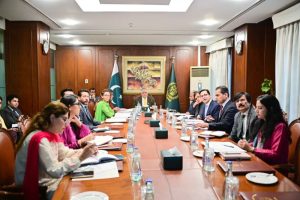
GILGIT/Skardu – Former prime minister and Pakistan Muslim League-Nawaz (PML-N) supremo Mian Nawaz Sharif on Tuesday said that he felt deep grief upon seeing the current state of Gilgit -Baltistan and lack of infrastructure development.
Addressing an election rally of the PML-N in Gilgit-Baltistan, Nawaz questioned the dilapidated condition of Gilgit-Baltistan’s roads and other basic amenities. He also promised the masses that development projects would be completed, whether the PML-N was voted in the election or not.
Ahead of the general elections to be held on June 7 in Gilgit-Baltistan, the election campaigns of political parties are picking up momentum. Following Bilawal Bhutto, PML-N supremo Mian Nawaz Sharif is also present in Gilgit-Baltistan in this regard.\In his address, Nawaz said that he was speaking to the people of this region after many years. “You might have forgotten me, but I still love Gilgit-Baltistan just the same,” Nawaz said while addressing the public in Gilgit, prompting roaring chants in his support.
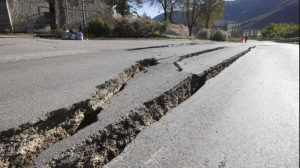
He added that he has a special attachment to the mountains and northern areas, and the people of Gilgit-Baltistan are close to his heart. Mentioning the poor condition of the roads during his journey from Gilgit airport to the city, Nawaz said he could not describe the situation in words.
He said, “I do not understand how all this was allowed to happen. If the money meant for public development and convenience had been used correctly, the situation of this area would have been different.” “My heart cries on why this was allowed, why the money that should have been spent on you all was not spent,” Nawaz added.
The PML-N leader also mentioned his last ouster during his speech, recalling that he had formed a committee as the prime minister in 2017 on GB’s share in the National Finance Commission (NFC) Award. “Do not complain to me. I am not ready to hear this grievance because this is your fault as well, that why you let a person like me be exiled,” he said. “Why did I have to leave the country and go abroad? Why were [we] jailed?”
The PML-N supremo said that in the past, the PML-N laid a network of roads across the country; however, he regretted that certain projects could not reach Gilgit-Baltistan.
Without naming any political party, he questioned why the governments that came into power did not give the required attention to the development of this area. He said that instead of criticising opponents, the PML-N asks the public for votes based on its performance.
Nawaz said that during the PML-N’s tenure, work was done on hospitals, powerhouses, and hydropower projects in this area. He added that the highway project started during his tenure should have been extended beyond Gilgit-Baltistan up to Khunjerab. He remarked, “I did no favour, rather all of this was the right of the people of Gilgit-Baltistan.”
He asked if any other party had started any notable development project here. He stated that his government had reduced the travel time between Gilgit and Skardu from nine hours to approximately three hours, which provided significant convenience to the public.
Nawaz assured the people of Gilgit-Baltistan that he would meet Prime Minister Shehbaz Sharif and recommend measures for the expansion of Gilgit airport and the operation of large commercial aircraft.
During his brief visit to Gilgit-Baltistan, Nawaz will also meet PML-N candidates participating in the elections. Defence Minister Khawaja Asif, Planning Minister Ahsan Iqbal, Inter-Provincial Coordination Minister Rana Sanaullah, Punjab Senior Minister Marriyum Aurangzeb, Senator Pervez Rashid, Senator Anusha Rahman, and other party leaders are also accompanying him on this visit.
It is worth noting that the general elections in Gilgit-Baltistan are being held on June 7, which are being conducted after a delay of about four months due to the severely cold weather.
Pakistan Peoples Party Chairman Bilawal Bhutto Zardari while addressing an election rally at Skardu’s main bazaar on Tuesday said that during the previous election campaign he had visited the people of Gilgit-Baltistan, traveled to every tehsil, and toured the entire region. He said that since then he could confidently say that no politician had seen as much of Gilgit-Baltistan as he had. Even the combined visits of all other political parties were fewer than the visits made by him. He said that their relationship with the people was not merely political, but one built across generations.
He said that everyone was praying for the success of the peace efforts being undertaken by the Field Marshal in the region. Youth across the Muslim world and the wider world were bearing the burden of this war. The conflict had created an economic crisis and caused a sharp rise in inflation, which is why they wanted to see an end to the war.
He added that he had wanted to conduct this campaign in the same spirit as the previous election campaign. During the last elections, there had been an atmosphere of joy, but now there was an atmosphere of grief for everyone. Referring to the martyrdoms in Iran, he said that young girls had been martyred and that the prevailing environment was one of sorrow. He strongly condemned the killing of Ayatollah Khamenei along with his granddaughter during Ramazan.
On the 7th, the people of this province must think carefully and not allow others to benefit by fighting among ourselves. If the PPP receives a heavy majority, then we will be able to solve the problems, he added.
The Chairman PPP said that the Pakistan Peoples Party believes in peace and opposes war. He stated that the tragedy was not limited to Iran, but that innocent people had also been killed in Palestine and Lebanon.
He said that the politics of the PPP differed from that of other parties. The party represents the underprivileged, grants them rights, and thinks about the poor. He said the PPP believes that the country’s progress depends on the uplift of marginalized communities, whereas other parties follow policies that make the rich even richer and call it development.
He said that during his tenure as Foreign Minister, other countries asked him how they too could help their poor through programs like BISP. Unfortunately, he said, the country’s politicians and political parties are focused on how to provide privileges to their wealthy friends, and they seek to end assistance for the poor through BISP. He emphasised that BISP benefits poor people across the entire country. He added that due to the prayers of mothers, the conspiracy to abolish BISP would fail. He further said that the PM would announce an increase in BISP allocations in the upcoming budget.
He further said that during the era of Pervez Musharraf, foreign countries were allowed to establish Military bases in Pakistan, but after the Salala incident, President Asif Ali Zardari shut down all such bases. Referring to recent bomb blasts in various countries, he said that whenever he speaks about the bomb developed by Shaheed Zulfikar Ali Bhutto and the contributions of Shaheed Benazir Bhutto, he also pays tribute to President Zardari as well.
The final list of candidates for the Gilgit-Baltistan Assembly General Elections 2026 was released on Tuesday, revealing that a total of 403 candidates will contest elections across 24 constituencies. The official figures show an overwhelming presence of independent candidates, while women’s representation remains significantly low.
According to the Election Commission’s data, 272 independent candidates are in the race, whereas 131 candidates are contesting on tickets of various political parties. Pakistan Peoples Party Parliamentarians (PPPP) leads the field with 23 candidates, followed closely by Pakistan Muslim League-Nawaz (PML-N) with 22 candidates.
Other political parties participating in the elections include Istehkam-e-Pakistan Party (IPP) with 15 candidates, Pakistan Muslim League with 11, Islami Tehreek Pakistan and Pakistan Nazriyati Party with 10 candidates each, and Jamiat Ulema-e-Islam (JUI) with 9 candidates. Majlis Wahdat-ul-Muslimeen (MWM) has fielded 7 candidates, while Jamaat-e-Islami and Muttahida Qaumi Movement (MQM) have nominated 6 candidates each. Awami Workers Party is represented by 4 candidates.
Constituency-wise details indicate that the most competitive contest is expected in GBA-2 Gilgit-II, where 40 candidates are vying for a single seat. The second-largest contest will take place in GBA-14 Astore-II, where 33 candidates are in the running. In contrast, GBA-24 Ghanche-III has the fewest candidates, with only 6 contestants.
The document also highlights the limited participation of women in the electoral process. Out of the total 403 candidates, only 8 are women. Among them, five are contesting as independent candidates, while one each represents Pakistan Peoples Party, Istehkam-e-Pakistan Party, and Pakistan National Party.
Following the issuance of the final candidate list, election campaigns have gained momentum across Gilgit-Baltistan. Political parties and independent candidates have intensified voter outreach efforts, resulting in heightened political activity throughout the region ahead of the polls.