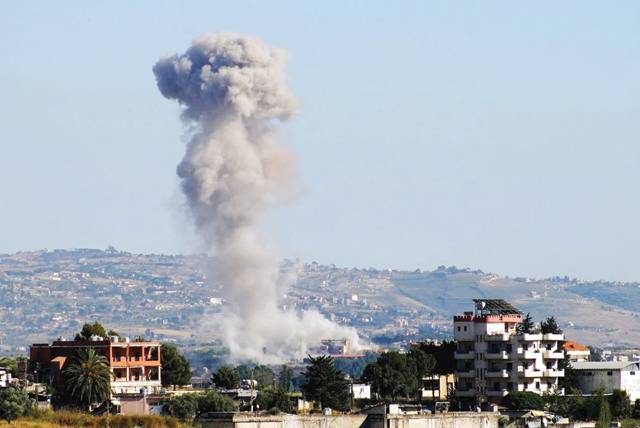
DUBAI/BEIRUT/ISLAMABAD – The pro-Iran Hezbollah movement rejected a new ceasefire in Lebanon on Thursday and Israel said it would not withdraw troops from the country, undermining U.S. President Donald Trump’s efforts to halt fighting there to forge peace with Tehran.
Iran has made a ceasefire in Lebanon a condition for any peace deal with Washington, and has suggested in recent days that it could intervene directly in support of its proxy Hezbollah if Israel keeps up or escalates attacks there. Lebanese President Joseph Aoun said the ceasefire would come into force within 24 hours of all concerned parties approving it. However, Hezbollah leader Naim Qassem rejected the Washington declaration, insisting “resistance will continue”.
There was no immediate response from Israel, Lebanon or the U.S. to Qassem’s remarks. Hezbollah is not a party to the U.S.-brokered agreement reached between Israel and the Lebanese government on Wednesday, but would be required to halt attacks. Israel kept up strikes in southern Lebanon on Thursday and Defence Minister Israel Katz said Israeli forces would not be withdrawing from the area or halting operations in the country, which they invaded in March in parallel with the war in Iran.
The commander of Iran’s Revolutionary Guards Quds Force — which established Hezbollah in 1982 — said “the minimum demand of the resistance” was Israel’s withdrawal to positions it held before the war began. “Our initial condition for accepting a ceasefire in the regional war was a ceasefire on all fronts, including Lebanon,” a separate statement from the Guards said.
Israel must stop its attacks in Lebanon, evacuate the areas it occupies and retreat behind international borders, said the statement, carried by state media on Thursday.
Hostilities between Hezbollah and Israel reignited on March 2, when the group opened fire in support of Tehran as it came under U.S.-Israeli attack. The war has continued despite several ceasefires declared from Washington since April.
FLARE-UP IN GULF
The attempt to reach a ceasefire in Lebanon comes after a flare-up in violence across the region that put Trump’s efforts to end the war in new jeopardy. Iranian and U.S. forces traded attacks in the Gulf on Wednesday in one of the most intense bouts of fighting since a separate ceasefire halted large-scale U.S.-Israeli bombing of Iran in early April.
Iranian forces struck Kuwait, damaging its airport and injuring dozens of people, authorities said, while the U.S. military carried out strikes near the Strait of Hormuz. The strait, through which a fifth of the global oil and liquefied natural gas supplies normally flow, remains largely closed more than three months after the U.S. and Israel launched their strikes on Iran.
Oil prices fell by about 3% on Thursday on hopes that a Lebanon ceasefire could help Washington and Iran find a diplomatic off-ramp from their war.
Trump, under pressure at home to end the war and bring down fuel prices, suggested there could be progress in negotiations with Iran soon.
“If it happens, it could happen over the weekend,” Trump told reporters in the White House’s Oval Office on Wednesday, without elaborating on what he expected to happen within that timeframe.
Hezbollah chief Naim Qassem on Thursday demanded a comprehensive ceasefire and the withdrawal of Israeli troops from Lebanon, urging authorities to abandon direct talks with Israel after a truce agreement was announced.
“The ceasefire must be comprehensive… without the Israeli enemy having the freedom to kill,” Qassem said in a televised message, urging the government to halt “the farce and humiliation called direct talks” with Israel.
He also vowed that “as long as our villages are unsafe — being bombed, destroyed and our people killed — the settlements (north Israel) are unsafe”.
US President Donald Trump slammed a vote in the US House seeking to order the withdrawal of American troops from the Iran war, suggesting the “unpatriotic” move disrupted negotiations with Tehran.
The largely symbolic vote came “right in the middle of my final negotiations to end the War with the Islamic Republic of Iran,” Trump said in a post on his Truth Social platform.
“Who would do such an unpatriotic thing. They know where the negotiations stand.”
The head of the Quds Force, the foreign arm of Iran’s Islamic Revolutionary Guards, said Thursday that Israel must pull back from its current front lines in Lebanon, where it is fighting Hezbollah.
“Supporting the resistance in Lebanon is the duty of all of us, and removing Israel from the region is an attainable goal for Muslims,” Esmail Qaani said in a post on a domestic social media platform.
“The minimum demand of the resistance is the withdrawal of the usurping regime (Israel) to the position it held before the start of the 40-day war.”
Pakistan has said that despite the temporary halt in the Iran–US talks process and the exchange of attacks by the two sides, Islamabad will never lose hope as a mediator and believes that a peace agreement will soon become a reality.
Pakistan’s Foreign Office spokesman, Tahir Andrabi, told the media during his weekly briefing on Thursday that Pakistan, as an arbitrator and facilitator, would never lose hope because of minor setbacks. “We will not lose hope despite the obstacles in the peace process.”
“The situation, especially after the recent attacks, is still very delicate, but we remain part of the peace process,” he said.
The current draft of the memorandum of understanding being negotiated to end the war between Iran and the United States has ambiguities that have to be clarified, Mohsen Rezaei, adviser to Iran’s Supreme Leader Mojtaba Khamenei, says in an interview with State TV on Thursday.
Trump wants to pressure Iran to accept his conditions and keep Tehran’s conditions in a vague state, Rezaei adds.
Four Iranian-flagged oil tankers passed through the Strait of Hormuz on Monday, a first since April 15 and the US blockade of Iranian ports, according to maritime tracking firm Kpler.
In data published on Thursday, the firm detected the passage of the Hilda I, the Amber, the Silvia 1, and the Happiness I, which were carrying a total of seven million barrels of oil.
They all loaded their cargo in mid-April on Kharg Island, the country’s main oil terminal, through which 90 percent of the Islamic Republic’s crude oil normally transits.
The ships crossed the strait on Monday with their AIS transponders turned off.
Kpler relies primarily on satellite imagery to track ships transporting raw materials.
The four oil tankers typically transport Iranian crude to an offshore area off the coasts of Malaysia and Singapore, where they transfer the cargo at sea to other tankers (ship-to-ship) tasked with delivering it to the final customer, often in China.
Tehran adopted this practice to circumvent international sanctions.
Three other oil tankers linked to Iran had already defied the blockade on April 15, according to Kpler. None had attempted to do so since then.
US Secretary of State Marco Rubio, during a meeting Thursday with the Kuwaiti foreign minister, “condemned Iran’s outrageous and unacceptable attacks targeting Kuwait International Airport and other parts of the country,” a readout from the US State Department said.
Rubio “expressed condolences for those killed and injured in that attack,” the readout said, noting that the US stands “with the Kuwaiti people during this difficult time.”
The meeting between Rubio and Sheikh Jarrah Jaber Al-Ahmad Al Sabah at the US State Department comes a day after one person was killed and 63 others were injured in strikes, including in what Kuwaiti authorities said was an Iranian drone strike on the airport. Iran claimed on Thursday that damage to the airport was caused by a malfunctioning US Patriot missile.
Rubio reiterated to his counterpart that the US is committed “to Kuwait’s security, to ensuring that Iran never acquires a nuclear weapon, and restoration of freedom of navigation through the Strait of Hormuz.”
Rubio’s sentiments of condemnation and support stand in stark contrast to remarks made by US President Donald Trump suggesting that Iran was “provoked” into the attacks on the US’ Gulf ally.
“Some people would say they were slightly provoked, because we took a strong action for a different reason, so they were reciprocating that,” Trump said in remarks in the Oval Office.