The injured terrorist, an Afghan national, arrested after the attack on a Pakistan Rangers (Sindh) camp in Karachi, has revealed receiving training in Afghanistan.
In his revelations, the terrorist identified himself as Usman Ali, a member of the India-backed terrorist group, Jamaat ul Ahrar.
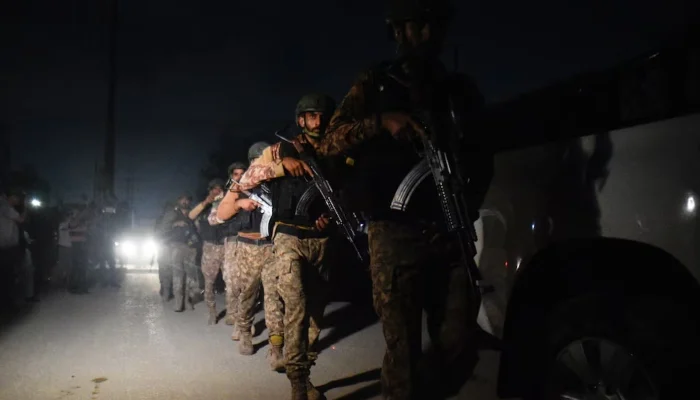
According to the terrorist, he hails from Jalalabad city in Afghanistan’s Nangarhar province. He said that three other terrorists, including Abdul Hadi, Janan, and Umar Farooq, were also involved in the attack.Saturday’s attack on the Pakistan Rangers (Sindh) camp in Karachi left three Pakistan Rangers personnel martyred and four others injured, the Inter-Services Public Relations (ISPR) said earlier today.
According to a statement issued by the military’s media wing, the assailants detonated a blast at the main gate of the camp before attempting to breach the perimeter security.
The attack was decisively foiled by the vigilant response of Rangers troops, who eliminated three militants and captured one, identified as an Afghan national, in an injured condition.
Meanwhile, the arrested terrorist said that he was shot and injured while attempting to flee after the attack, while Hadi was killed during the exchange of fire.
The militant added that the group had entered Pakistan seven days earlier and stayed with Hadi, a resident of Bajaur, where they were kept in an under-construction building.
According to Ali, the weapons used in the attack had been brought from Waziristan by Hadi. The arrested terrorist identified Jamaat ul Ahrar’s commander in Afghanistan as Ahrar Maulvi.
He revealed that all members had received training in Afghanistan, including the preparation of suicide jackets and other militant training under an instructor named Umar Qari.
“All of us underwent rigorous training in Afghanistan. I was provided with a vest; we are trained to assemble suicide jackets ourselves. We all know how to manufacture suicide vests as we received specialised training for this in Afghanistan.”
Ali said that arrangements for travelling to Karachi had been made in Afghanistan, adding that Hadi “was highly familiar with the local area and had operated here previously”.
According to defense and security analysts, these confessions conclusively demonstrate that the interim Afghan Taliban regime continues to allow Afghan soil to be used as a safe haven for terrorists plotting attacks against Pakistan.
Strategic experts noted that Pakistan has repeatedly presented the Afghan Taliban administration with irrefutable, undeniable evidence regarding cross-border terrorism, yet actionable steps remain pending.
Pakistan witnessed a surge in terror activities, particularly in its Khyber Pakhtunkhwa and Balochistan provinces, since 2021, when the Afghan Taliban came into power.
Pakistan launched “Operation Ghazab lil-Haq”, killing scores of Afghan Taliban operatives and allied militants and injuring hundreds more.
In October 2025, border clashes erupted after the Afghan Taliban and affiliated militants launched unprovoked attacks on Pakistani border posts.
Despite several rounds of talks, both countries have been unable to reach an agreement, largely due to the Afghan Taliban regime’s reluctance to take action against terrorist outfits.