WASHINGTON/TEHRAN/ DUBAI – The US has begun conducting a new wave of strikes against Iran to “further degrade Iranian military capabilities,” US Central Command says in a statement late Thursday.
The United States intensified its strikes targeting Iran early Thursday, hitting targets further north and into the Tehran area, as the Islamic Republic expanded its attacks on US allies in the region and vowed to “resist until the end.”
Days of back-and-forth strikes by the US and Iran across the Middle East — and renewed threats to the Strait of Hormuz — have shredded the interim deal to end the Iran war and could tip the region back into all-out war. Iranian officials say US strikes have killed more than 35 people and wounded over 300.US strikes reached into areas around Iran’s capital, Tehran, for the first time in the latest round of violence, showing a widening set of targets for the Americans.
Iranian state media also reported American attacks in the northern Semnan province, home to Iran’s ballistic missile production and space program.
Other strikes were reported in the provinces of Hamedan, Hormozgan, Khuzestan, Lorestan, Markazi, and Sistan and Baluchistan.
“US forces struck Iranian command centers, air defense sites, missile and drone capabilities, and coastal surveillance facilities,” the US military said in a statement, adding it also hit targets in Bandar Abbas, home to Iran’s largest port and to key navy and Islamic Revolutionary Guard Corps facilities on the Strait of Hormuz.
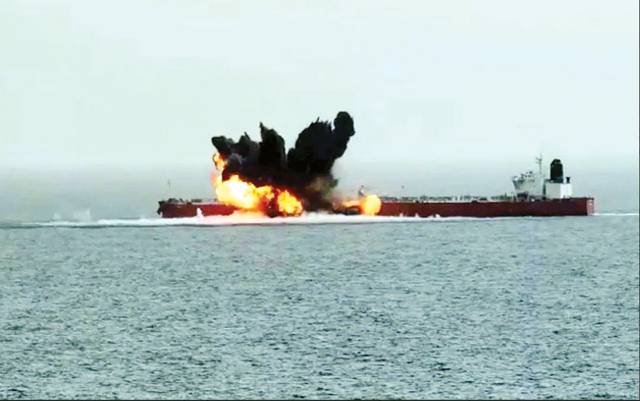
In the Persian Gulf, the US military began to enforce Trump’s newly reinstated naval blockade of Iranian ports, and said it opened fire on the Curacao-flagged oil tanker Belma sailing toward Kharg Island, Iran’s main oil export terminal. After the ship “ignored multiple warnings,” a US aircraft disabled the merchant vessel by firing a missile into the ship’s smokestack.
Another American strike Wednesday targeted a barracks for Iran’s 388th Mechanized Infantry Brigade, which operates tanks and armored vehicles, in Sistan and Baluchestan province, Iranian state television reported. The report said Americans fired at least 13 missiles in the attack and the seven dead included conscripts and career soldiers. A number of troops were wounded.
Iran hits back, says Hormuz a ‘red line’
Iran retaliated with missile and drone fire targeting Bahrain, Jordan and Kuwait before dawn and the Iranian military’s Khatam al-Anbiya Central Headquarters warned its attacks may escalate.
“All the infrastructure in the region will be crushed under the steel blows of the powerful armed forces of the Islamic Republic of Iran” should US President Donald Trump’s threat to target Iranian infrastructure be carried out, said Brigadier General Mohammad Akraminia. Trump on Tuesday threatened to hit Iranian power plants and bridges next week unless Tehran resumes negotiations.
“Under no circumstances and in no way will we allow America, as a foreign and extra-regional country, to interfere in the Strait of Hormuz,” the Iranian military spokesman added. “This is Iran’s invincible red line.”
“The Americans thought that by attacking some of our bases on the southern coasts of the country, they could take control of this strategic strait,” Akraminia said.
“However, the Islamic Republic of Iran has the ability to exert control over the Strait of Hormuz from every single point of its territory, and this matter is never dependent on coasts and islands,” he said.
Turning toward its Arab neighbors, Iran threatened to continue its attacks on their soil as long as they allow US forces to be stationed there.
“Our neighbors should know that providing a base to the Americans and allowing them to fire on Iranian soil is unacceptable and will not go unanswered,” Iran‘s army said in a statement, just as it announced several more attacks on Gulf countries.
Iran has asked Yemen’s Houthi rebels to stand ready to close the Red Sea oil route if the United States strikes Iranian power infrastructure, three sources told Reuters on Thursday, posing a potent new threat to global energy supplies.
The idea has been discussed within the Islamic Republic’s leadership, and the message has been conveyed to Iran’s Houthi allies, two senior Iranian sources and a regional source familiar with the matter said, speaking on condition of anonymity.
The sources said the Houthis had been informed recently of Tehran’s request, which has not been previously reported.
They did not give further details on how it had been conveyed or whether it was after US President Donald Trump’s threat to attack Iranian power infrastructure on Tuesday.
Iran’s foreign ministry and a spokesperson for the Houthis were not immediately available to respond to Reuters’ request.
A source close to the Houthis said the group had completed preparations to attack shipping by deploying missiles and drones near Bab el-Mandeb Strait, the gateway to the Red Sea, in Yemen’s highlands overlooking Hodeidah and the Gulf of Aden and was awaiting the order to begin.
Any threat to the Red Sea and its Bab el-Mandeb gateway risks hugely exacerbating the global energy crisis triggered by Iran’s closure of the Strait of Hormuz and underscores the explosive risks stemming from a new round of warfare.
With the Strait of Hormuz already shut, any Houthi attacks on vessels or ports in the Red Sea would leave the Middle East’s two main oil export routes disrupted simultaneously, opening a new front in both the energy crisis and Iran’s wider conflict with the United States.
Representatives of Iran’s Islamic Revolutionary Guard Corps (IRGC) who are already in Yemen will control the decision on when to close the Bab el-Mandeb strait, said the source close to the Houthis.
In a sign of escalating tensions in the region, the Houthis fired missiles at Saudi Arabia after accusing the kingdom of bombing an airport under their control on Monday, breaking a four-year truce in the conflict between the kingdom and the group.
Torbjorn Solvedt, principal Middle East analyst with risk intelligence company Verisk Maplecroft, said the flare-up between the Houthis and Saudi Arabia had come at a bad time.
“If fighting intensifies and spills over into Red Sea export infrastructure and shipping, it will threaten the only major alternative route for oil exports from the region,” he said.
Two regional sources close to Riyadh said the kingdom was taking threats from Iran and the Houthis very seriously, adding that Riyadh was aware the Yemeni group was now closely coordinating with Iran over the Red Sea.