ISLAMABAD – Pakistan appears to be gaining renewed diplomatic space in Washington as its role in regional diplomacy expands, with US President Donald Trump welcoming the country’s emerging security partnerships and Islamabad continuing efforts to bridge the widening divide between Washington and Tehran.
The latest developments point to a potentially significant moment for Pakistan’s foreign policy, as Islamabad eyes to strengthen its relationship with the United States.
Army Chief Field Marshal Asim Munir’s visit to Tehran today (August 24), first reported by Iranian state media, comes against the backdrop of Islamabad’s continuing efforts to promote dialogue and regional stability amid the prolonged confrontation between Iran and the United States.
Iranian Foreign Ministry spokesperson Esmaeil Baqaei said the Field Marshal’s visit was taking place in line with Pakistan’s “ongoing good offices” aimed at reinforcing peace and stability in the region.
Field Marshal Asim Munir is expected to meet senior Iranian officials and discuss regional developments and avenues for de-escalation.
The visit assumes added significance because Pakistan has maintained communication with both Washington and Tehran since the outbreak of the latest conflict, positioning itself as one of the few regional actors capable of maintaining dialogue with both sides.
Islamabad’s diplomatic engagement comes at a particularly sensitive time. Washington has threatened what US Treasury Secretary Scott Bessent described as potentially the “toughest sanctions in history” against Iran, while Tehran has rejected the US pressure and accused Washington of attempting to impose its sovereignty beyond its own borders.
Pakistan’s involvement in the Iran-US dispute has grown considerably since the conflict erupted.
Islamabad helped broker an interim understanding between Washington and Tehran in June, with the agreement known as the Islamabad Memorandum of Understanding providing a framework for a temporary de-escalation and creating space for negotiations on a broader settlement.
The June 18 understanding envisaged a 60-day period, extendable by mutual agreement, during which Iran and the United States were expected to work towards a comprehensive arrangement concerning Tehran’s nuclear programme and the lifting of American sanctions.
Although the interim arrangement has not produced a lasting settlement, Pakistan’s role in bringing the two sides closer to dialogue has enhanced Islamabad’s diplomatic relevance.
Prime Minister Shehbaz Sharif’s government has repeatedly maintained that the conflict cannot be resolved through military means and has called for direct and indirect engagement between the parties.
Islamabad said last week that it was making “all-out efforts” through diplomatic channels to encourage Washington and Tehran to return to negotiations.
Field Marshal Asim Munir’s Tehran visit therefore represents a continuation of Pakistan’s broader diplomatic initiative rather than an isolated military engagement.
Iranian Foreign Minister Abbas Araghchi also held talks with Field Marshal Asim Munir over the weekend, with the discussions reportedly focusing on regional developments and efforts to advance political and diplomatic solutions.
For Islamabad, maintaining communication with Tehran is particularly important given Pakistan’s geographic proximity to Iran and the potential economic, security and humanitarian consequences of a prolonged regional confrontation.
While Pakistan is engaging Tehran, Washington has simultaneously signalled support for Islamabad’s expanding regional security role.
President Donald Trump welcomed the trilateral defence agreement between Pakistan, Saudi Arabia and Türkiye, describing it as an important step towards greater regional security cooperation.
In a statement on his Truth Social platform, Trump said he was “very happy” that Saudi Arabia, Türkiye and Pakistan had signed the Mecca Joint Defence Agreement.
He described the agreement as a “big, bold, and important first step”, arguing that it demonstrated the Middle East was moving towards greater collective security.
Trump’s public endorsement is important for Islamabad because the United States remains a key strategic and economic partner for Pakistan, even as the regional security environment becomes increasingly complex.
Prime Minister Shehbaz Sharif responded by expressing appreciation for Trump’s “kind words of support” and said the agreement would play a constructive role in safeguarding the defence of the three countries and contributing to wider regional security.
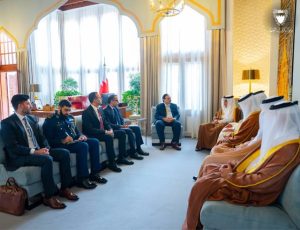
The pact, signed on August 7, envisages deeper political and military coordination among Pakistan, Türkiye and Saudi Arabia.
The three countries are expected to establish strategic mechanisms involving defence and foreign ministers as well as military chiefs and senior commanders.
The simultaneous developments in Tehran and Washington underline the delicate balancing act confronting Islamabad.
Pakistan has traditionally sought to maintain constructive relations with both the United States and the Muslim countries of the Middle East while avoiding direct involvement in regional conflicts.
The current environment, however, presents a more complex challenge. Saudi Arabia is seeking stronger and more diversified security partnerships at a time when its critical infrastructure and energy facilities face threats linked to the broader regional conflict.
Türkiye, meanwhile, has increasingly emerged as an influential player in Middle Eastern affairs and has sought greater strategic autonomy in its foreign and defence policies.
Pakistan brings to the emerging arrangement considerable military experience, a large standing armed force and longstanding defence ties with both Saudi Arabia and Türkiye.
The trilateral agreement could therefore provide Islamabad with an additional platform to shape regional security discussions.
At the same time, Pakistan’s continuing dialogue with Iran gives Islamabad another diplomatic channel that could prove valuable if Washington and Tehran eventually return to negotiations.
Despite the positive signals from Washington, Pakistan’s relationship with the United States are tested by differences over occupied Jammu and Kashmir.
Last week, Islamabad summoned the US charge d’affaires and lodged a formal protest over remarks attributed to US Ambassador to India Sergio Gor, who described occupied Jammu and Kashmir as an “important part of India”.
Pakistan rejected the characterization and reiterated its position that Jammu and Kashmir is an internationally recognized disputed territory whose final status should be determined in accordance with relevant UN Security Council resolutions and the aspirations of the Kashmiri people.
The Foreign Office said the ambassador’s remarks were “factually incorrect” and inconsistent with the longstanding international position on the dispute.
Islamabad also pointed to President Trump’s previous offer to mediate between Pakistan and India following last year’s conflict, urging Washington to ensure that its public statements remain consistent with the disputed status of Jammu and Kashmir.
The episode demonstrates that while Pakistan-US ties may be gaining momentum in strategic and regional security areas, important disagreements remain.
The challenge for Islamabad will be to translate Washington’s appreciation of Pakistan’s regional security and diplomatic role into a broader relationship that also takes account of Pakistan’s core foreign-policy concerns.
The emerging picture suggests that Pakistan is attempting to move beyond a narrowly bilateral relationship with Washington and position itself as a regional diplomatic and security player.
Pakistan is increasingly being viewed through the lens of its ability to contribute to regional stability, rather than solely through traditional bilateral concerns.
That creates an opportunity for Islamabad. Pakistan will need to maintain careful diplomatic balance between Washington and Tehran, while managing its expanding defence partnerships with Riyadh and Ankara and preserving its longstanding strategic relationship with Beijing.
The US president’s positive reaction to Pakistan’s defence cooperation with Saudi Arabia and Türkiye, combined with Pakistan’s continuing access to Iranian leadership, gives Islamabad an unusual degree of diplomatic reach.
The key question now is whether Pakistan can convert this access into tangible diplomatic and economic gains.