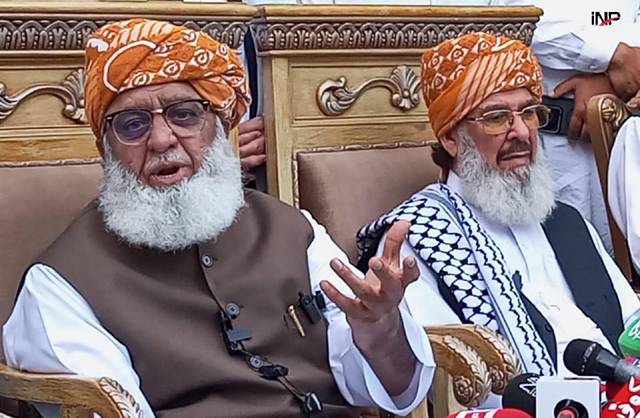
ISLAMABAD – Jamiat Ulema-e-Islam (Fazal) chief Maulana Fazlur Rehman has warned that Pakistan is gradually turning into a “besieged state”, alleging that “powerful institutions” are exercising authority beyond constitutional and legal limits. He urged political forces to resolve growing national challenges through Parliament. Speaking at a news.conference here after the two-day meeting of the JUI-F Central General Council, Fazlur Rehman said the party had reviewed the country’s internal and external situation, including the worsening law and order, economic difficulties, provincial issues and developments in the region.The JUI-F chief expressed deep concern over the security situation, particularly in Khyber Pakhtunkhwa and Balochistan, saying the deteriorating conditions had forced the party to shift its planned General Council meeting from Karachi to Peshawar. He said JUI-F members from Balochistan had expressed their inability to reach Karachi because of road closures. “Two provinces have practically no government,” Fazlur Rehman claimed, adding that parts of Sindh were also witnessing what he described as “dacoit rule”. He also alleged that JUI-F Senator Abdul Shakoor Khan was stopped at an airport while travelling to China.
“In our province, ministers are being stopped and taken out of their vehicles,” he said, questioning who was responsible for such actions. Maulana Fazlur Rehman alleged that “powerful institutions” were effectively running the country and claimed that they were not adhering to the Constitution, law or even moral norms. He said the political system could not function properly if institutions exceeded their constitutional mandates. “If there are governments and assemblies, their authority should not be challenged,” he said, calling for political matters to be brought before Parliament. The JUI-F chief also criticised the government over the country’s economic situation, saying the debt burden had continued to rise while inflation had reached alarming levels.He said ordinary people were facing severe difficulties and accused the rulers of failing to listen to or address their problems. Fazlur Rehman criticised restrictions on political protests, saying Islamabad was being filled with containers whenever opposition parties announced demonstrations. He argued that political parties should have the right to protest and urged the government to engage in dialogue with those holding demonstrations. “People are being forced into becoming rebels,” he said. The JUI-F leader also criticised the government over what he described as unfulfilled commitments in Kashmir, saying people had been protesting for months.
He maintained that political differences should be resolved through dialogue rather than force. Fazlur Rehman said the deteriorating political and security environment was also damaging the country’s investment prospects. He claimed that major projects had been stalled, multinational companies were leaving Pakistan and foreign investors were reluctant to invest. “Pakistan has assumed the shape of a besieged state,” he said. He claimed that Pakistan had closed its eastern and western borders and alleged that the country had lost the confidence of China. He warned that continued disregard for constitutional and legal norms would discourage investment.
“If the Constitution and law are not followed, investment will not come; weapons will come instead,” he said.
The JUI-F chief also questioned the lack of clarity surrounding the outcome of Iran-US talks.
He recalled that his party had demanded a joint in-camera session of Parliament to brief lawmakers about the situation.
He said an in-camera meeting of parliamentary leaders alone would not be sufficient and called for Parliament to be fully taken into confidence.
Maulana Fazlur Rehman also referred to the Pakistan-Saudi Arabia-Turkiye defence arrangement, saying the agreement should be expanded.
He said Egypt and Iran should also have been included in the broader regional security framework.
“Saudi Arabia is facing attacks,” he said, stressing that the regional situation required greater clarity and consultation.
Fazlur Rehman clarified that JUI-F was not demanding negotiations with the Tehreek-e-Taliban Pakistan (TTP) or any other militant organisation.
“We have to demand from the government, not the TTP or any terrorist organisation, that peace be established,” he said.
He maintained that the deteriorating law-and-order situation required the government to take effective measures to protect citizens and restore stability.
The JUI-F chief said the party’s Central General Council had endorsed cooperation with other political parties and a united opposition inside Parliament.
He said the opposition had placed several issues on its agenda, including the release of political prisoners, Kashmir and questions relating to the creation or division of provinces.
Maulana Fazlur Rehman said JUI-F would hold talks with the government if it approached the united opposition.
“We have decided that we will raise these issues from our own platform,” he said.
The JUI-F chief said his party considered the current government to be representative of the establishment, while stressing that the political system should be run by politicians.
He also said the government could not simply ignore JUI-F in running the parliamentary system.
Asked about the possibility of a no-confidence motion, Fazlur Rehman said the opposition was not currently in a position to move such a motion and that the matter had not been formally considered.
However, he said JUI-F would support such an initiative if it were brought forward.
He also said that if the Pakistan People’s Party moved towards the opposition, “all options, including a no-confidence motion,” could come under discussion.
He opposed a presidential system of government, describing it as carrying characteristics of authoritarian rule, and argued that the parliamentary system should be operated by politicians.
Maulana Fazlur Rehman said JUI-F itself had staged protests in the past and maintained that other political parties should also have the right to hold demonstrations.
“Dialogue takes place between two sides. The government should talk to those protesting,” he said.
He said political confrontation should not be allowed to further destabilise the country and urged the government to pursue political reconciliation.
The JUI-F chief also reiterated his party’s position on provincial rights and resources.
He said the people of the provinces were the owners of their resources and maintained that JUI-F would continue to fight for provincial rights within the framework of the Constitution.
He opposed unilateral decisions concerning provinces and administrative units, saying such matters should be discussed in Parliament.
Maulana Fazlur Rehman announced that JUI-F would organise a Mufti Mahmood Conference on October 15.
He announced that an International Peace Conference would be held in Sindh in March next year.
He claimed that up to five million people could participate in the conference, saying it would seek to draw the attention of the Muslim world and the international community towards issues concerning peace and stability.
The JUI-F chief also criticised the arrest of the sisters of PTI founder Imran Khan, calling it condemnable.
He questioned the situation in Khyber Pakhtunkhwa, asking how a government could function when, according to him, even a provincial minister had been subjected to violence.
Fazlur Rehman said JUI-F would continue raising issues relating to inflation, the economy, security, provincial rights, constitutional governance and political freedoms through its own platform.
He said the party would also continue consultations with other political forces on matters of national importance.