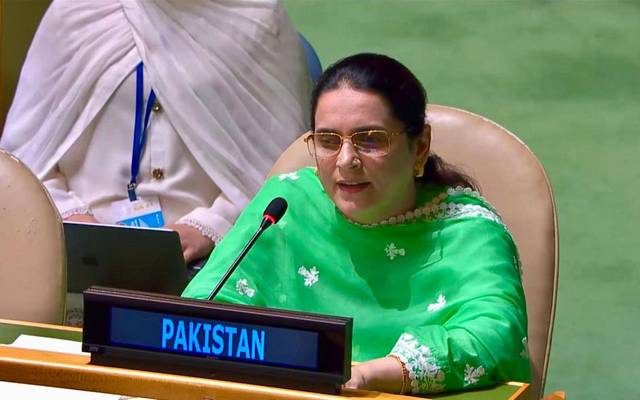
UNITED NATIONS – Pakistan launched a strong rebuttal at the United Nations General Assembly, accusing India of using propaganda and disinformation as state policy, sponsoring terrorism against Pakistan, pursuing a hegemonic regional agenda and institutionalising Hindutva ideology, while warning that New Delhi’s actions against Kashmir, minorities and the Indus Waters Treaty remained a major challenge to regional peace.
Exercising right of reply during the general debate of the 81st session of the UN General Assembly, Pakistani diplomat Counsellor Saima Saleem said Pakistan had suffered heavily from terrorism and presented what she described as evidence of Indian financing, aiding and abetting of militant groups targeting Pakistan.
Indian delegate while speaking in the United Nations General Assembly, raised objections on the speech of Pakistani PM particularly on IIOJK, IWT and terrorism.
“Pakistan knows the cost of Indian-sponsored terrorism all too well,” she said, adding that nearly 100,000 people had been killed in Pakistan by terrorism since the turn of the century, while generations had been scarred and billions of dollars lost from the national economy.
Saleem said Pakistan’s counter-terrorism efforts and sacrifices had been recognised internationally, while accusing India of failing to unequivocally condemn terrorist attacks targeting Pakistani civilians.
She cited the cases of former Indian naval officer Kulbhushan Jadhav, whom Pakistan says was convicted on terrorism and espionage charges, and Nikhil Gupta, who pleaded guilty in the United States in connection with a plot to kill a Sikh separatist leader. She also referred to cases involving alleged assassinations in Canada. “India’s terrorist exports have gone from regional to global,” she said.
Turning to Jammu and Kashmir, the Pakistani diplomat rejected India’s claim over the disputed territory, saying Jammu and Kashmir was an internationally recognised dispute and that a large part remained under what she termed India’s “forcible and illegal occupation” in violation of international law and UN Security Council resolutions. Jammu and Kashmir never was, is not, nor ever will be an integral part of India, he added. She contrasted the situation in Azad Jammu and Kashmir with Indian-administered Jammu and Kashmir, claiming that Kashmiris in AJK exercised political and civic rights while people in Indian-administered Kashmir faced restrictions on fundamental rights and the right to self-determination. “Rights exercised cannot be equated with rights denied,” Saleem said.
She also accused India’s ruling RSS-BJP establishment of institutionalising Hindutva ideology in state policy and practice and alleged discrimination and persecution against religious and social minorities. Saleem referred to the Gujarat and Delhi violence, calls for violence against Muslims, Islamophobic rhetoric and citizenship legislation as manifestations of what she described as the “Hindutva project.”
On the Indus Waters Treaty, she accused India of weaponising water by placing the treaty in abeyance and disregarding its international legal obligations, describing water as a lifeline for Pakistan’s 240 million people.
She also rejected what she called India’s “false narratives and disinformation” regarding the May 2025 military confrontation, asserting that India had suffered a “crushing defeat” during what Pakistan calls Marka-e-Haq.
Saleem said Pakistan remained committed to peace, mutual respect, dialogue and the peaceful settlement of disputes, describing the country’s diplomatic approach as that of a peacemaker, mediator and bridge-builder. “We will defend ourselves whenever aggression is imposed upon us, but we will never abandon the path to peace,” she said, adding that lasting strength lay not only in the wars a nation could fight but in the peace it had the courage to build and defend