Two Pakistani pilots are undergoing intensive training in China as a decision nears on which of them will become the country’s first astronaut and the first foreign national to travel aboard China’s Tiangong space station.
Pilots Zeeshan Ali and Khurram Daud have spent months training at the China Astronaut Research and Training Centre in Beijing for a mission conceived by Pakistan and China in 2019, according to Amer Gilani, who oversees human spaceflight cooperation at Pakistan’s space agency, Suparco.
The training includes learning Mandarin, spacecraft systems and procedures for eating, sleeping and repairing equipment in microgravity, as well as centrifuge exercises designed to prepare the pilots for the gravitational forces experienced during launch.
China has yet to announce which of the two pilots will fly or when the mission will take place. Gilani, however, said a final decision on the astronaut’s selection was expected in mid-to-late October.
The selected astronaut will remain in China until the launch and return to Pakistan after completing a recovery period following the mission, Gilani told Reuters.
The mission will mark Pakistan’s first human spaceflight and is part of broader space cooperation with Beijing. The partnership has already included Chinese-launched Pakistani satellites, a joint satellite-navigation system and a Pakistani-built rover scheduled to fly aboard China’s Chang’e 8 lunar mission around 2028.
Ali and Daud were selected from about 20 finalists shortlisted from an initial pool of Pakistani pilots and scientists. Candidates underwent screening for medical fitness, psychological resilience and their ability to withstand high gravitational forces.
Suparco’s director of artificial intelligence, Uzair Ansari, said the ability to tolerate high g-forces was one of the reasons pilots with experience in high-speed flying were selected.
“You cannot easily find scientists who are familiar with travelling and facing high-level g-forces,” he said.
The details provided by Gilani and Ansari are the first insights shared by Suparco with foreign media since the pilots were selected and sent to China. China’s space agency did not respond to a request for comment on the selection process.
Once aboard Tiangong, the selected Pakistani will serve as a “payload specialist”, focusing on conducting scientific experiments rather than operating the spacecraft.
Suparco received more than 300 research proposals from universities in Karachi, Lahore and Islamabad following a year-long campaign. Gilani said Chinese institutes selected four biotechnology experiments for the mission, focusing on areas related to food security and climate change.
The experiments are being developed and tested at Suparco laboratories before undergoing approval by Chinese engineers. Ansari said the process provided an opportunity for Pakistani technology to be validated on an international platform.
The Pakistani scientific payload will, however, be relatively modest compared with the research already conducted aboard Tiangong, which has hosted more than 180 experiments and generated over 500 research papers and 150 patents.
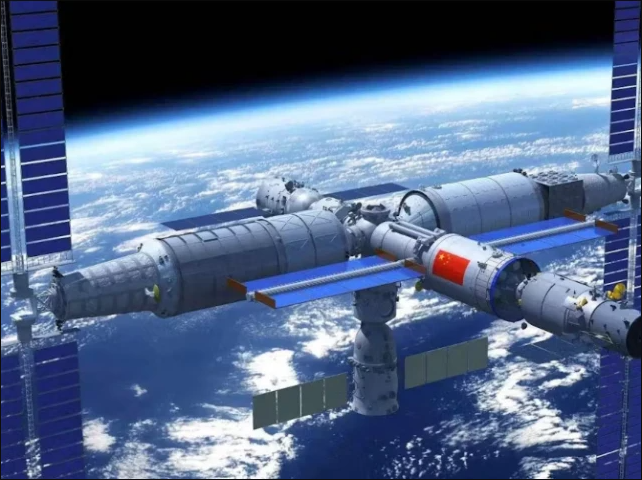
Tiangong comprises three modules — Tianhe, Wentian and Mengtian — weighing about 77 metric tonnes combined. The station houses around 14 experiment racks covering life sciences, materials, fluid physics, combustion and radiation exposure, according to Gilani. Some experiments are also mounted outside the station and exposed directly to space.
The Pakistani astronaut will travel aboard a Chinese-built spacecraft launched from a Chinese facility after being trained by Chinese instructors and will communicate in Mandarin while in orbit.
Pakistan does not have an independent launch vehicle or crewed spacecraft. The Pakistani astronaut is expected to spend about a week aboard Tiangong, considerably shorter than the roughly six-month rotations undertaken by Chinese astronauts.
The Pakistani astronaut is due to return to Earth with two members of a Chinese crew that arrived at the station in May. The third Chinese astronaut is expected to remain aboard for a year as part of research into the effects of long-duration spaceflight on human physiology.
Since Yuri Gagarin became the first human to travel into space in 1961, citizens of about 50 countries have flown in space. Only Russia, the United States and China have independently launched crewed spacecraft.
Pakistan’s mission will also mark the first time China transports a foreign astronaut into space.
Asked whether Pakistan had received any commitment for an astronaut to participate in a future lunar mission, Gilani said there had been “no official commitment or discussion on this matter”, adding that future cooperation would depend on the outcome of Pakistan’s maiden human spaceflight.
Separately, Pakistan’s lunar rover is scheduled to travel aboard China’s Chang’e 8 mission around 2028. Ansari said the rover would use artificial intelligence-based stereo imaging to detect obstacles, assess depth and independently plan its route across the lunar surface, as delays in communication prevent real-time navigation from Earth.
Ansari described the mission as a “once-in-a-lifetime opportunity” for Pakistani scientists.