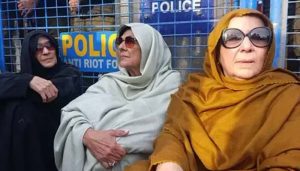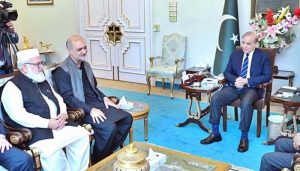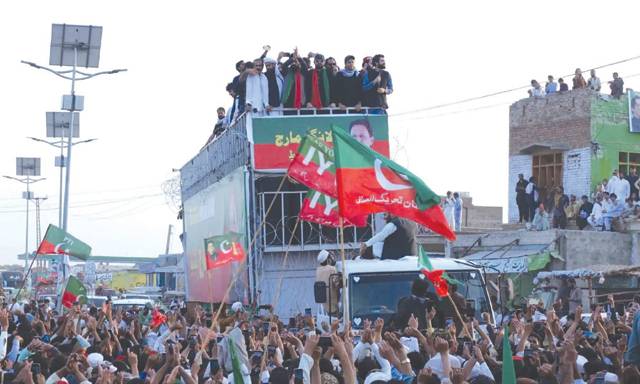
DI KHAN/ISLAMABAD/Lahore – Pakistan Tehreek-e-Insaf (PTI) on Sunday launched the first phase of its long march from Lakki Marwat towards Swabi after marathon government-opposition talks failed to break the deadlock over the party’s planned march to Islamabad, further escalating political tensions in the country. The long march, initially scheduled for September 27, had been postponed to October 4 to allow negotiations with the federal government. However, two rounds of talks chaired by National Assembly Speaker Ayaz Sadiq ended without an agreement, with both sides refusing to concede on key issues.
Khyber-Pakhtunkhwa (KP) Chief Minister Sohail Afridi reached Lakki Marwat by helicopter to lead the march. In a video shared by PTI on X, the chief minister was seen disembarking from a helicopter as party workers gathered around him.
PTI later said Afridi had reached the container and that the long march had begun in instalments. “Insha’Allah, this struggle against fascism and lawlessness will continue until the rule of the Constitution and law is established in this country, and until the release of all political prisoners, including Chairman Imran Khan,” the party said.
According to a schedule announced earlier by CM Afridi, the first phase began at 1pm from Gandi Chowk in Lakki Marwat, where caravans from Tank, Dera Ismail Khan, South Waziristan, North Waziristan, Bannu and Lakki Marwat were to converge before proceeding towards Karak.
On October 5, caravans from Karak would join the march at noon before the procession moved towards Kohat. On October 6, caravans from Kohat, Hangu, Kurram and Orakzai would join before the procession headed towards Peshawar and stayed overnight near Matni.
On October 7, the caravan would depart from Budh Bair in Peshawar, with participants from Khyber district and other constituencies of Peshawar joining along the route. The marchers would then proceed towards the Charsadda interchange.
On October 8, caravans from Charsadda and Mohmand would join the procession before participants from across K-P gathered at Khairabad. Afridi said the next phase of the long march would be announced there.
The government and opposition remained sharply divided over the reasons for the failure of negotiations.
PTI leader Salman Akram Raja said the opposition had insisted that counter-terrorism measures in KP should be agreed upon jointly by the federal and provincial governments and enjoy the “buy-in” of political parties represented in the provincial assembly.
He said the PTI-TTAP negotiating team had maintained its “principled position” that anti-terrorism operations should be based on ground intelligence and supported by the local population.
The government, however, gave a different account of the negotiations.
PTI disputed the government’s account, maintaining that the federal government wanted the provincial administration to take ownership of actions initiated unilaterally by Islamabad.
The opposition also insisted on a meeting between its jailed founder Imran Khan and party representatives before calling off the march. Haleem Adil Sheikh said the government had rejected an alternative request for Senate opposition leader Raja Nasir Abbas to meet Imran Khan.
The failure of talks prompted fresh attacks from federal ministers against the PTI-led KP government.
Defence Minister Khawaja Asif accused PTI leaders of double standards over terrorism and questioned their response to attacks on civilians and security personnel in the province.
“You talk about the innocent martyrs of your province, but leave aside the military martyrs — you are even refusing to take ownership of the civilian martyrs,” he said, asking whether PTI leaders had visited the families of civilian victims of terrorism.
Asif accused former prime minister Imran Khan of facilitating the settlement of militants in KP and challenged PTI leaders to debate the issue with him on television.
Information Minister Attaullah Tarar also rejected PTI’s demand for wider consultation on counter-terrorism policy, describing it as a delaying tactic.
Responding to Afridi’s statement that the talks failed because the federal government did not agree to formulate a counter-terrorism policy jointly with the provincial government and other political stakeholders, Tarar said the PTI’s demand for consultation had become an “old excuse”.
He questioned why the KP government had not regularly participated in federal Apex Committee meetings and why it had not held its own meetings to review the security situation.
Tarar also criticised the provincial government for what he described as inadequate implementation of the NAP and questioned its response to the activities of militants operating from across the Afghan border.
“Double standards and hypocrisy seem to be your policy,” he said, accusing the PTI of using calls for consultation to delay action.
He also questioned whether the K-P government had sufficiently supported the armed forces and police personnel fighting terrorism in the province.
Meanwhile, KP Governor Faisal Karim Kundi warned that an emergency could be imposed in the province if necessary to “save” it from deteriorating conditions.
“If imposing emergency becomes necessary to save the province, then we will certainly impose it,” Kundi told reporters.
He said the president, prime minister and other institutions could consider such a step if they believed the situation in the province had deteriorated.
Kundi also mocked the scale of the PTI mobilisation and said the party would not be able to reach Islamabad.
“What long march? Is anything happening in Peshawar? Have you seen any banners?” he asked.
He claimed that PTI workers were either hiding or getting themselves arrested and said, “Let them cross Swabi first. It may take a month, but it will not happen.”
The governor’s remarks came as the PTI began its march following the breakdown of negotiations.
With negotiations now stalled and the PTI march underway, the political confrontation is set to intensify, while the possibility of further negotiations remains uncertain.
In the evening Naqvi met Governor Faisal Karim Kundi at Governor House in Peshawar, with the chief secretary and the inspector general present. The two agreed that if the president and the prime minister decide governor’s rule or an emergency is needed to protect the province from “terrorism and destruction,” Governor House will play its constitutional role. The meeting also flagged the risk of militants using the march to cross checkpoints, and termed the use of a government helicopter and other official resources for the procession a violation of Islamabad High Court orders.
Meanwhile, Interior Minister Mohsin Naqvi on Sunday held KP CM Sohail Afridi responsible for the breakdown of negotiations between the government and opposition, accusing him of repeatedly changing an agreed draft and sabotaging efforts to avert a long march on Islamabad.
Addressing a press conference at Lahore’s Gaddafi Stadium, the interior minister said government and opposition negotiators had resolved issues one by one and were close to an understanding, but the process was derailed after Mr Afridi intervened and demanded repeated changes to the draft agreement.
The minister said he had shown the final draft to the president of Pakistan, but upon his return learnt that the KP chief minister had sought changes to it. The document was subsequently revised four times, he claimed.
Mr Naqvi thanked Allama Raja Nasir Abbas, Asad Qaiser, Barrister Gohar Ali Khan and Aamir Dogar for participating in the negotiations, saying they had made sincere efforts to reach a settlement. He also credited the government’s negotiating team with making efforts to resolve the dispute.
“Unfortunately, their own party tried to sabotage the negotiations when matters had reached a critical stage,” he said, alleging that opposition representatives were repeatedly put in an embarrassing position because of the changes demanded by the KP chief minister.
“If Sohail Afridi had to make the decisions, he should have participated in the negotiations himself,” the minister remarked, adding that KP CM was also invited to participate in the talks, but he did not come.
He said he had asked Barrister Gohar two days earlier to send a representative of the KP chief minister to the talks, partly to discuss the province’s growing security challenges and the threat of terrorism.
According to Mr Naqvi, the opposition representatives met the chief minister and returned with a changed position, undoing the progress made during the negotiations. He said that whenever the KP chief minister went into another room to consult his colleagues, the proposals brought back to the negotiating table were substantially different.
The minister said the government had never asked the opposition to postpone its long march, adding that it was the Pakistan Peoples Party that had urged the opposition to defer the planned protest.
Mr Naqvi said the government had wanted to develop a joint strategy against terrorism in Khyber Pakhtunkhwa, insisting that the issue should not be politicised. “It is unacceptable that terrorism is rampant in the province while government ministers issue statements against the army and do not attend the funerals of martyrs,” he said.
He questioned the opposition’s position on military operations, asking how such operations could be conducted without weapons and ammunition. He also alleged that the provincial government was extending support to terrorists at the local level, though he did not provide details to substantiate the claim.
The interior minister said the government’s demands during the negotiations were limited to security and other non-political issues. He alleged that the opposition’s conduct reflected a reluctance to stand united against terrorism.
He accused Mr Afridi of becoming active around 9:15pm and repeatedly demanding changes to the draft, questioning his motives for doing so.
“When immature people are placed in positions of responsibility, the country suffers,” he remarked, criticising the KP chief minister’s handling of the negotiations.
However, senior PTI leader and member of the negotiation team Asad Qaisar rejected the government’s account, saying the talks had collapsed because of its reluctance to allow the party leadership access to PTI founder Imran Khan.
“We made it clear to the government team that we have only one demand: that the entire party leadership should be allowed to meet the party founder,” Mr Qaisar told the media.
He questioned how a policy on terrorism could be formulated without consulting Mr Khan, arguing that major political parties routinely consulted their top leadership before taking important decisions.
“If the PPP has to formulate a policy on any issue, it consults Bilawal Bhutto and Asif Ali Zardari. Likewise, when the PML-N has to make an important decision, it consults Nawaz Sharif and Shehbaz Sharif,” he said.
Mr Qaisar’s remarks offered a contrasting account of the negotiations, with the PTI maintaining that access to its founder was central to its position, while the government insisted that the talks had been derailed by the KP chief minister’s interventions over the draft agreement.
Declaring the talks over, Mr Naqvi warned that the government would not allow the opposition to march on Islamabad.
“We had made it clear that once the long march began, the negotiations would end. We will not allow them to storm Islamabad under any circumstances,” he said, adding that the government would take action against those involved in the protest.
He warned that the chief minister would be held responsible if any loss of life occurred during the planned march. He also cautioned that participants in the sit-in could face legal proceedings for contempt of court and said those gathering for the protest would be dealt with under the law.
The minister said the government was aware of preparations being made by the opposition for the march and would not permit it to turn into an assault on the federal capital.
He said he had briefed the prime minister and president on the situation shortly before the press conference. Both leaders, he added, were fully engaged with developments and would jointly take whatever decision they considered to be in the country’s best interest.
Mr Naqvi reiterated that the government had made sincere efforts over the preceding two days to settle the dispute through dialogue, but said it could not accept a situation in which the KP government sought to enjoy the privileges of power while acting independently of its responsibilities.
He further alleged that the opposition wanted to retain the benefits of being in government while pursuing its own political agenda without accepting the obligations attached to public office. The minister added that Sohail Afridi should quit as chief minister if he had nothing to do with the war against terrorism in his province.
Referring to the negotiations, Mr Naqvi said Asad Qaiser had initially responded positively to the government’s proposals, but the process subsequently lost momentum because of the changes demanded by the KP chief minister. He maintained that the government had approached the negotiations in good faith and that the failure to reach an agreement was entirely attributable to Mr Afridi’s conduct.