ISLAMABAD – President Asif Ali Zardari on Sunday proclaimed an emergency and governor’s rule in Khyber Pakhtunkhwa on the advice of Prime Minister Shehbaz Sharif, citing the province’s worsening security situation and breakdown of negotiations between the federal government and the provincial leadership.
The President approved the prime minister’s advice under Articles 232 and 234 of the Constitution, the President Secretariat’s Media Wing said in a statement. A subsequent notification was issued by the federal government.
The decision followed recommendations from the federal cabinet, a summary submitted by the prime minister and law-and-order reports received from relevant security institutions. The Centre cited alleged shortcomings in the provincial government’s counterterrorism efforts as one of the grounds for the move.
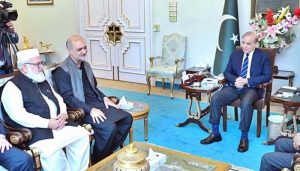
Earlier, Interior Minister Mohsin Naqvi, accompanied by Minister of State for Interior Talal Chaudhry, called on President Zardari and delivered the prime minister’s summary seeking approval for emergency measures in the province.
Following the presidential approval, the federal government formed an 11-member KP Advisory Council to assist Governor Faisal Karim Kundi in exercising the functions of the provincial government on behalf of the Centre.
Federal Minister for Information and Broadcasting Attaullah Tarar announced the appointments, saying the council comprised individuals with extensive public-service experience or specialised qualifications.
Advocate Sanaullah was appointed advocate general of KP, while former prisons chief Kifayatullah Khan was assigned home affairs. Former Federal Board of Revenue chairman Tariq Mahmood Pasha was appointed adviser on finance affairs, and MNA Samar Haroon Bilour was given the information portfolio.
Retired Lt Gen Nigar Johar was assigned health affairs, former advocate general Amir Javed law, and former senator Osman Saifullah Khan energy and power. Asif Rafiq Afridi was appointed adviser on communications and works, while Maulana Tayyab Qureshi was assigned religious affairs.
Dr Muhammad Irshad, a former FBR official with a PhD in finance, was appointed adviser on industries and commerce. Dr Sarfraz Ali Shah, who holds a doctorate in economics, was assigned mines and minerals, while Dr Syed Amir Abdullah, who holds a PhD in international relations, was appointed adviser on education.
According to a notification, the federal government has formed the council as part of the emergency measures under Article 232 of the Constitution. It will assist the governor in exercising the functions of the KP government on behalf of the Centre.
In addition to that, the government established an Area Development Secretariat headed by an additional chief secretary to govern 12 districts including formerly Federally Administered Tribal Areas (ex-FATA). The governor and the provincial chief secretary would oversee affairs of the secretariat.Through the order, the government exercising its powers under Article 232 established the Area Development Secretariat (ADS), under the supervision of the Area Representative and Development Council (ARDC), to “restore law and order, safeguard the security of the citizens of Pakistan and ensure good governance and development” in 12 districts. These include Dera Ismail Khan, Tank, Lakki Marwat, Bannu, Bajaur, Mohmand, Khyber, Kurram, Orakzai, North Waziristan, South Waziristan (Upper) and South Waziristan (Lower).
The order said that the ARDC should be a representative council comprising the notables from the designated districts and should be headed by a chairman.“Officials of the provincial government and of other bodies or authorities posted in the designated districts shall be placed under the operational and administrative control of ADS,” it said.
The order further said that provisions of the Constitution, which pertained to the separation of the judiciary from the executive, would not apply to the designated districts. KP Government Rules of Business 1985 will not apply either.
PTI-terrorists Nexus:
Information Minister Tarar accused the former PTI-led provincial government in KP for the present deteriorating law and order situation in the region.
“PTI government in KP was hand in glove with terrorists and had an unholy alliance with terrorists,” he said.
He said the PTI government not only facilitated terrorists but also had a power sharing formula with them, which started from southern districts and was ingressing further into the entire KP.
He accused the provincial government of even outsourcing police stations of some districts to the Taliban, emphasizing that the case was not merely of inaction and incompetence but of “empowering” the terrorists.
Chairing the Advisory Council’s first meeting on Sunday, Governor Kundi said the province’s immediate priorities were restoring peace, improving law and order and eliminating terrorism.
“We have to fast-track things. There will be zero tolerance on corruption. Things should be done in a timely manner,” he said, urging council members to demonstrate a clear improvement in governance.
He said the law-and-order situation would be the council’s first priority and that there should be no hesitation in learning from the experiences of other provinces. He also called for efforts to improve KP’s image to attract tourists and investors.
Addressing the people of the province, Kundi said the extraordinary circumstances had necessitated constitutional measures, adding that he would avoid political rhetoric and allegations.
He said the government would strengthen the capacity of the police and the Counter Terrorism Department to address the security challenge.
He added that the council would also focus on healthcare, education and employment, stressing that the performance of a government should be judged by the services it provided to the people rather than its statements.
The governor said the government would target not only terrorists but also those facilitating and financing terrorism, adding that all action would be taken in accordance with the law.
He assured the people that the extraordinary measures were not intended to target any particular political party or group and urged them to cooperate in restoring peace and security.
Meanwhile, KP Governor Faisal Karim Kundi said the province’s people welcomed the presidential proclamation and wanted peace, stability, development and prosperity rather than unrest and insecurity.
The move triggered strong criticism from Pakistan Tehreek-e-Insaf (PTI), whose leaders described the imposition of emergency and governor’s rule as unconstitutional and undemocratic.
PTI Chairman Barrister Gohar Ali Khan termed the decision a serious political mistake, arguing that peace could not be achieved by disregarding the province’s electoral mandate or undermining provincial autonomy.
He said his party supported efforts to eliminate terrorism but rejected the use of security concerns to restrict constitutional rights or pursue political objectives.
“Provinces cannot be weakened to strengthen the federation,” Gohar said, calling for political dialogue and constitutional supremacy. He urged the federal government to reconsider its decision, warning that persisting with the measures could cause further political and economic damage.
Former National Assembly speaker Asad Qaiser also rejected emergency and governor’s rule, calling for the implementation of a unanimous resolution adopted by a peace jirga. He urged political parties to speak up for KP’s constitutional rights and said the PTI would continue its democratic struggle.
PTI leader Ali Muhammad Khan described the move as contrary to the mandate of millions of people in the province, calling for the restoration of governance under elected representatives.
Former federal minister Asad Umar criticised the decision, saying it could initiate a process that would undermine the existing political system.
PTI KP president Junaid Akbar, meanwhile, vowed that the party’s planned long march would continue regardless of whether governor’s rule or martial law was imposed. He said the participants had reached Swabi and that neither pressure nor threats would deter them.
KP Information Minister Shafi Jan earlier claimed that Chief Minister Sohail Afridi and Junaid Akbar had been arrested. However, no official confirmation of the reported arrests was available at the time.
Jan called on people from across the province, particularly the tribal districts, to gather in Peshawar in support of the chief minister, saying he would join them wherever they assembled.
The reported arrests came amid the PTI’s long march towards Islamabad, which began in Lakki Marwat on October 4 after negotiations between the government and opposition failed to produce an agreement. The talks had broken down over disagreements concerning counterterrorism cooperation in KP and access to jailed PTI founder Imran Khan, including a meeting with his personal doctor.
Meanwhile, security was tightened across Peshawar, with shipping containers placed at several points to block roads and restrict movement following the imposition of emergency measures.
Containers were positioned near the railway station to block routes towards Khyber Bazaar and Shoba Bazaar, while entry to Jail Road and Malik Saad Shaheed Flyover was restricted near Edwardes College. Sher Shah Suri Road was also reported closed.
Police personnel were deployed in large numbers, particularly around Governor House, with additional personnel called from other districts. Containers were placed on Khyber Road, while traffic movement on Grand Trunk Road was restricted near Firdous Chowk, where only pedestrians were reportedly allowed to proceed.
Roads near Bala Hisar Fort and the Pakistan International Airlines office on Arbab Road were also blocked. Only official vehicles were allowed to travel between Governor House and Chief Minister’s House, while security was tightened around the provincial government’s key installations.
Royal Artillery Bazaar was closed, while Saddar remained partially open. Peshawar’s Bus Rapid Transit stations were also reported to have been shut.
University Road was blocked by containers at Tehkal, while traffic at Stadium Chowk was restricted to single-file movement. The closures caused traffic congestion as vehicles were diverted to adjoining roads.
Telecommunications services, including landline and DSL connections, were also reported suspended in the provincial capital. The city had experienced a nearly 48-hour mobile service blackout days earlier during the PTI long march.
In Islamabad, the sealing of KP House created difficulties for the opposition alliance Tehreek-i-Tahafuz-Ayin-i-Pakistan (TTAP), which had planned to hold a press conference there.
TTAP spokesperson Akhunzada Hussain Ahmed Yousafzai said the alliance subsequently approached the National Press Club but was refused permission despite offering to pay the required fee.
The alliance then decided to hold its press conference at Jamia Al Wilaya near Bhara Kahu on the Murree Expressway.