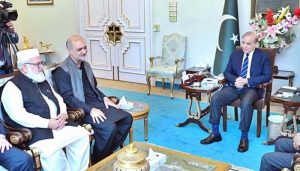
A resolution seeking constitutional endorsement of the emergency imposed in Khyber Pakhtunkhwa was presented in the National Assembly, with Law Minister Azam Nazeer Tarar defending the federal government’s decision on the grounds of rising terrorism and deteriorating law and order in the province.
Pakistan Peoples Party (PPP) Chairman Bilawal Bhutto-Zardari also backed the move, describing the imposition of emergency as a last resort and urging political parties to unite against terrorism.
The National Assembly session, chaired by Speaker Sardar Ayaz Sadiq, began 45 minutes behind schedule.Ahead of the sitting, the speaker held consultations with coalition partners to finalise a strategy for securing constitutional endorsement of the emergency in KP. Lawmakers from the PPP, Pakistan Muslim League-Nawaz (PML-N) and other allied parties attended the meeting.
At the outset of the session, Federal Minister for Parliamentary Affairs Tariq Fazal Chaudhry moved a motion seeking the suspension of Question Hour, which was opposed by the opposition. Question Hour was subsequently suspended.
Chaudhry later presented a resolution seeking parliamentary endorsement of the emergency imposed in the province.Addressing the house, Law Minister Azam Nazeer Tarar rejected criticism that the emergency had resulted in the removal of an elected provincial government, saying the decision had been necessitated by internal unrest and cross-border infiltration.
He said the proposal to impose emergency rule had been presented following two and a half hours of deliberations during a federal cabinet meeting.
Tarar maintained that the decision was taken in accordance with the Constitution and that constitutional powers had been exercised to safeguard national security, state unity and public welfare.He said the Constitution provided a clear mechanism for dealing with extraordinary situations, adding that the deteriorating law and order situation in KP was a major factor behind the decision.
Citing figures on terrorist activities, the law minister said 2,911 terrorism-related incidents had been reported in the province between 2021 and 2024, reflecting the federal government’s growing concerns over the resurgence of militancy.
He maintained that extraordinary circumstances required extraordinary measures.
Tarar accused KP Chief Minister Sohail Afridi of disregarding the sacrifices of security personnel and civilians killed in terrorist attacks.Instead of standing with victims of terrorism, he alleged, the provincial leadership had undertaken political visits and announced a march towards Islamabad rather than addressing the province’s worsening security situation.
The minister further alleged that the ideology of a political party had contributed to the resurgence of terrorism, claiming that its leadership appeared more interested in taking control of Islamabad than tackling militancy.
He said the federal government had prioritised negotiations, while the KP chief minister had chosen political confrontation.
Referring to two days of consultations, Tarar said the nation had witnessed efforts to resolve the situation through dialogue, but alleged that the provincial chief minister had ignored the growing security threats.
The law minister also addressed demands concerning the release of the incarcerated PTI founder, saying the matter fell within the jurisdiction of the courts rather than the executive.
He said demands raised during negotiations included concessions and facilities for the PTI founder, which were beyond the federal government’s executive authority.
According to Tarar, the opposition had also sought clarification on when the PTI founder would be released.
He stressed that the interests of the state must take precedence over political considerations.
During the minister’s speech, a heated exchange took place between Tarar and Shafqat Abbas, prompting PPP Chairman Bilawal Bhutto-Zardari to intervene and ask Abbas to remain silent.
Tarar again referred to the security situation in KP, saying 2,911 terrorist incidents had occurred over three years, while 3,783 incidents had been reported during the preceding year.
He reiterated that the provincial government’s approach towards counterterrorism posed a threat to national security.
The law minister added that KP Governor Faisal Karim Kundi had long been raising concerns over the province’s deteriorating security situation.
Bilawal terms emergency a last resort
Speaking during the session, PPP Chairman Bilawal Bhutto-Zardari defended the emergency proclamation, saying the Constitution empowered the president to take such action under exceptional circumstances.
He maintained that the federal government had exhausted all possible options to avoid imposing emergency rule and had made efforts to resolve the crisis through political negotiations.
Bilawal accused the PTI of contributing to the circumstances that led to the emergency and held the provincial chief minister responsible for the prevailing situation.
Announcing his intention to vote in favour of the federal government’s decision, he said Article 232 of the Constitution authorised the president to proclaim an emergency in cases of war, external aggression or internal disturbance beyond the control of a provincial government.
The PPP chairman stressed that political differences should be set aside to formulate an effective strategy against terrorism.
He accused the PTI of carrying out a political “suicide attack”, alleging that the party’s provincial leadership had played a significant role in creating the crisis.
Bilawal said the opposition must acknowledge the PTI’s responsibility for the situation, adding that the provincial leadership should have provided convincing reasons for the federal government to refrain from imposing emergency rule.
He maintained that the government had made every possible effort to engage the opposition and reach a political settlement.
Recalling the negotiations, Bilawal said he had received information late at night suggesting that the talks were progressing successfully and that an understanding was close to being reached.
He said the provincial government had been prepared to designate terrorism-affected areas as areas affected by terrorists, while an agreement was also expected on joint measures to combat militancy.
The PPP chairman said he had initially believed that the negotiations represented a major political breakthrough.
He cautioned that restricting political space for one party could eventually undermine the political space available to all political forces.
Questioning the PTI’s conduct, Bilawal asked what the party’s actions amounted to if they could not be described as a political suicide attack.
He said the opposition had reportedly agreed that the provincial government would work collectively with other stakeholders to counter terrorism.
Despite supporting the emergency, Bilawal urged the federal government to renew efforts for dialogue, stressing the need to find common ground and resolve the political impasse.
He maintained that the emergency had been imposed out of necessity and was not intended to remain in force permanently.
The PPP chairman emphasised that national unity was essential for effectively combating terrorism.
Referring to Pakistan’s role in facilitating a ceasefire between Iran and the United States, Bilawal said the security challenges confronting Khyber Pakhtunkhwa had reached a point where the provincial government could not tackle terrorism on its own.
He called on political parties to rise above their differences and work collectively to restore peace and address the province’s security challenges.