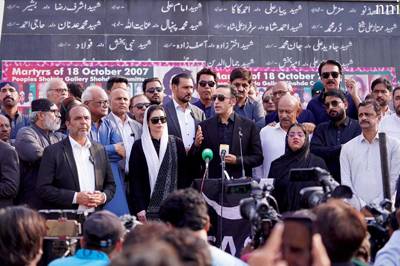
Karachi – Pakistan Peoples Party (PPP) Chairman Bilawal Bhutto-Zardari on Sunday said governor’s rule and emergency measures in Khyber Pakhtunkhwa could be withdrawn if the opposition agreed to work with the federal government on a joint strategy to combat terrorism.
Speaking to the media during a visit to the Karsaz Monument on the 19th anniversary of the Karsaz tragedy, Bilawal urged the PTI-led opposition to engage with the Centre and political parties to develop a consensus-based policy against terrorism.
“If they really want to fight terrorists, and if they want emergency and governor’s rule in KP to end, they should engage with the federal government and politicians and discuss a united policy regarding the fight against terrorism,” he said.
The PPP chairman said the emergency measures could be withdrawn if the opposition agreed on a joint plan to tackle the security challenges facing the country.
Criticising Khyber Pakhtunkhwa Chief Minister Sohail Afridi, Bilawal said that if the provincial government was unwilling to confront terrorists, the PPP was ready to play its role in the fight against militancy.
“If the chief minister of Khyber Pakhtunkhwa is not ready to fight terrorists, then the PPP is ready to fight them. That is why we supported the government’s decision to impose governor’s rule,” he said.
Bilawal said Pakistan was once again facing terrorism across the country, with attacks occurring “from Khyber to Khuzdar”. He recalled that when the PPP came to power in 2008, it launched counterterrorism operations in Swat and other parts of Khyber Pakhtunkhwa.
He blamed earlier decisions to allow militants to return from Afghanistan and release detained militants for contributing to the current security challenges, saying Pakistan was now suffering the consequences.The PPP chairman said the country could effectively combat terrorism only through collective efforts involving political parties, security forces, law enforcement agencies and the public. He urged politicians not to politicise the issue or create controversy over measures intended to address the security situation.
Referring to the Karsaz tragedy, Bilawal said one of the greatest mistakes was failing to take terrorist attacks seriously. He also recalled the PPP’s efforts to build national consensus on counterterrorism during its 2008-2013 government, including institutional reforms and the development of a comprehensive approach to tackling militancy.He called for a renewed National Action Plan (NAP) and urged the opposition to participate in efforts to strengthen the country’s counterterrorism framework.
Bilawal also stressed the need for political reconciliation, saying compromise was an essential part of democratic politics. Citing the political legacy of his mother, former prime minister Benazir Bhutto, he said political leaders must find common ground to resolve national problems.
He referred to the passage of the 18th Amendment as an example of consensus-building, saying political parties had worked together despite their differences to strengthen the democratic system.The PPP chairman said his party was also seeking electoral reforms and welcomed the federal government’s decision to establish a committee in the National Assembly. He invited opposition parties to participate in the process, saying those who believed democracy was weak should help strengthen it.
Responding to a question about Jamiat Ulema-i-Islam-Fazl (JUI-F) chief Maulana Fazlur Rehman’s criticism of the emergency measures, Bilawal said the cleric had every right to disagree with government policies. However, he urged him to condemn terrorism unequivocally, noting that members of his party had also been killed in militant attacks.
Bilawal maintained that the PPP had supported emergency measures through constitutional and legal means. He cited the imposition of governor’s rule in Balochistan during the PPP government as an example of his party’s willingness to take decisions in response to security challenges, even when they affected its own political interests.
The federal government imposed emergency measures in Khyber Pakhtunkhwa on October 11 after President Asif Ali Zardari approved the move on the advice of Prime Minister Shehbaz Sharif under Articles 232 and 234 of the Constitution.
On the economy, Bilawal said Pakistan was facing a historic economic crisis and warned that the situation could worsen. He said addressing the economic challenges also required tackling terrorism and improving the democratic and electoral systems.
Regarding the creation of new provinces, Bilawal reiterated that any such move must comply with the Constitution and the law and have the support of the relevant provincial assembly. He cited Gilgit-Baltistan’s demand for constitutional rights as an example of the need for consensus and said Interior Minister Mohsin Naqvi was aware of the PPP’s position on the issue.
The PPP chairman also clarified that KP Governor Faisal Karim Kundi, who was nominated by his party, was constitutionally a representative of the federal government. He said he would continue to communicate with and advise the governor while acknowledging his official role.
Bilawal said the PPP was not part of the federal government and did not command a parliamentary majority, but would continue working within the available political space to promote its manifesto and address public concerns.
He urged political leaders on both sides of the aisle to work together against terrorism, strengthen democratic institutions and seek consensus on national issues.