Canada and the European Union on Friday launched a new alliance aimed at strengthening economic security, defense cooperation, and technological ties, with agreements covering critical minerals, artificial intelligence (AI), digital trade, and energy.
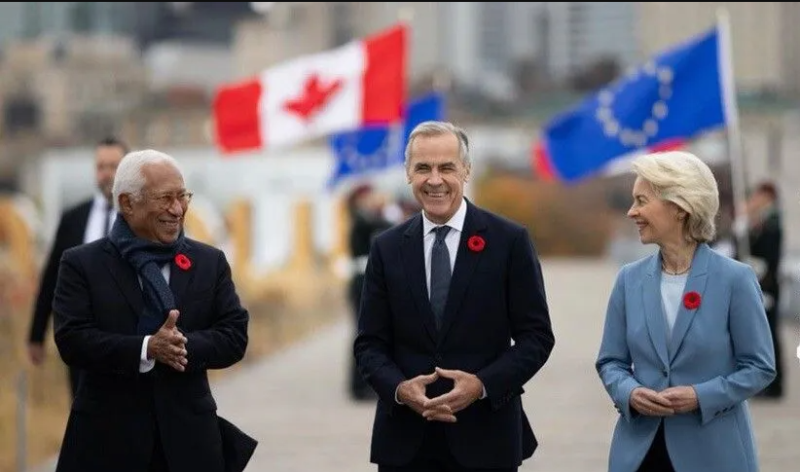
The announcement came at the 21st EU-Canada Summit, held in Montreal, where Canadian Prime Minister Mark Carney met European Council President Antonio Costa and European Commission President Ursula von der Leyen.
In a joint statement, the leaders announced the launch of the Canada-EU Alliance for the Future, an initiative designed to create a common prosperity and economic security space between the two partners.”Our Alliance for the Future will be based on the principle of reciprocity in industrial sectors where both sides have agreed to deepen strategic cooperation to identify and mitigate shared economic security concerns and to build more integrated and resilient supply chains across our markets,” the statement said.
Critical minerals, energy, economy
A major pillar of the new alliance will be securing access to critical raw materials and strengthening supply chains on both sides of the Atlantic.
Canada and the EU intend to accelerate investment across the entire critical minerals value chain, from extraction and processing to refining, manufacturing, and recycling.
The leaders also agreed to explore mechanisms to improve security of supply, including possible stockpiling arrangements for strategic resources needed by civilian and defense industries.
The European Investment Bank and Canada have also concluded negotiations on an agreement intended to facilitate European investment in Canada’s critical resources, particularly critical raw materials.
Energy cooperation will also be expanded, including support for the development of liquefied natural gas exchanges, in line with both sides’ climate commitments.
AI, trade, education
Canada and the EU announced the conclusion of substantive negotiations on a digital trade agreement, which aims to provide a modern framework for digital trade, improve legal certainty, and facilitate cross-border data flows.
The partners will work to remove bilateral trade barriers, strengthen regulatory and standards cooperation, and develop sectoral roadmaps for strategic industries.
They also plan to establish a business council bringing together companies from both sides of the Atlantic.
The two sides also intend to deepen cooperation on digital infrastructure and artificial intelligence, including trusted and sovereign cloud infrastructure, computing capacity, data, AI models, software, and applications.On education and research, Canada and the EU will launch negotiations towards deeper Canadian participation in Erasmus+, the EU’s flagship program for education, training, youth, and sport.
No reference to ‘associate membership’
The summit also takes place against the backdrop of a debate over the future institutional relationship between Canada and the EU.
Von der Leyen had previously floated the idea of associate membership for Canada during her State of the Union address in Strasbourg, suggesting a closer relationship that would stop short of full EU membership.However, the proposal reportedly ran into resistance among some EU member states ahead of the summit, with Germany reportedly leading efforts to remove the wording.
The final joint statement makes no reference to associate membership.
Instead, the leaders describe their ambition as creating an even closer association between Canada and the EU, with more frequent high-level political engagement, exchanges on shared priorities, and closer coordination on international challenges.