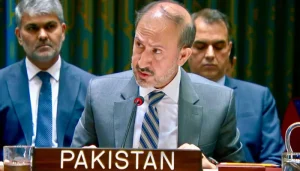
Pakistan has called for grant-based international climate financing, rejecting debt-funded recovery for climate-vulnerable developing countries, as Federal Minister for Climate Change and Environmental Coordination Dr Musadik Malik criticised the international community for failing to honour its climate finance commitments.
Speaking at a session on debt-stressed, climate-vulnerable economies at the Pakistan Pavilion during COP31, Dr Musadik Malik said international assistance to developing countries had declined by 23 per cent in a single year, returning to 2015 levels despite repeated pledges to increase funding.
He argued that countries already struggling with debt could not rebuild after climate disasters or achieve their climate targets through additional borrowing.
Criticising financing mechanisms such as green bonds, green sukuk and blended finance, the minister said these instruments largely involved loans rather than providing additional financial resources to vulnerable countries.
He said Pakistan collected around Rs16 trillion in revenue, with Rs8 trillion spent on debt servicing, leaving limited resources for development and climate resilience.
Referring to the devastating 2022 floods, Dr Musadik Malik said reconstruction costs amounted to around nine per cent of Pakistan’s gross domestic product, while much of the international response involved repurposed loans worth $8 billion to $10 billion.
He noted that funds originally allocated for health and education had been diverted towards reconstruction, further affecting essential social development.
The minister said Pakistan’s previous five major floods had resulted in approximately 6,000 deaths, 20,000 injuries or disabilities and affected or displaced around 40 million people. He also highlighted the prolonged disruption to education caused by repeated climate disasters.
Questioning the distribution of global climate finance, he said 10 countries accounted for 70 per cent of greenhouse gas emissions but received 80 per cent of green financing. He stressed that financial assistance should prioritise climate vulnerability rather than emissions.
Dr Musadik Malik also raised concerns over the Loss and Damage Fund, saying that although $822 million had been pledged and $422 million collected, no funding had reached affected communities since its establishment.
Highlighting Pakistan’s domestic clean energy efforts, he said citizens and farmers had installed an estimated 33 to 37 gigawatts of rooftop solar capacity. Clean energy sources now accounted for around 55 per cent of the country’s energy mix, with a target to increase the share to 70 to 75 per cent.
Earlier, MNA Dr Nafisa Shah, co-convenor of the Parliamentary Forum on Energy and Economy, said climate-vulnerable communities were increasingly being pushed into a climate-debt trap as disaster recovery relied heavily on loans.
She said the 2022 floods affected around 33 million people and caused more than $30 billion in losses, calling for alternative financing arrangements, including grants, concessional finance, debt swaps and improved access to the Loss and Damage Fund.
Minister of State for Climate Change Dr Shezra Mansab Ali Khan Kharal highlighted Pakistan’s adaptation measures, saying 284 early-warning stations established with UNDP support were protecting around 700,000 people in Gilgit-Baltistan and Khyber Pakhtunkhwa.
She added that more than one million climate-resilient homes had been completed for flood-affected families in Sindh, with ownership rights granted to women.
Dr Shezra also highlighted the federal Climate Budget Statement, which had mapped more than 5,000 cost centres for climate-related expenditure, stressing the importance of monitoring allocations and measurable outcomes.
MNA Danyal Chaudhry said parliamentarians had a responsibility to translate international climate commitments into national legislation and budgetary priorities.
The session was organised by the Parliamentary Forum on Energy and Economy in collaboration with the Asian Peoples’ Movement on Debt and Development (APMDD), bringing together parliamentarians, policymakers and experts from climate-vulnerable countries.