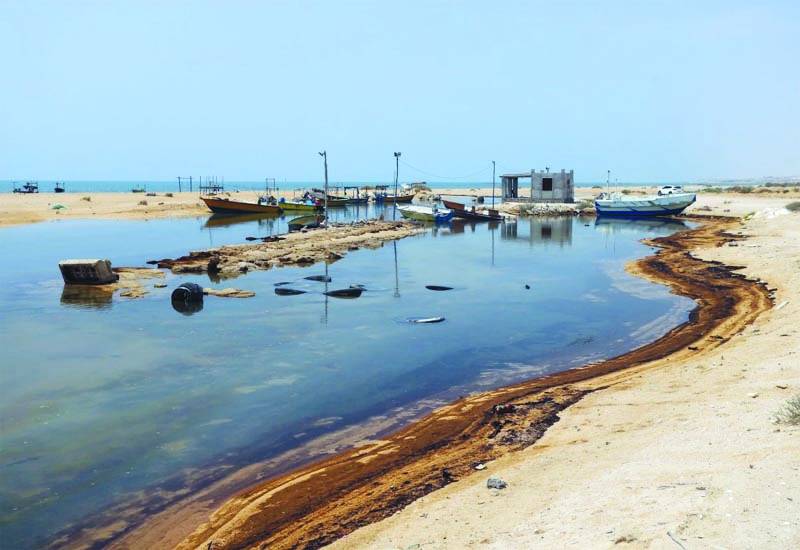
WASHINGTON – The United States on Tuesday carried out several attacks on Iran’s southern Island of Qeshm, located in the Strait of Hormuz, a local Iranian official said.
“The American attack on locations on Qeshm island caused no damage to residential, commercial, or infrastructural areas,” said Ahmad Nafisi, deputy provincial governor of the southern province of Hormozgan, quoted by the official IRNA news agency. “The situation on Qeshm island is under control, and all relief, service, and executive agencies are on full alert,” he added.
“The sounds of five to six explosions were heard on Qeshm on Tuesday evening,” IRNA said. Earlier in the day Iran’s Revolutionary Guard said they had launched a drone attack targeting a radar system in Bahrain operated by the United States.
“Combat drones belonging to the Revolutionary Guards carried out a precision operation this morning, targeting a radar system operated by US forces at the Sheikh Isa Air Base in Bahrain,” the Guard’s Sepah news website said.
It added that the attack was in response to the “repeated violations of Iranian airspace by US military drones”.
Since the outbreak of the Middle East war in late February, Tehran has attempted to restrict traffic through the strategic waterway, insisting vessels use only routes authorised by the country. It has regularly targeted ships that transit without its authorisation.
The United States has, in response, imposed a naval blockade on Iranian ports and helped tankers travel the strait, which normally carries about one-fifth of global oil supplies.
In recent weeks, Tehran has made multiple announcements saying ships have caught fire in the strait, often claiming they struck mines.
On Tuesday, the Iranian armed forces said three oil tankers struck naval mines while attempting to transit Hormuz.
The US military recently said it had cleared all mines from the main routes through the waterway.
US Central Command, which oversees US military operations in the region, said last month that it had helped Gulf countries export 1.5 billion barrels of oil via Hormuz since the summer.
The United States carried out several attacks on Iran’s southern Island of Qeshm, located in the Strait of Hormuz, earlier today, a local Iranian official says, after footage of explosions over the island. “The American attack on locations on Qeshm Island caused no damage to residential, commercial, or infrastructural areas,” says Ahmad Nafisi, deputy provincial governor of the southern province of Hormozgan, quoted by the official IRNA news agency.
Iranian parliament speaker Mohammad Bagher Ghalibaf warned the United States and Israel on Tuesday that civilian infrastructure near their military bases could be considered legitimate targets, as the Islamic Revolutionary Guard Corps claimed a new attack on US forces in Bahrain.
In response to a New York Times report published Monday suggesting that some of Iran’s dams and water-transfer projects may have been built to support underground missile facilities, Ghalibaf wrote on X that the US was “prepping the next round on civilian infra,” shortening the word infrastructure.
US President Donald Trump has said the US is taking “very seriously” the potential for any Iranian plot to attack Washington DC, after he was asked about a CNN report citing US intelligence assessments.
In the Philippines, where he attended the Asean Summit, Trump nodded when asked by a journalist about the report that Tehran was planning to detonate a so-called dirty bomb in the US capital and said: “We’re looking into it.”
CNN cited unnamed US intelligence officials suggesting Iran could target senior figures in Trump’s administration with such an attack.
Iran called the claim “baseless.” Concerns about dirty bombs grew after the 9/11 attacks in 2001, although no such attack has ever occurred.
Such a device would contain radioactive material – such as uranium – which would be scattered through the air when its conventional explosive detonated.
The BBC has not independently verified CNN’s reporting.
During his comments to reporters in Manila, Trump was asked whether there was reason to believe an attack was imminent.
“I hope it’s not,” he said, “but we take it very seriously because they [the Iranians] happen to be crazy.”
In a statement before Trump’s comments, White House spokesperson Lauren Bis wrote: “We remain vigilant monitoring any and all potential threats, but at this time there are no credible threats to the homeland.”
Iranian foreign ministry spokesman Esmail Baghaei rebutted the CNN article and other US reports.
He posted on X: “Those who initiated the aggression against Iran are now seeking to lay the media groundwork for their sinister designs by manufacturing and disseminating baseless allegations.”
Mohammad Bagher Ghalibaf, Iran’s parliamentary speaker and chief negotiator in indirect talks with the US, responded to the report saying it was part of a “messaging operation”.
“Same false flags, same war mongering, new logos,” he wrote on X.
Mick Mulroy, a former CIA paramilitary officer and deputy assistant defence secretary, told the BBC: “A dirty bomb is not difficult to make or deploy.”
“Although it is not a weapon of mass destruction, it can be a weapon of mass disruption,” he added.
Imran Bayoumi, a geostrategy expert with the Atlantic Council in Washington DC and former policy adviser to the defence department, said that it remains “unclear how serious” would be the threat of a supposed Iranian dirty bomb.
“But Iran has planned and threatened to attack the US in the past,” he said. “It is also unclear why this report is becoming public now.”
It comes as intelligence officials and members of the Trump administration seek congressional renewal of a key national security law.
Section 702 of the Foreign Intelligence Surveillance Act (Fisa), which allows the US to spy on foreign nationals, expires next March.