WASHINGTON/TEHRAN/TEL AVIV – President Donald Trump said the unidentified Iranian officials his administration is negotiating with on a potential end to the US-Israeli war in Iran allowed “big boats of oil” to cross the strait of Hormuz as a sign of their influence in Tehran.
Earlier this week, Trump said those officials had offered a high-valued “gift” that arrived on 24 March that was related to oil and gas flows through the Strait of Hormuz, where the threat of attack from Iran has heavily limited shipments. Trump said at a cabinet meeting on Thursday that the gift was safe passage for eight tankers, which later increased to 10 tankers. The tankers were Pakistani-flagged, Trump said he believes.
“They said, ‘To show you the fact that we’re real and solid, we’re going to let you have eight boats of oil, eight big boats of oil’” that subsequently made it through the strait, Trump said. “And I said, ‘Well I guess they were right.’”
US President Donald Trump’s envoy Steve Witkoff on Thursday confirmed that the White House has sent a 15-point plan to Tehran via Pakistan in an attempt to end the war with Iran.
“I can report to you today that we have, along with your foreign-policy team, presented a 15-point action list that forms the framework for a peace deal. This has been circulated through the Pakistani government, acting as the mediator,” Witkoff told Trump at a cabinet meeting at the White House.
The plan has “resulted in strong and positive messaging and talks,” said Witkoff.
Deputy Prime Minister and Foreign Minister Mohammad Ishaq Dar confirmed on X that his country is serving as an intermediary, saying the 15-point plan is “being deliberated upon by Iran.”
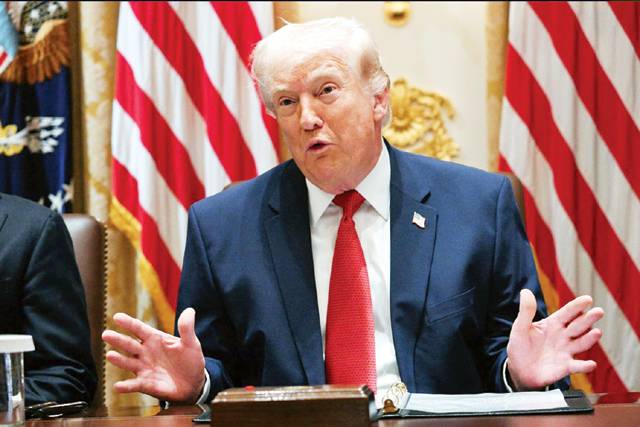
However, at the start of the cabinet meeting, Trump dismissed reports that he was seeking to end the war through diplomacy, saying it was Iran that had moved to restart talks and that it is up to Iran to convince him to stop the strikes.
“They are begging to work out a deal,” Trump argued.
“We’ll see if they want to do it,” said Trump. “In the meantime, we’ll just keep blowing them away unimpeded.”
A CNN report said Wednesday that the White House is trying to arrange a meeting in Pakistan this weekend to discuss an off-ramp to end the military conflict with Iran. US Vice President JD Vance may travel to Pakistan for the talks, said the report.
Asked if his Friday deadline still stands for Iran to accept the US offer for a deal or see its energy sites bombed, US President Donald Trump says, “I don’t know.”
Responding to questions from reporters at a White House cabinet meeting, Trump says he’ll reassess after being updated by his negotiators, Steve Witkoff, Jared Kushner and Vice President JD Vance.
“They will tell me whether or not they think it’s going along, and if it’s not going along, maybe not,” he says. “We have a lot of time. A day in Trump time — that’s an eternity.”
Asked whether it’s possible to end the war if Iran still holds on to its stockpiles of enriched uranium, Trump responds, “You’re going to have to see… we’re roaming free… I can’t talk to you about it.”
As for the Strait of Hormuz, Trump insists that the US isn’t the one that even needs the channel, as it exports its oil through other routes. “We don’t need the Hormuz Strait. We have so much oil. We have twice the amount of oil as Saudi Arabia or Russia.”
Israel said Thursday it killed the Iranian navy chief overseeing what is a near-total blockade of the Strait of Hormuz. Alireza Tangsiri, head of the Islamic Revolutionary Guards Corps (IRGC) navy, was “directly responsible for the terrorist act of bombing and blocking the Strait of Hormuz”, and has been “blown up”, according to Israel’s defence minister Israel Katz. He added that a number of other “senior Navy command officials” have also been killed. Iran has not yet commented.
The Israeli Air Force carried out several waves of airstrikes in Iran in the past day, targeting dozens of Iranian weapon production facilities, the military says. According to the military, 60 IAF fighter jets dropped more than 150 bombs on the facilities near Tehran and in central Iran.
In a wave of strikes in Isfahan overnight, the military says it bombed several weapon manufacturing sites, including one belonging to the IRGC Quds Force, and a facility used to manufacture air defense systems.
Iran pummeled Israel with seven salvos of missiles within hours on Thursday morning, injuring nine people in Israel and the West Bank and causing damage as cluster warheads spread submunitions across wide areas.
Tehran also continued to attack its Gulf neighbors with missiles and drones. Two people were killed in Abu Dhabi by debris from an intercepted missile, the emirate’s media office said, adding that three others were injured and several vehicles were damaged.
Seven salvos of ballistic missiles were fired at Israel within a matter of hours on Thursday morning, after an overnight lull of some 14 hours.
The volleys sent millions running for shelter repeatedly in central and northern Israel, which also faced concurrent attacks from Lebanon’s Hezbollah terror group.
The first missile was intercepted, with no reports of injuries or damage.