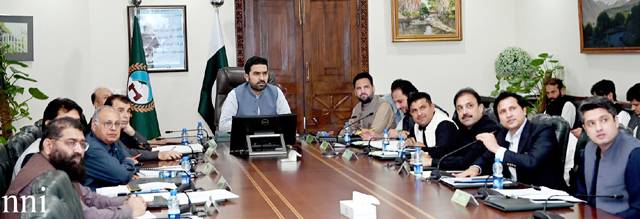
Peshawar – Chief Minister Khyber Pakhtunkhwa Sohail Afridi, while addressing a meeting of the provincial cabinet, spoke at length on the prevailing national and provincial situation, the political context, and the government’s forward-looking development priorities.
The Chief Minister said that the decision to postpone public gathering scheduled for 9 April was taken in the broader national interest. He noted that Pakistan is increasingly being recognized globally for its role in promoting peace and dialogue, adding that Imran Khan has consistently advocated this approach for over two decades. He reiterated that Imran Khan’s long-standing position has been that military operations and wars do not offer sustainable solutions, and that lasting peace lies in dialogue and negotiated settlements.
Highlighting the conduct of Pakistan Tehreek-e-Insaf, the Chief Minister said that the party had prioritized national interest over political considerations and demonstrated responsible political behaviour. He added that participation in federal-level meetings, despite political costs, was undertaken in good faith to support national objectives.
The Chief Minister expressed concern over what he termed as continued political discrimination against the party, including use of excessive force against workers and violations of the sanctity of private spaces. He further noted incidents involving the mistreatment of family members of Imran Khan, describing them as deeply concerning. He also raised serious concerns regarding the reported denial of access to personal physicians and family members in the case of Bushra Bibi, terming it violation of fundamental rights.
The Chief Minister also conveyed strong reservations over delays in the hearing of legal cases of Imran Khan and broader impediments to the provision of justice, stating that continued discriminatory treatment of a major political party would compel a reassessment of the government’s current approach. He cautioned that, if such trends persist, the provincial government may consider discontinuing cooperation with the federal government, including the option of a boycott.
The Chief Minister also took serious notice of the suspension of CNG supply in the province. He underscored that, under the law, provinces where natural resources are produced have the first right to meet their domestic and commercial needs. He said that discontinuation of CNG supply in Khyber Pakhtunkhwa by SNGPL is not only contrary to the law but also undermines the rights of the province. He directed the relevant authorities to take up the matter with SNGPL on an urgent basis and warned that failure to rectify the situation would invite a strong response, including the option of a boycott.
On provincial development, the Chief Minister informed that the Annual Development Programme 2026–27 is in its final stages of preparation and is being consolidated for implementation. He directed all departments to fully utilize their capacities to ensure comprehensive and effective planning.
Emphasizing participatory governance, the Chief Minister announced that citizens would be actively engaged in the development planning process. He said that public input would be sought on key service delivery areas including roads, water supply, and healthcare facilities.
For this purpose, a dedicated feedback mechanism will be made available through the official social media platforms of Deputy Commissioners, enabling citizens to submit their suggestions and grievances directly. He further informed that the feedback portal will remain open from 4 May to 8 May and encouraged broad-based public participation.
The Chief Minister affirmed that the received inputs would be duly incorporated into the Annual Development Programme 2026–27, with a view to ensuring responsive planning and effective implementation aligned with public needs.
Briefing the media on the important decisions of the provincial cabinet, Special Assistant to the Chief Minister (SACM) Khyber Pakhtunkhwa on Information, Shafi Jan, said that the cabinet had approved the Khyber Pakhtunkhwa Fiscal Responsibility & Debt Management (Amendment) Bill, 2026, introducing a series of fiscal and debt management reforms aimed at strengthening financial discipline, refining borrowing limits, and improving institutional oversight of public debt.
The proposed amendments, he said, seek to promote prudent and well-planned borrowing for productive development while reducing reliance on excessive debt through enhanced fiscal management mechanisms. The reforms also provide for the establishment of a dedicated Debt Management Office to strengthen institutional arrangements.
Under the amended fiscal limitation provisions of Section 9(b), the government shall ensure that net investment in non-financial assets in any financial year is not less than 20 percent of the Province’s average revenue. In cases where such investment falls below the prescribed threshold, prior approval of the government will be mandatory.
The amendments also revise debt limitation provisions under Section 10. According to the revised framework, debt servicing in any financial year shall not exceed five percent of the Province’s average revenue. However, with prior government approval, debt servicing may exceed the limit up to a maximum of seven percent of the average provincial revenue.
The cabinet, he said, also approved the Budget Strategy Paper (BSP) 2026-27, outlining the provincial government’s fiscal priorities and development roadmap for the next financial year. The strategy focuses on strengthening tax and non-tax revenues, reducing reliance on borrowing, improving returns on public investment and promoting youth empowerment and environmental protection.
Key development priorities identified in the BSP include reforms in health, education, law and order and clean energy sectors, alongside initiatives such as solarization of public buildings, telemedicine in remote districts, school performance monitoring systems, youth digital skills and employment programmes, and the Safe City Project.
According to Shafi Jan, the cabinet approved amendments to the Khyber Pakhtunkhwa Prisons Rules, 2018, specifically revising Rule 545 to facilitate virtual visits and interviews for prisoners with their parda nasheen female family members, as well as elderly and sick relatives. He said the amendment aims to improve access to family interaction on humanitarian grounds while ensuring convenience, dignity and security through the use of virtual communication facilities in prisons across the province.
The Cabinet, he said, also approved a Performance Framework under the Good Governance Roadmap aimed at incentivizing high performance among government officers and strengthening service delivery and governance across the province. Under the framework, officers demonstrating exceptional performance on key interventions will be eligible for incentives of up to four running basic pays, while recognition letters will also be placed on their service records.
Shafi Jan said the cabinet approved the mutation, transfer and waiver of lease process for sites identified for the construction of civil dispensaries in polio virus-related super high-risk union councils of Peshawar to strengthen healthcare infrastructure and support ongoing anti-polio efforts in vulnerable areas.
The Cabinet also approved the Khyber Pakhtunkhwa Journalist Welfare Endowment Fund (Amendment) Bill, 2026, introducing changes to make the fund more financially sustainable and effective in providing support to journalists.