WASHINGTON/ISLAMABAD/MOSCOW – Iran has offered to end its chokehold on the Strait of Hormuz in exchange for the US lifting its blockade on the country and an end to the war, while proposing that discussions on the larger question of its nuclear program would come in a later phase, two regional officials said Monday.
A standoff remains on the strait, the narrow mouth of the Persian Gulf through which a fifth of all traded oil and natural gas passes, as Iran has restricted movement through it and the U.S. enforced a blockade of Iranian ports.
Iran’s ability to choke off traffic in the Strait of Hormuz, the narrow mouth of the Persian Gulf, has proved one of its biggest strategic advantages in a war that has often boiled down to which side can take more pain.
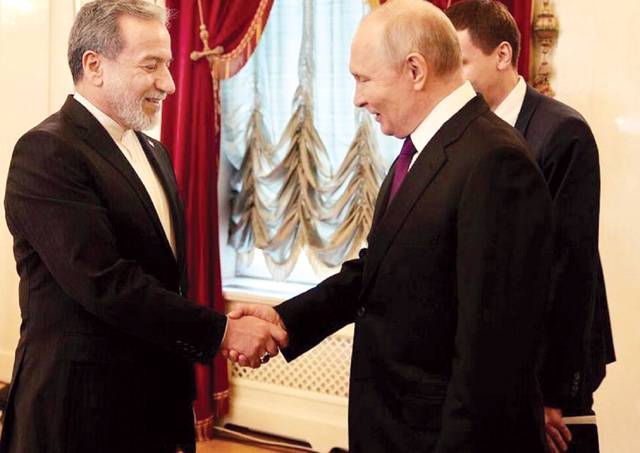
Iranian Foreign Minister Abbas Araghchi met with Russian President Vladimir Putin on Monday in Saint Petersburg, Russian state news agency Tass said. Putin praised the Iranian people as “bravely and heroically fighting for their sovereignty,” and said Russia would do everything possible to bring peace to the Middle East, Tass reported.
Araghchi said before the meeting in a video interview posted by Iran’s state-run IRNA news agency that it was “a good opportunity for us to consult with our Russian friends about the developments that have occurred in relation to the war during this period and what is happening now.”
The meeting came as Pakistan has been seeking to revive stalled talks between Iran and the U.S., and negotiations had been expected in Islamabad over the weekend. Instead, Trump called off a trip by his envoys and suggested the talks could take place by phone instead.
The meeting came as Pakistan has been seeking to revive stalled talks between Iran and the U.S., and negotiations had been expected in Islamabad over the weekend. Instead, Trump called off a trip by his envoys and suggested the talks could take place by phone instead
Iran has proposed a deal with the United States to reach an agreement on reopening the Strait of Hormuz and ending the war, while delaying negotiations on Tehran’s nuclear program to a later stage, according to a report Sunday, after hoped-for talks in Pakistan over the weekend failed to materialize.
The Axios report, citing a US official and two sources familiar with the matter, was published as Iranian Foreign Minister Abbas Araghchi briefly returned to Islamabad after visiting Oman on Saturday, despite US President Donald Trump signaling that he did not plan to dispatch a negotiating team anytime soon.
Instead, after calling off a planned delegation to Pakistan at the last minute the previous day, the president said on Sunday that the Iranian team could reach Washington by phone if they wished to speak, and Araghchi departed Pakistan again, this time headed for Russia.
According to Axios, Iran’s attempt to kickstart negotiations again by solving the issues centered on the Strait of Hormuz was conveyed to the US by Pakistani mediators.
US President Donald Trump has discussed a new Iranian proposal on resolving the war with Tehran with his top national security aides today, White House press secretary Karoline Leavitt told reporters on Monday.
“The meeting may be ongoing, maybe not, but the proposal was being discussed,” she says. “The president’s red lines with respect to Iran have been made very, very clear.”
“I wouldn’t say they were considering it,” Leavitt adds, regarding an Iranian suggestion to reopen the Strait of Hormuz in exchange for ending the US blockade. “I would say there’s a discussion.”
US Secretary of State Marco Rubio said a purported offer from Iran to reopen the Strait of Hormuz under strict conditions is not acceptable to the United States or others.
Speaking in an interview with Fox News, Rubio said Iran has a different view of the strategic waterway than most of the rest of the world. “What they mean by opening the straits is, yes, the straits are open, as long as you coordinate with Iran, get our permission, or we’ll blow you up and you pay us,” Rubio added. “That’s not opening the straits. Those are international waterways. They cannot normalize, nor can we tolerate them trying to normalize, a system in which the Iranians decide who gets to use them.”
Also, Iran’s Foreign Minister Abbas Araghchi said that Tehran is looking into US President Donald Trump’s request for negotiations, according to a post on the minister’s Telegram account.
He told reporters in Russia that Trump requested negotiations because the US has not achieved any of its objectives.
Araghchi said the Islamic Republic is “stable, solid” during a meeting in Russia with President Vladimir Putin, according to Russian state TV.
The Iranian foreign minister said due to the war with the United States and Israel, “the world has now realized Iran’s true power” and “it has become clear that the Islamic Republic of Iran is a stable, solid and powerful system,” he says in the meeting in Saint Petersburg.
He added that Russia has stood by Iran and the two countries will continue their “strategic partnership.”
Iran’s top diplomat blamed Washington on Monday for the failure of Middle East peace talks during a visit to Russia, where President Vladimir Putin promised him Moscow’s support in bringing the war to a close.
Foreign Minister Abbas Araghchi was in Saint Petersburg on the fourth leg of a whirlwind diplomatic tour, having sandwiched a trip to Oman in between two visits to main mediator Pakistan over the past few days.