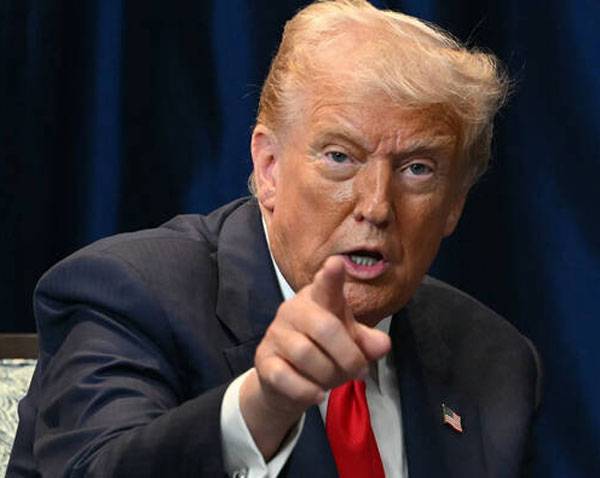
Washington/Tel Aviv – US President Donald Trump said Friday he’s not satisfied with Iran’s latest proposal for an agreement to permanently end the war with the US.
“They want to make a deal, but I’m not satisfied with it,” Trump tells reporters outside the White House when asked about the proposal the US received from Tehran on Thursday.
“They’ve made strides, but I’m not sure if they ever get there,” Trump says, again claiming that Iran’s leadership is “disjointed.”
US President Donald Trump confirms he was briefed this week by Central Command chief Adm. Bradley Cooper about military options against Iran.
“Do we want to go and just blast the hell out of them and finish them forever, or do we want to try and make a deal — those are the options,” Trump tells reporters outside the White House.
Trump claims that on a “human basis,” he would prefer not to bomb Iran, but also doesn’t want them to have a nuclear weapon.
He again claims that Iran’s leadership is so disjointed that different factions want different types of deals with the US. “They’re not getting along with each other, and it puts us in a bad position.”
Asked what specifically he’s unsatisfied with when it comes ot Iran, Trump says, “They’re asking for things that I can’t agree to.”
Asked whether he still plans to host the leaders of Israel and Lebanon, Trump responds, “They’re going to be coming.”
The US has been pushing such direct engagement between the two leaders for weeks, with little success.
Lebanese President Joseph Aoun has thus far held off on engaging directly with Prime Minister Benjamin Netanyahu.
He faces significant domestic pressure back home, including threats from Hezbollah, and it’s unclear whether Aoun would be willing to meet Netanyahu while Israeli forces continue to occupy a buffer zone in southern Lebanon.
The White House says it will not detail private diplomatic conversations when asked about Iran’s new proposal to the United States that was submitted to Pakistani mediators.
“We do not detail private diplomatic conversations. President Trump has been clear that Iran can never possess a nuclear weapon, and negotiations continue to ensure the short- and long-term national security of the United States,” spokeswoman Anna Kelly tells Reuters.
US President Donald Trump’s administration argued that a ceasefire with Tehran had “terminated” hostilities as a legal deadline arrived on Friday for coming to Congress about the two-month Iran war.
Under the 1973 War Powers Resolution, the president can wage military action for only 60 days before ending it, asking Congress for authorization or seeking a 30-day extension due to “unavoidable military necessity regarding the safety of United States Armed Forces” while withdrawing forces.
Israel is on heightened alert, ramping up preparations for a possible return to fighting with Iran, amid indications that US President Donald Trump may be nearing a decision on renewed military action, Israeli television reported Thursday.
The report came as Trump was briefed at the White House on military options by US Central Command chief Adm. Brad Cooper. At the same time, Israeli officials held a series of intensive consultations amid what they see as growing momentum toward a decision in Washington.
According to Channel 12, Israeli officials were bracing for the possibility that negotiations between the US and Iran could collapse as early as the start of next week. The report cited cabinet ministers briefed in recent days as assessing that the US may need to “give a push” to its pressure campaign in the Strait of Hormuz through military strikes on Iranian gas and energy facilities, as well as government infrastructure.
As part of the buildup, Israel and the US were also reportedly working to project a credible naval threat against Iran.
Ahead of Trump’s briefing with Cooper, a US official told Reuters that the US president would be updated about plans for a series of fresh military strikes to compel Iran to negotiate an end to the conflict.
The Axios news site said another plan, intended to be shared with Trump during the briefing, involved deploying ground forces to take control of part of the strait to reopen it to commercial shipping. Trump is also considering extending the US blockade or declaring a unilateral victory, officials have said.
Amid the preparations for a potential resumption of hostilities, Bloomberg reported Thursday that CENTCOM has requested the long-delayed Dark Eagle hypersonic missile be sent to the Middle East for potential use against Iran, marking the first time Washington would deploy the technology.
The request by Central Command was made after Iran shifted its missile launchers out of range of the US Army’s Precision Strike Missile, the current technology it has deployed, a person with direct knowledge of the request told Bloomberg, adding the request to the military was still pending.
CENTCOM declined to comment on the report.
Meanwhile, Defense Minister Israel Katz warned earlier Thursday that while Israel supports the United States’ diplomatic efforts with Iran, it may “soon be required to act again” to remove the “existential threats” posed by the Islamic Republic.
“Iran has suffered extremely severe blows over the past year, blows that have set it back years in all areas,” said Katz during a ceremony promoting the next Israeli Air Force chief, Omer Tischler, to the rank of major general.
“US President Trump, in coordination with Prime Minister Benjamin Netanyahu, is leading the effort to complete the campaign’s objectives in a way that ensures Iran will not return to being a threat to the existence of Israel, to the United States, and to the free world for generations to come,” he said.
“We support this effort and provide the necessary backing, but we may soon be required to act again to ensure the objectives are achieved,” Katz added.
But the commander of the Islamic Revolutionary Guard Corps’ aerospace force, Majid Mousavi, threatened on Thursday that even a “short and tactical” enemy operation would be met “with painful, prolonged, and extensive strikes,” while Iranian President Masoud Pezeshkian said the blockade of his country’s ports was effectively an “extension of military operations” by Washington.
Despite Pezeshkian’s remarks, Trump reportedly told oil executives and national security officials this week to prepare for a prolonged US blockade designed to force Tehran to surrender its nuclear program. Oil prices struck a four-year high on Thursday. International benchmark Brent crude soared more than seven percent to $126 a barrel before easing in afternoon trading in London.
Trump faces domestic political pressure to end the military operation, which is unpopular even among parts of his base and has driven up costs at the pump for American consumers.
Iran’s economy is also suffering, with the rial falling to historic lows against the dollar.
Iran has proposed easing its chokehold over the Strait of Hormuz if Washington lifts its blockade and broader negotiations take place. But the Trump administration has insisted that Iran’s nuclear program be on the table.
Iranian Foreign Ministry spokesman Esmaeil Baghaei said Thursday evening that it was not reasonable to expect quick results from US talks.
“Expecting to reach a result in a short time, regardless of who the mediator is, in my opinion, is not very realistic,” he was quoted as saying by the official IRNA news agency.