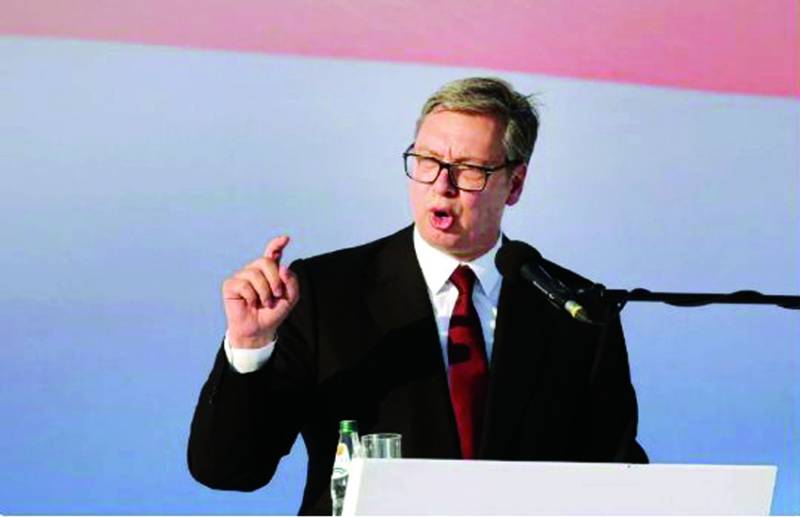
BELGRADE – Serbian President Aleksandar Vucic said on Saturday he would resign within weeks and the country will hold early presidential and parliamentary elections, following 18 months of anti-government protests. The announcement by Vucic, who has been in power as president or prime minister for 12 years, came amid persistent anti-corruption demonstrations led by students and triggered by the collapse of an awning at a railway station in the northern city of Novi Sad in November 2024, in which 16 people died. Protesters, opposition and rights groups allege the railway station disaster was a sign of broader government mismanagement of construction projects and corruption. “I will be president for only a couple more weeks, and then I will resign,” Vucic told throngs of his supporters at a pro-government rally in the capital, Belgrade. Vucic’s second and final mandate was due to expire in mid-2027. Vucic said he would help his Serbian Progressive Party (SNS) win the presidential election and the early parliamentary vote, also originally set for 2027. “My proposal is for our list, the winning list in the upcoming elections, to be named ‘United Serbia’.” He did not specify when he would resign nor when he would dissolve parliament, a precondition for early parliamentary elections.
Vucic is unlikely to depart from the political stage as his resignation could pave the way for him to become prime minister if his party triumphs in parliamentary elections. That would continue a long trend in which the power in Serbia follows Vucic, regardless of his title. Analysts said Vucic would try to place an ally as his successor in the presidency so he can continue to hold the levers of power. “This is not at all the end of Vucic,” said Radivoje Grujic, a Warsaw-based analyst. “He already has a plan, one that definitely does not mean he’s going to go into political retirement — quite the opposite.” Still, the timing of Saturday’s announcement suggests the protests — the biggest string of rallies since the overthrow of Slobodan Milosevic in 2000 — have played a role. Days ago, in the city of Novi Sad, students commemorated victims of the disaster and demanded snap general elections. Another student rally is scheduled for Sunday in the town of Kraljevo, in south-central Serbia. Activists from the student-led movement and the opposition have both said they want to challenge Vucic and the SNS in the elections. Savo Manojlovic, head of the student opposition Move-Change movement, said: “By resigning and with early presidential and parliamentary elections, Vucic is trying to preempt his inevitable fall, because of protests and because of the student movement, which has more support than he does.” The position of president in Serbia is largely ceremonial, but Vucic has wielded considerable influence over his party and the government. He has already floated the idea of becoming prime minister again, and recently several top allies publicly said he should.
In an interview with Reuters in February, Vucic said he was unsure what he would do after his term expires, but did not rule out returning to party politics or seeking to become prime minister.
“I would like to be less engaged in politics or not at all, but taking care of my legacy might require some sort of engagement; we’ll see,” he said.