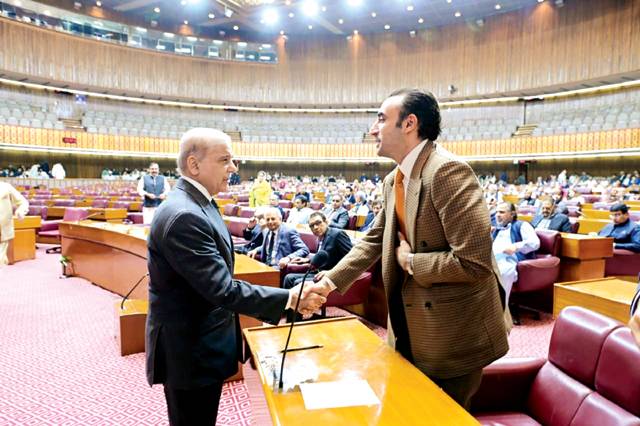
ISLAMABAD – The Senate and the National Assembly on Thursday passed “ The National Command Authority (Amendment) Bill, 2026” and “The Defence Forces of Pakistan Bill, 2026”.
The Senate passed Defence Forces Act 2026 and the National Command Authority Amendment Bill aimed at implementing legal and administrative changes arising from the 27th Constitutional Amendment.
Minister for Defence Khawaja Asif moved the bills including the Defence Forces Act, 2010 and the amended National Command Authority Act, 2010 in the House. The House passed the bills through clause by clause reading.
Defence Forces Act 2026 seeks to establish the necessary legal and administrative framework concerning the office of the Chief of Defence Forces and the Chief of Defence Forces Headquarters. The amendment also proposes removing the Chairman Joint Chiefs of Staff Committee from the composition of the authority, representing a significant change in its existing structure.
The draft amendment to the Defence Forces Act 2026 has been prepared as a continuation of the 27th Constitutional Amendment. One of its key purposes is to establish the legal framework for the post of Chief of Defence Forces.
The legislation will also determine the administrative affairs and structure of the Chief of Defence Forces Headquarters, providing a legal basis for its functioning.
According to statement of objects and reasons, Defence Forces of Pakistan Bill 2026, “Pakistan’s response to Indian unprovoked aggression was a textbook demonstration of integrated tri-services jointness, enabled by real-time situational awareness, network centric warfare capabilities, and seamless multi-domain operations. This synergy across, land, sea, and cyber domains allowed for precision engagements, overwhelming lethality, and lightning operational tempo.
The resilient armed forces of Pakistan carried out the most effective counter terrorism operations in the western region without any pause, simultaneously with the conduct of Operation Bunyan ul Marsoos.
Marka-e-Haq has been a great example of synergy between all elements of National power, with overwhelming support of the Pakistani public, to effectively counter the threats to our national sovereignty and territorial integrity,”.
It says, “As a result, Defence Forces Headquarters shall be the headquarters of the Armed Forces and shall function under the command and authority of the Chief of Defence Forces, who shall be the principal military advisor to the Prime Minister on national security, Defence and all matters relating to armed forces,”.
Speaking in the House, Minister for Law and Justice Azam Nazeer Tarar said the changes were essentially consequential to the constitutional restructuring of the country’s defence command.
The National Assembly has also passed the bills aimed at bringing the relevant laws in conformity with the new constitutional framework.
Tarar said the office of Chairman Joint Chiefs of Staff Committee had ceased to exist following amendments to Article 243 of the Constitution, necessitating removal of references to the office from the National Command Authority Act.
Under the new constitutional amendment, he said, the Chief of Army Staff concurrently holds the office of Chief of Defence Forces.
The minister said the Defence Forces legislation provided the legal basis for establishment and functioning of the Chief of Defence Forces Headquarters, enabling the office to exercise its functions and authority through a structured institutional mechanism.
He said the framework was designed to strengthen cohesion and coordination among the Pakistan Army, Pakistan Navy and Pakistan Air Force while retaining their respective operational responsibilities.
Tarar said the country had witnessed the effectiveness of such coordination during Marka-e-Haq on May 8, 9 and 10, when the three armed services operated with cohesion and coordination.
He said the legislation sought to translate that coordination into a permanent institutional framework.
The legislation, he said, would clearly structure the relevant functions and authority and provide an institutional mechanism for the new defence command arrangement.
Explaining the amendments to the National Command Authority Act, 2010, Tarar said these were also required following the 27th Constitutional Amendment to bring the existing law into conformity with the changed higher defence hierarchy. Earlier, the chair strongly reacted over the absence of the minister during the Question-Hour session. He suspended the proceedings of the House until the relevant ministers came to respond their ministries issues. Later, the House was adjourned to meet again on Friday at 10:30 am.