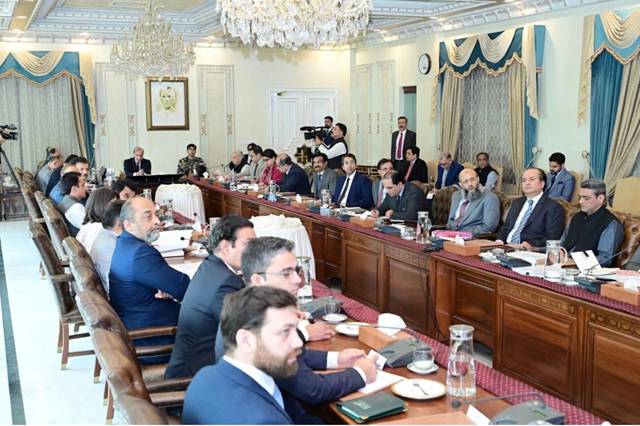
ISLAMABAD – Prime Minister Shehbaz Sharif on Friday took notice of increasing electricity load-shedding in various cities across the country and expressed displeasure over the situation, directing that no area should face load-shedding for more than two hours.
The prime minister gave these directions while chairing an important review meeting on power load management in the country, a Prime Minister’s Office news release said.
The meeting was informed that due to the prevailing regional situation, tensions in the Strait of Hormuz and transportation difficulties affecting the supply of Regasified Liquefied Natural Gas (RLNG), electricity generation had been reduced, resulting in a decrease in power output. Consequently, load management had to be carried out to maintain balance between demand and supply.
The prime minister directed that keeping in view the regional situation and future requirements, immediate measures be taken to address the disruption in RLNG supply. He directed that all available resources be utilised effectively so that no area faces load-shedding for more than two hours.
The prime minister also ordered the establishment of Consumer Grievance Redressal Committees at the level of power distribution companies (DISCOs) to address public complaints related to electricity supply and other issues across the country.
He directed that the redressal committees should also include public representation, and that the grievance committees be made functional within one week.
The meeting was informed that electricity consumers could lodge their complaints through helpline number 118, and that upon registering a complaint, the consumer is provided with a token number as well as the expected time for resolution of the complaint. The meeting was further informed that at present, except for six electricity consumers in Rajanpur district, no consumer across the country was facing disruption in power supply due to monsoon rains.
The meeting was attended by Federal Minister for Planning Ahsan Iqbal, Minister for Economic Affairs Ahad Khan Cheema, Federal Minister for Climate Change Musadik Malik, Federal Minister for Information and Broadcasting Attaullah Tarar, Minister for Petroleum Ali Pervaiz Malik, Federal Minister for Power Division Sardar Awais Leghari, Advisor to the Prime Minister Rana Sanaullah, Minister of State for Finance and Railways Bilal Azhar Kayani, and other senior government officials concerned.
Also, PM Shehbaz Sharif called for coordinated measures to expand access for Pakistani agricultural products to international markets and explore new markets.
He was chairing a high-level meeting on promotion of agriculture sector and agricultural exports in Islamabad.
The Prime Minister directed Pakistan’s commercial officers posted at its missions abroad to play an effective role in promoting the country’s agricultural exports.
Shehbaz Sharif directed that an effective media campaign be launched to raise awareness among farmers about the mobile application available for monitoring crops.
He emphasized that value addition in agricultural products is essential for increasing agricultural exports.
He noted that agricultural sector plays a key role in the growth and stability of Pakistan’s economy. He emphasized the need for effective coordination and partnership between the federal and provincial governments for increasing per-acre agricultural productivity, introducing innovation in agriculture, developing the livestock sector and promoting agricultural exports.
The meeting was informed that Pakistan’s agricultural exports stood at 5.18 billion dollars during the last fiscal year. Rice, fisheries, halal meat, potatoes, sesame, tobacco, mangoes, and maize were among Pakistan’s major agricultural exports.
The meeting proposed the development of value chains to increase agricultural exports. A Digital Farmers’ Diary -Agri Stack was proposed, under which farmers across the country and agricultural land records will be digitized.
It was informed National Agriculture and Food Security Council will be activated, and the Chief Ministers will represent their respective provinces in the council.
The meeting was also informed that Pakistan Good Agriculture Practices (Pak-GAP) system will be developed to promote agricultural practices that deliver better results.