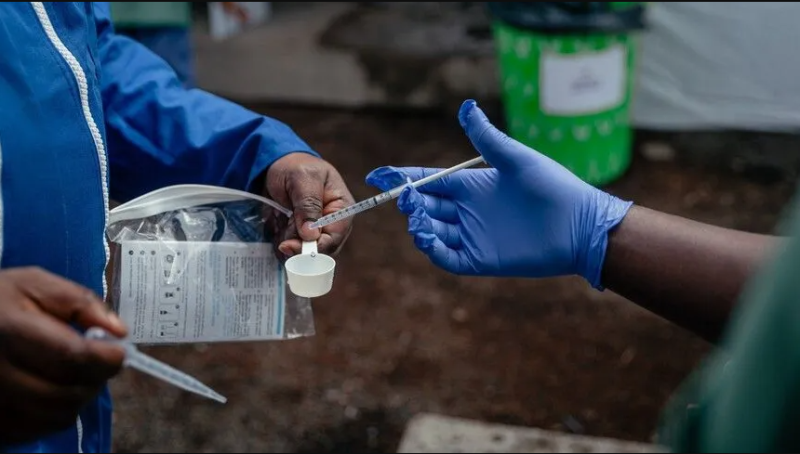
Health officials in the Democratic Republic of Congo have launched a trial of a new Ebola vaccine as the struggle to contain the fast-spreading epidemic continues, the World Health Organization (WHO) said Friday.
The first participants in a new vaccine trial, known as Tumaini, which means hope in Swahili, were vaccinated in Ituri’s provincial capital Bunia, the WHO Africa regional office said.
The WHO called the launch “a major step in the fight against Ebola disease caused by the Bundibugyo virus strain,” which is spreading rapidly across geographic boundaries.
The trial will evaluate candidate vaccines against Ebola strains caused by the Bundibugyo virus among contacts of confirmed cases.
No vaccine against the Bundibugyo virus strain has been approved, which was first declared in Congo in May.
The trial is being guided by scientific rigor, transparency, ethical principles, informed consent, as well as community engagement, according to the WHO.
“This trial will help us understand whether any of the vaccine candidates designed for Bundibugyo virus work,” WHO Director-General Tedros Adhanom Ghebreyesus said in a post on US social media company X.In August, Congo received 70,000 Ervebo vaccines from the global Ebola virus disease vaccine stockpile for use in the outbreak, which was approved for use against the Zaire Ebola virus.
The vaccine trial is coordinated by the Coalition for Epidemic Preparedness Innovations (CEPI) and supported by WHO, the Congolese Health Ministry, and partners.
The number of confirmed Ebola cases in Congo since the outbreak has surpassed 9,700, including more than 4,690 deaths, according to the latest data by Africa Centers for Disease Control and Prevention (Africa CDC).
The disease has affected eight provinces: Haut-Uele, Ituri, North Kivu, South Kivu, Bas-Uele, Tshopo, South-Ubangi, and North Ubangi.
Health officials said the spread to other countries in the region is complicating efforts to contain the outbreak.
Kenya has reported nine confirmed cases, including two deaths. Nigeria confirmed its first case earlier this week, believed to be imported from Congo.