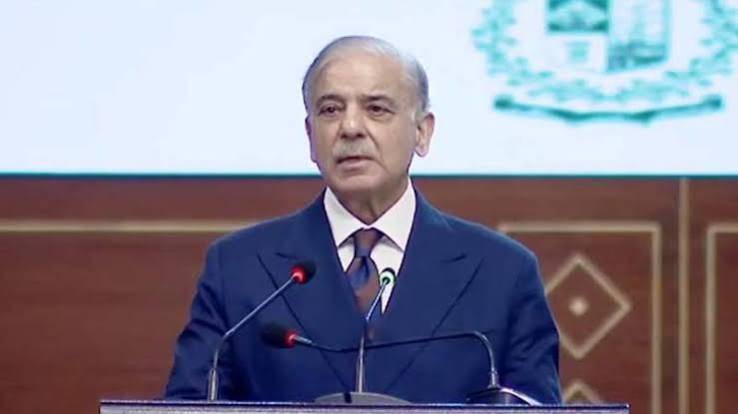
ISLAMABAD – Prime Minister Shehbaz Sharif on Sunday launched a programme to distribute 500,000 Chromebooks among talented students from schools and religious seminaries across Pakistan over the next two years, stressing that access to education and technology should not be determined by financial status.
“Intelligence and hard work should not be held captive by wealth and poverty,” the prime minister said while addressing a ceremony organised under the Prime Minister’s Youth Programme, emphasising that merit and hard work would be the sole criteria for selecting beneficiaries.
The selected students will also receive bags and MiFi devices to access the internet, attend online classes and use electronic libraries from home. “Through these Chromebooks, you will be able to acquire knowledge and, as you grow up, become some of the most distinguished and capable people in this country,” Shehbaz told the students.
He said the government was committed to ensuring that talented young people were not left behind in an increasingly technology-driven world.
Recalling the laptop distribution programme launched under former prime minister Nawaz Sharif, Shehbaz said around 600,000 laptops had been distributed on merit among students in Punjab, Sindh, Balochistan, Khyber-Pakhtunkhwa, Gilgit-Baltistan and Azad Jammu and Kashmir. The earlier programme had taken approximately 10 years to complete, he said, adding that the government now intended to distribute 500,000 Chromebooks nationwide within two years. Describing the devices as an important tool for learning, the prime minister said they would help students develop their abilities and compete with their counterparts around the world.
He recalled that the previous laptop scheme had benefited students from diverse backgrounds, including children whose fathers had died and those whose parents worked as labourers.
Recalling an exchange with a student at the ceremony, Shehbaz said he had asked the child about his father’s occupation.
“Prime Minister, my father is a labourer,” the student had replied.
The prime minister said a child’s family circumstances should never become an obstacle to education or the development of talent.
He thanked Rashid Minhas, founder of the Tokyo Care Foundation, for his contribution to the initiative, saying the donation reflected the confidence of overseas Pakistanis in the potential of the country’s young people.
Shehbaz said Pakistanis living abroad worked hard to enhance the country’s standing internationally and expressed gratitude to the foundation on behalf of the government and the students who would benefit from the programme.
The prime minister also highlighted the government’s efforts to expand access to quality education through the Daanish schools programme. He said he had inaugurated a Daanish school in Islamabad recently, while 27 more were under construction across the country.
He said the schools would provide quality education, qualified teachers and modern facilities, including smart boards, electronic libraries, sports grounds, residential dormitories and meals.
“No child has to spend a single penny at these Daanish schools,” he said, emphasising that financial constraints should not deprive children of educational opportunities.
“It is our responsibility to ensure that our children receive the education and facilities they deserve,” he said, adding that building the future of the country’s children should be a government’s foremost responsibility.
Referring to two students who spoke at the ceremony, Shehbaz highlighted the challenges they had overcome to pursue their education.
He mentioned Syed Shams Raza, a student from a tribal area whose father had been martyred, and praised his resilience in facing the hardships of life.
“Just consider how this child is facing the hardships of life; you and I cannot even imagine it,” he said.
The prime minister expressed confidence that thousands of talented children across Pakistan were overcoming similar difficulties and striving to become capable professionals who could serve the country.
He also praised a girl from Baltistan who attended a religious seminary and spoke confidently about her educational ambitions.
The student had expressed concern that seminary students might not be eligible for laptops or Chromebooks. Shehbaz clarified that the new programme would cover students from both mainstream schools and religious seminaries.
He said previous laptop distribution initiatives had also benefited students from religious seminaries alongside those enrolled in colleges and universities.
“Only your hard work and ability will be the criteria,” the prime minister said.
He added that the devices could help students pursue higher education, acquire professional skills and eventually earn a livelihood.
Shehbaz said the importance of technology in education had become particularly evident during the Covid-19 pandemic, when students relied on laptops to attend online classes and continue their studies despite widespread disruption.
He said many beneficiaries of earlier laptop schemes had subsequently secured employment and become doctors, engineers and other professionals.
“Education is an adornment that makes you stand out in society, regardless of where you come from,” he said.
“Wealth can be stolen, prosperity can disappear, and there can be profit and loss, but no one can steal education, and no one can steal ability,” he added.
Concluding his address, the prime minister invoked the poetry of Allama Iqbal, linking determination, confidence and the pursuit of new ideas with national progress. He expressed confidence that providing talented young people with educational opportunities and modern technology would help them contribute to Pakistan’s future.
The new initiative comes amid broader efforts to expand digital access and technology-related opportunities for students. Under the Prime Minister’s Youth Laptop Scheme, the government has previously distributed around 600,000 laptops on merit, with further distributions announced in subsequent years.
Pakistan has also moved to expand local Chromebook production. In November 2025, Google began manufacturing Chromebooks in collaboration with the Ministry of Defence Production and the National Radio and Telecommunication Corporation in Haripur, with plans to produce around 600,000 devices annually.
In August 2026, Pakistan also signed an agreement with Google to provide students with one year of free access to advanced artificial intelligence tools, including Gemini, and offer 150,000 Google Career Certificates to young people during 2026.
Prime Minister Muhammad Shehbaz Sharif on Sunday stressed the need to further strengthen the role of export-based industries in ensuring robust economic growth and long-term financial stability in the country.
He expressed these views during a meeting with Lahore Chamber of Commerce and Industry (LCCI) President Ali Hussam Asghar here, where matters relating to the national economy, promotion of trade and business, industrial challenges, and facilitation of the business community were discussed in detail.
The Prime Minister stated that the government was working closely with the private sector to promote economic activities and foster a business-friendly environment across the country. He emphasized the importance of mutual cooperation between the state and the business community to generate employment opportunities and expand trade volume.
LCCI President Ali Hussam Asghar apprised the Prime Minister of key issues faced by the business fraternity and presented a set of comprehensive proposals aimed at resolving operational hurdles, increasing industrial production, and creating jobs. He commended the government’s economic policies and lauded its investor-friendly initiatives.
Taking prompt action on the recommendations, the Prime Minister constituted a dedicated committee to review the proposals presented by the LCCI president and formulate an actionable implementation plan.
Federal Minister for Information and Broadcasting Attaullah Tarar was also present during the meeting.