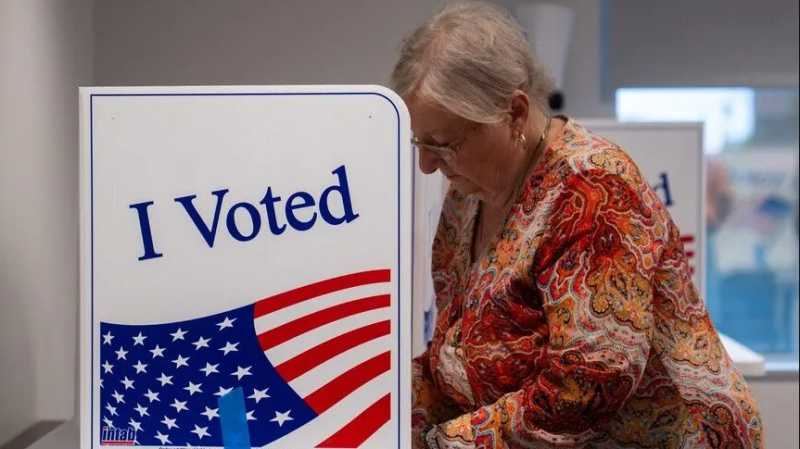
In the US, winning an election is a multibillion-dollar undertaking.
Few countries spend on elections at the scale of the US, where the 2024 federal cycle cost nearly $16 billion. Even in a midterm year, when the presidency is not on the ballot, candidates, parties, billionaires, corporations and interest groups are pouring record sums into contests that will determine control of Congress.
By the end of June, congressional candidates had spent more than $2 billion, 16% above the same point in the 2022 midterms.
Candidates’ committees raise money to hire staff, organize voters and buy advertising. Individuals can contribute up to $3,500 per election to a federal candidate, while qualifying multicandidate political action committees, or PACs, can give $5,000.
Corporations and unions cannot contribute treasury funds directly to federal candidates. Outside spending, however, operates under different rules. Super PACs cannot donate directly to candidates or coordinate their spending with campaigns, but they can accept unlimited sums from individuals, corporations and unions to support or oppose candidates.
The framework largely dates to 2010, when the Supreme Court’s Citizens United decision lifted restrictions on independent corporate and union spending, followed by an appeals court ruling that cleared the way for unlimited contributions to groups spending independently.
Political parties can contribute directly to candidates and spend on their behalf, while some nonprofits can finance political activity without disclosing all their donors, contributing to what campaign-finance advocates call “dark money.”
The result is that candidates may control only a portion of the money spent to influence their races.
2026 spending surges to record levels
Federal Election Commission filings through Oct. 24 show $3.1 billion in independent spending on House and Senate races, including $2.3 billion in the general election.
Political advertising across federal, state and local contests had surpassed $10 billion by mid-October. AdImpact projects a record $11.6 billion, exceeding both the $8.9 billion spent during the 2022 midterms and $11.2 billion in the 2024 presidential cycle.
Senate Leadership Fund had reported about $292 million in independent expenditures by late October, followed by Democratic-aligned WinSenate at $221 million and Republican-aligned No Going Back PAC at $220 million.
The money is concentrated among donors, too. The Washington Post found the 50 largest donor sources had supplied $2.77 billion by Oct. 23. Elon Musk led individual donors with $446 million, followed by Richard and Elizabeth Uihlein with $150 million and Jeff and Janine Yass with $110 million.
Texas illustrates how outside spending can upend the picture suggested by candidates’ own fundraising. Democrat James Talarico had raised $146.3 million, against Republican Ken Paxton’s $22.3 million. Yet outside groups had spent $298.5 million supporting Paxton or attacking Talarico in the general election, compared with $79.9 million benefiting Talarico’s side.
“Billionaires are spending millions attacking me,” Talarico said in a campaign ad. “I don’t take corporate PAC money. I’m running to ban dark money so billionaires can’t buy our elections.”
Daniel Lobo-Lewis, executive director of the Washington-based Political Integrity Project, said candidates increasingly see funding sources as an issue voters can judge.
“Politically, I can use it against my opponent, but in order to do that, I have to be clean,” he told Anadolu.
His group grades candidates using public campaign-finance data and asks them to pledge to reject corporate PAC money, back a congressional stock-trading ban, restrict lawmakers becoming lobbyists and support campaign-finance reform. More than 100 candidates had signed, he said, including about 70 who advanced to the general election.
Public concern crosses party lines. An April Pew Research Center survey found 74% of Americans regarded money in politics as a “very big problem,” including 70% of Republicans and Republican-leaning independents and 79% of Democrats and Democratic leaners.
Getting big money out of politics
Few groups illustrate the reach and controversy of outside money better than the American Israel Public Affairs Committee.
AIPAC’s traditional PAC had raised $57.8 million through Oct. 14 and bundled about $44 million in individual donations for candidates by Oct. 24. Those bundled funds belong to individual donors, not AIPAC itself.
Its affiliated super PAC, United Democracy Project (UDP), had raised $112.8 million and reported $54 million in independent spending through Oct. 24.
AIPAC says it seeks to elect pro-Israel candidates from both parties and defeat those it considers hostile to the US-Israel relationship.
Its largest 2026 intervention came in Michigan’s Democratic Senate primary, where UDP spent $20.7 million opposing Abdul El-Sayed and $10.6 million supporting Rep. Haley Stevens.
El-Sayed, a critic of unconditional US military aid to Israel, linked the spending to his advocacy for campaign-finance reform.
“When you launch a campaign and you’re trying to get money out of politics, that invites record amounts of spending against you,” he told Detroit public radio station WDET afterward.
Cory Archibald, co-founder of TrackAIPAC, launched in 2024 to challenge the pro-Israel lobby’s influence, said wealthy interests across industries exercise disproportionate power.
“If somebody’s got $100 million that they’re waving around saying, ‘Do what I say, or I’m going to spend this against you,’ that’s a problem,” she told Anadolu, citing cryptocurrency and pharmaceutical interests alongside AIPAC.
But she argued that AIPAC differs from domestic industry lobbies because it seeks to shape US foreign policy in another country’s interests.
“AIPAC’s goal and the Israel lobby’s goal is to influence American foreign policy to benefit a foreign government, even when that happens at the expense of American interests,” she said.
Archibald said AIPAC faces growing resistance from a younger generation of politicians more willing to criticize Israel, a shift that began before the war in Gaza. She said the group responded by sharply increasing its direct election spending in 2022.
More than 40 candidates aligned with TrackAIPAC had won primaries this year, she said, including over 20 in districts where she expected them to enter Congress. Their arrival, she argued, could change congressional debates on US military aid to Israel.
Other industries are also spending heavily to influence Washington.
Cryptocurrency-linked groups tracked by FEC-based PaidForPolitics had raised $324.6 million and spent about $162 million supporting or opposing candidates by late October. Defend American Jobs alone accounted for more than $101 million in independent spending.
Artificial intelligence regulation has sparked another spending battle. Groups seeking lighter oversight had raised $125 million and spent about $36 million on elections, while groups advocating stronger regulation had spent roughly $25.6 million.
Yet even unprecedented spending does not guarantee victory.
“Money, you can’t win without money, but money won’t make you win,” Lobo-Lewis said.