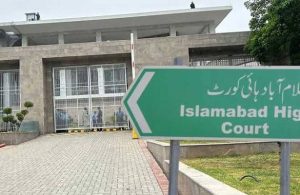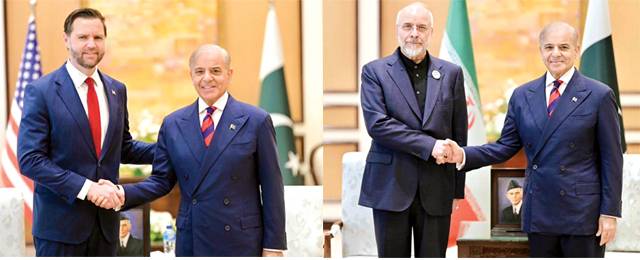
Washington\ JERUSALEM – The White House said Saturday that high-level in-person trilateral talks with Iran and Pakistan are “ongoing” in Islamabad, with negotiations aimed at ending the war in the Middle East.
A senior White House official said in a brief statement that the talks are continuing, after Iranian state media reports two rounds took place and a third was expected.
“According to information provided to the state TV correspondent by a person close to the negotiating team, another round of negotiations will likely be held tonight or tomorrow,” Iranian state broadcaster IRIB said. An Iranian state TV reporter in Islamabad, meanwhile, claimed last efforts are being made to close gaps in the talks while accusing the US of continuing with its “extravagant” demands, as Iran’s Tasnim news agency says the Strait of Hormuz remains one of the main points of serious disagreement and that the Islamic Republic is insisting on preserving military gains.
The US and Iranian delegations exchanged written texts outlining the issues under discussion as the first phase of diplomatic talks in Pakistan concluded, Iran’s Fars news agency reported on Saturday. The talks between Iran and the US have entered the “expert-level stage” in which committees specializing in economic, military, legal and nuclear issues meet with each other, Iran’s government posted on X this afternoon.
Negotiations are continuing to “finalise technical details,” the post added.
Iran’s delegation contains 71 people, including negotiators, experts, media representatives and security, state-affiliated outlet Tasnim reported, while the US has also brought a “full suite of experts on relevant subject areas,” a senior White House official said. “Additional experts” are supporting from Washington, the official added.
Talks between the US and Iran are expected to last well into the night and possibly even stretch into Sunday, a Pakistani source told CNN.
Talks between the US and Iran, with Pakistan acting as a mediatory between them, are ongoing in Islamabad today. Pakistan’s Prime Minister Shehbaz Sharif and army chief, Field Marshal Asim Munir, are in the room, the source added.
Israel decided to go to war with Iran in February because it “was very close to achieving a nuclear weapon” and to gaining the ability to produce thousands of missiles, claimed Israeli Prime Minister Benjamin Netanyahu on Saturday.
If Israel hadn’t attacked Iran twice in the past year, he said, the Islamic Republic “would already have a nuclear weapon.” He further said that that Israel had intelligence last year Iran was preparing to turn its enriched uranium into a nuclear weapon. “The moment we received that intelligence, we went into action,” he added.
Netanyahu also said that only months later he received new intelligence that Iran wanted to expand its missile and nuclear projects, and bury them deep underground.
Israel killed eight nuclear scientists dealing with weaponization in Operation Roaring Lion, he says, adding that Israel also destroyed the heavy water reactor in Arak and Iran’s centrifuge production and uranium lines.
“We succeeded in smashing its nuclear program, in smashing its missile program,” he said.
The campaign against Iran “is not over,” Netanyahu said in a video statement, “but we can already say clearly — We have historic achievements.”
Moving to a map of the Middle East with the Iranian axis highlighted in red, Netanyahu said that “they wanted to strangle us, and we are strangling them.”
“We hit them, we still have more to do,” he added. Netanyahu said that he spent much of his life ensuring that Iran won’t achieve a nuclear weapon, including approving covert operations to delay it and telling the world of the danger. “But the world wouldn’t hear,” he said. Netanyahu said that Israel “broke the barrier of fear” by striking Iran last June.