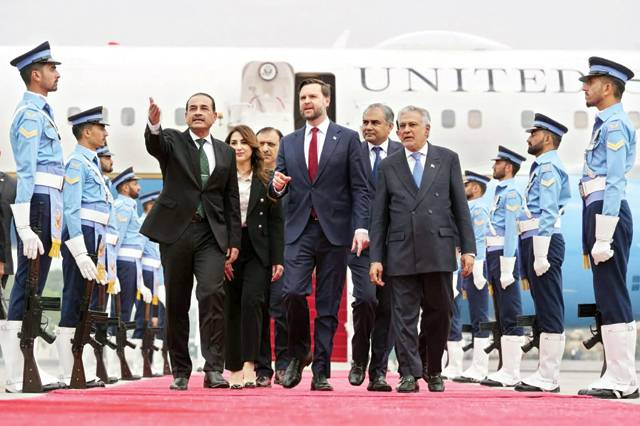
ISLAMABAD/WASHINGTON – Senior US and Iranian officials met on Saturday in Islamabad for the highest-level talks between Washington and Tehran in half a century as they sought to bring an end to their six-week war.
The direct talks between US Vice President JD Vance, special envoy Steve Witkoff and President Donald Trump’s son-in-law Jared Kushner, and Iranian Parliamentary Speaker Mohammad Baqer Ghalibaf and Foreign Minister Abbas Araghchi lasted for two hours before the delegations broke for a rest, according to a Pakistani source. Pakistan’s army chief was also present.
As the talks began, there were conflicting accounts of what had been agreed. A US official told Axios that several US Navy ships on Saturday had crossed the Strait of Hormuz, whose blockade by Iran has caused the biggest-ever disruption to global energy supplies. But Iranian state TV and a Pakistani source denied that any US vessel had passed through the waterway.
“We’re now starting the process of clearing out the Strait of Hormuz,” Trump wrote in a social media post, adding that all 28 of Iran’s mine-dropping ships had been sunk.
Earlier, a senior Iranian source told Reuters the US had agreed to release frozen assets held in Qatar and other foreign banks, an assertion swiftly denied by a US official. The senior Iranian source welcomed the purported move as a sign of “seriousness” in the talks. Late Saturday, US and Iranian officials again convened for a second round of talks tonight in Islamabad after a break, with both sides backed by technical experts, two Pakistani officials say.
They add that Pakistan’s top political and military leadership is encouraging both sides to resolve their differences to ensure durable peace in the region, and the talks are progressing.
The officials speak on condition of anonymity because they aren’t authorized to speak to the media.
The officials decline to share further details, saying they hope for a win-win solution. After US President Donald Trump said his military is clearing the Strait of Hormuz, Iran’s state-affiliated Nournews claimed that is “false news.”
The American military says it has begun a mine-clearing operation in the Strait of Hormuz.
Two US Navy missile destroyers, USS Frank E. Peterson and USS Michael Murphy, “transited the Strait of Hormuz and operated in the Arabian Gulf as part of a broader mission to ensure the strait is fully clear of sea mines previously laid by Iran’s Islamic Revolutionary Guards Corps,” the US Central Command says in a statement.
The direct talks followed a morning of mediation by Prime Minister Shehbaz Sharif as Tehran laid down its red lines that it said Washington must accept before the face-to-face talks could take place.
Tehran’s agenda includes the acknowledgment of its authority over the Strait of Hormuz, where it aims to collect transit fees and control access. The strait is a chokepoint for about 20 percent of global oil and liquefied natural gas shipments.
Iran is also demanding a full ceasefire between Israel and Hezbollah in Lebanon, which it has said was supposed to be part of the original deal with the US, though both Israel and the US have denied that Lebanon was part of the ceasefire, with the White House chalking up the dispute to a misunderstanding.
Israel, which launched the military campaign against Iran jointly with the US six weeks ago, is not represented at the talks. Host Pakistan has no diplomatic ties with Israel and does not recognize its sovereignty.
US and Iranian officials claimed leverage and issued new demands and preconditions as talks approached. US President Donald Trump posted repeatedly on social media leading up to Saturday, saying Iranian officials “have no cards” to negotiate with. “The only reason they are alive today is to negotiate!” he wrote.
He accused Iran of using the Strait of Hormuz for extortion, and told reporters on Friday it would be opened “with or without them.”
Islamabad was deserted on Saturday as security forces sealed roads and authorities urged residents to stay inside, leading the normally bustling Pakistani capital to look like it was under lockdown.
Earlier, Iranian Foreign Minister Abbas Araghchi said Tehran was entering negotiations with “deep distrust” stemming from prior strikes on Iran during previous rounds of talks. Araghchi, who is part of Iran’s delegation in Pakistan, said on Saturday that his country was prepared to retaliate if it was attacked again. Iran published a 10-point proposal. The United States submitted a 15-point proposal that includes restricting Iran’s nuclear program and reopening the strait.
Meanwhile, in Tehran, residents told The Associated Press they were skeptical yet hopeful about the talks after weeks of airstrikes carved a path of destruction across their country. Some said even if one is reached, the path to recovery will be long.
“Peace alone is not enough for our country, because we’ve been hit very hard, there have been huge costs, and the people have to pay for that,” 62-year-old Amir Razzai Far said in downtown Tehran.
Hormuz remains a sticking point
Iran’s closure of the Strait of Hormuz has proved to be its biggest strategic advantage in the war. Commercial vessels have avoided the strait, effectively blocking the passage of oil, natural gas and fertilizer.
The spot price of Brent crude, the international standard for oil prices, was above $94 on Saturday, up more than 30% since the war started.
Before the conflict, around a fifth of the world’s traded oil typically passed through the strait on more than 100 ships a day. With the ceasefire in place, only 12 have been recorded traversing the strait.
Iran has floated the idea of charging ships passing through the strait as part of a peace deal, though the idea has been widely rejected by countries, including the United States and Iran’s neighbor Oman.
However, it is unclear how the US is looking to clear the area, as Iran itself has had trouble locating all the mines it laid in the waterway, according to US officials cited by The New York Times on Saturday.
The officials said that safe routes through the mines provided by Iran’s Islamic Revolutionary Guard Corps were limited, due to Tehran’s careless mining operations.
The report also noted that both the US and Iran are limited in their capabilities to remove nautical mines. Some mines, according to the report, are also able to drift, while it is unclear whether Iran documented each mine it placed in the waterway.