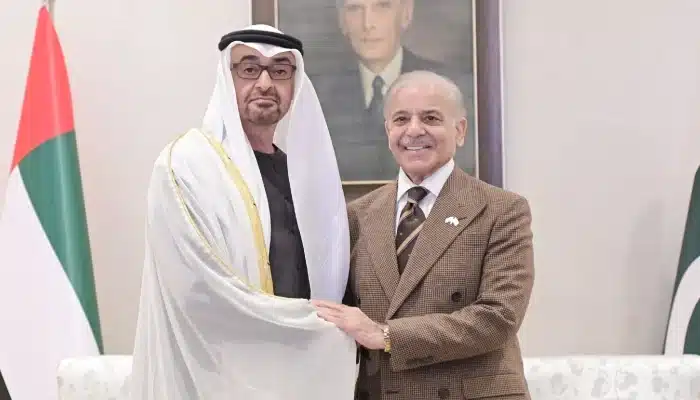
Prime Minister Shehbaz Sharif has strongly condemned reported missile and drone attacks targeting civilian infrastructure in the United Arab Emirates, expressing full solidarity with the Emirati leadership and people.
The statement comes a day after a drone strike on an energy facility in Fujairah injured three Indians, with the UAE blaming Iran for the attack. Iranian state TV said the Islamic republic had “no pre-planned programme” to attack oil facilities in the UAE.The Gulf Arab state’s foreign ministry said in a statement that the attacks marked a serious escalation and posed a direct threat to the country’s security, adding that the UAE reserved its “full and legitimate right” to respond.
In a statement on X, the prime minister conveyed Pakistan’s support for the UAE and extended solidarity to President Mohamed bin Zayed Al Nahyan.
“Pakistan stands firmly with our Emirati brothers and sisters as well as with the Government of the United Arab Emirates at this difficult time,” he posted.
PM Shehbaz also emphasised the importance of respecting the ceasefire, warning that any escalation would undermine regional stability. He urged all parties to preserve diplomatic space and prioritise dialogue to achieve lasting peace and stability in the region.
“It is absolutely essential that the ceasefire be upheld and respected, to allow necessary diplomatic space for dialogue leading to enduring peace and stability in the region.”
The drone attacks shattered a period of relative calm in the region since a Pakistani-mediated ceasefire between Washington and Tehran took effect on April 8, pausing more than a month of intense fighting in the Gulf region.
Monday’s strike was not the first time Fujairah’s energy infrastructure had been targeted. A drone attack on March 14 had previously hit the Port of Fujairah, triggering fires and the suspension of some oil-loading operations.
Fujairah has been critical to UAE oil exports during the Iran war as it sits at the end of the Abu Dhabi Crude Oil Pipeline, which carries crude from inland fields to the Gulf of Oman, bypassing the Strait of Hormuz.
This has allowed the UAE to continue shipping oil to global markets even as the waterway remained under threat.
Fresh hostilities
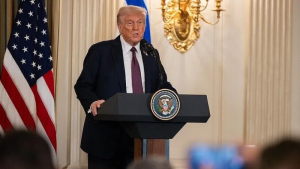
The fresh volleys of missiles and drones came after US President Donald Trump launched a new effort to get stranded tankers and other ships through the strait, the vital energy-trade chokepoint that has been virtually closed since the US and Israel began attacks on Iran in February, a war that has killed thousands of people across the region.
Before Monday was out, several merchant ships in the Gulf reported explosions or fires, the US said it had destroyed six small Iranian military boats, and an oil port in the United Arab Emirates, which hosts a large US military base, was set ablaze by Iranian missiles.
Trump gave scant details about his new effort, which he called “Project Freedom,” to help stuck ships travel through the strait when he announced it on social media, two days after a legal deadline under US law had passed for him to get authorisation from Congress for the war
Trump told Congress the war was “terminated,” and the deadline was moot, a claim disputed by some lawmakers.
It was the first apparent attempt to use military force since last month’s ceasefire announcement to unblock the world’s most important energy shipping route, which Iran’s Islamic Revolutionary Guard Corps has said can only happen with its permission. The cost of shipping insurance has also rocketed. For weeks, the US Navy has blockaded Iran’s trade by sea, which Iran says is itself an act of war.
Meanwhile, Iranian FM Araghchi said Monday’s events showed there was no military solution to the crisis. He said peace talks were progressing with Pakistan’s mediation while warning the US and the UAE against being drawn into a “quagmire by ill-wishers”.
Criticising the US initiative aimed at escorting vessels through the Strait of Hormuz, Araghchi said: “Project Freedom is Project Deadlock”.