Says PPP will continue to prioritise peaceful political engagement to resolve emerging disputes Key differences persist between PPP-PML-N over taxation measures, provincial financial autonomy, and development funding allocations.
ISLAMABAD – Pakistan People’s Party (PPP) chief Bilawal Bhutto Zardari is set to hold a crucial meeting with Prime Minister Shehbaz Sharif in Islamabad to discuss the evolving political situation in Azad Jammu and Kashmir (AJK), as the coalition government simultaneously struggles to bridge widening differences over the federal budget.
The proposed high-level engagement comes at a sensitive political moment, with tensions simmering both in AJK’s internal political environment and within the federal ruling alliance, where negotiations over fiscal allocations have reached an impasse.
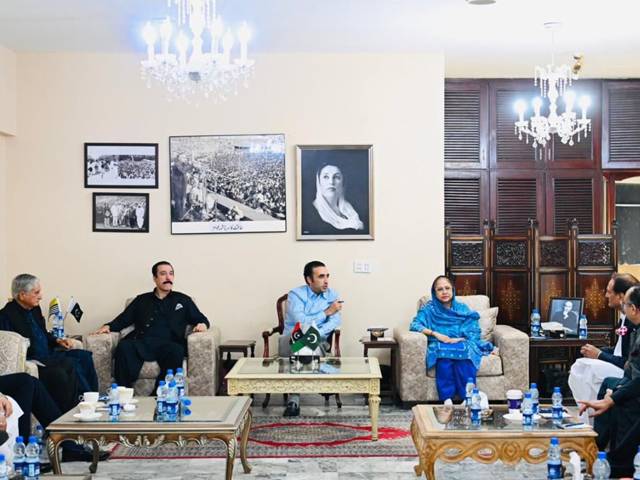
The announcement followed a detailed meeting of the PPP Azad Jammu and Kashmir parliamentary party chaired by Bilawal Bhutto Zardari yesterday, where senior leadership reviewed the region’s political landscape and emerging governance challenges. The session was attended by key party figures, including senior leader Faryal Talpur, along with PPP legislators from AJK who presented in-depth briefings on current political developments, local grievances, and administrative pressures affecting the region.
During the meeting, lawmakers tabled a series of proposals and recommendations aimed at stabilising the political environment in AJK. These were examined in detail by the party leadership, reflecting PPP’s intent to pursue a coordinated and institutional response rather than ad hoc political intervention.
Bilawal Bhutto expressed serious concern over the situation, stressing that political differences must be addressed through dialogue and parliamentary mechanisms rather than confrontation or escalation.
He reaffirmed that the PPP would continue to prioritise peaceful political engagement to resolve emerging disputes.
Reiterating the party’s historical position, he noted that the PPP was founded on the Kashmir cause and has consistently advocated for the rights, representation, and aspirations of the Kashmiri people.
Party sources indicate that the upcoming meeting with the prime minister will focus on finding a political pathway to defuse tensions and strengthen coordination between federal and regional stakeholders.
Even as PPP seeks political dialogue on AJK, the party remains locked in difficult negotiations with its coalition partner over the upcoming federal budget, with an emergency round of talks ending without agreement.
According to PPP insiders, key differences persist over taxation measures, provincial financial autonomy, and development funding allocations, issues that have become central sticking points in the broader fiscal framework.
The party has raised objections to proposed additional tax burdens linked to provinces, arguing that such measures could deepen regional disparities and place excessive strain on already constrained provincial budgets.
Development financing has also emerged as a major source of friction, with PPP expressing concern over funding shortfalls for key infrastructure projects, including the K-IV water project and the Sukkur–Karachi Motorway. Party representatives argue that delays in these projects risk slowing down long-term urban and economic development in Sindh.
Sources within the PPP said that federal allocations are being disproportionately directed toward certain provinces, while other regions are facing delays or reductions in development funding commitments, a claim that has intensified political friction within the coalition.
Despite the deadlock, PPP officials confirmed that written recommendations have been formally submitted to the government. These proposals are currently under review, with another round of negotiations expected once the federal side responds.
Officials familiar with the talks said that the government is also considering broader fiscal arrangements that include provincial contributions amounting to approximately Rs1.7 trillion, a proposal that has added further complexity to ongoing discussions.
With the federal budget approaching, political observers say the twin pressures of AJK’s political situation and the unresolved fiscal dispute are testing the stability of the governing alliance.
The upcoming Bilawal–Shehbaz meeting is now seen as a key opportunity to reset political communication channels, ease tensions in AJK, and potentially revive stalled budget negotiations before divisions deepen further.