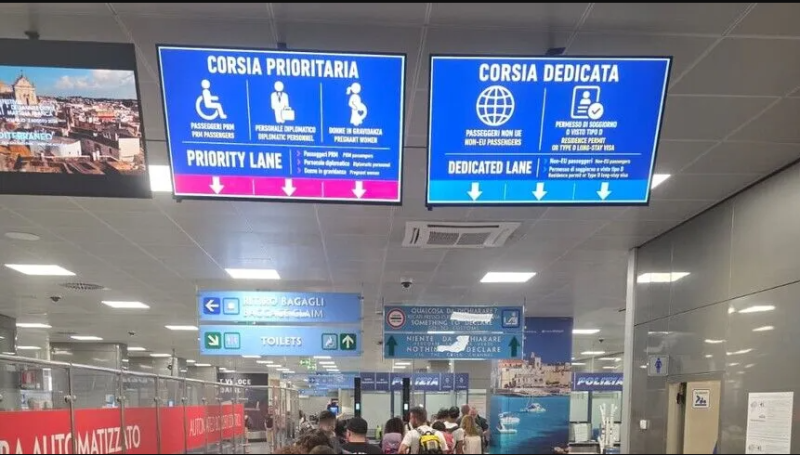
Spain will begin carrying out random identity checks on travelers arriving from Italy on Saturday, according to local media reports, after Rome refused to lift temporary border controls imposed following the recent migration crisis in the Spanish enclave of Ceuta.
The Spanish government said on Friday evening that checks at airports and ports would begin at midnight and remain in place until Sept. 7, according to Spain’s public broadcaster RTVE and other major outlets.
Travelers to Spain may be asked to present identification documents, including passports or residence permits.
The move came after Spain gave Italy until Sunday to remove its border checks or face what it called “proportionate measures.” Italy quickly rejected Spanish “ultimatums,” saying the controls would remain in force until at least Aug. 15.
Italian Prime Minister Giorgia Meloni’s government linked the border controls to Spain’s recent mass regularization of undocumented migrants and the migration crisis in Ceuta, where an estimated 72,000 people crossed into the North African enclave last week.
Foreign Minister Jose Manuel Albares described Italy’s border controls as “unjustifiable,” calling them an “attack on the dignity of Spaniards as well as European unity.”
“There is no reason whatsoever to introduce these measures,” Albares told reporters during a visit to Colombia, arguing that secondary movements of migrants from Spain to Italy are “practically zero.”
Madrid said that the Ceuta crisis does not threaten the Schengen area because the enclave has a special status requiring identity checks before anyone can travel onward to mainland Spain or the rest of Europe’s passport-free zone.
According to Spanish authorities, around 70,000 of the migrants who entered Ceuta last week have since returned to Morocco.
Spain also pointed to migration trends in Italy. Earlier Friday, the government said in a statement that Italy has experienced roughly twice as much irregular migration as Spain in recent years, arguing there was no objective basis for maintaining the border controls.
According to El Pais, Spain is arguing that higher levels of irregular migration in Italy justify its decision to introduce border checks.