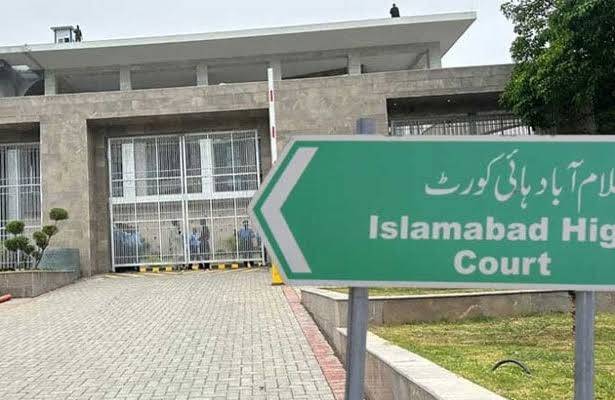
ISLAMABAD: The Islamabad High Court (IHC) has reserved its verdict on petitions seeking the transfer of three ordinary prisoners to private hospitals for medical treatment and permission to speak with their families abroad by telephone.
Justice Muhammad Asif reserved the verdict after hearing arguments from lawyers representing the petitioners, Advocate General Islamabad Naveed Hayat Malik and Advocate General Punjab Barrister Zafarullah.
Both advocate generals opposed the petitions seeking treatment for the three prisoners at private hospitals.
During the hearing, Advocate General Punjab said authorities were following the prison manual prepared during the British era, adding that changes were now being introduced to prison laws in Punjab.
Justice Muhammad Asif questioned what would happen if a prisoner developed a serious illness, observing that authorities could not compromise a prisoner’s health.
The court also questioned whether a prisoner who had no family members in Pakistan could be denied telephone contact with relatives abroad.
Barrister Zafarullah replied that authorities would follow the applicable law, adding that telephone conversations were permitted with people present in Pakistan.
Justice Asif asked where the law prohibited prisoners from speaking to family members living abroad.
The judge also raised questions about situations in which a prisoner might require a specialist doctor from another city or be in the final stage of a terminal illness. He further questioned whether a death-row prisoner’s final wish could be considered under the law.
Advocate General Islamabad Naveed Hayat Malik said the government’s position was not that prisoners should be denied medical treatment, stressing that prisoners also had fundamental rights.
He referred to Article 9, which guarantees life and liberty, Article 14, which protects dignity, and Article 25, which provides equality before law. He said prison rules also contain a complete mechanism for treating sick prisoners under Chapter 32.
According to the advocate general, medical officers examine prisoners and recommend appropriate treatment. He added that the medical officer’s opinion was also included in the report submitted by the Superintendent of Adiala Jail.
Malik argued that the petitioners had raised their personal wishes, but not every wish could be fulfilled.
He said the Pakistan Institute of Medical Sciences (PIMS) had highly qualified medical officers and was among the country’s leading hospitals. He maintained that neither the jail superintendent nor the medical officer had reported that the prisoners could not be treated at PIMS.
Justice Muhammad Asif, however, remarked that the condition of PIMS should be assessed to understand the hospital’s situation and advised the advocate generals of Islamabad and Punjab to visit the facility.
An unusual situation also arose during the hearing when a uniformed official entered the courtroom while the petitions were being heard.
The judge asked the official which case he had come for. The official said he was an affected party in a prisoner’s case and wanted to become a party through a miscellaneous application. The court directed him to take a seat.
After completion of arguments, the IHC reserved its verdict.