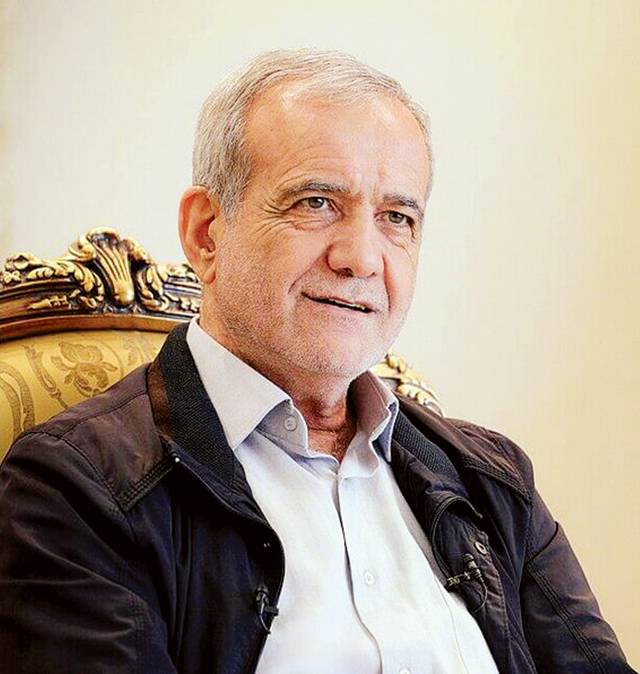
TEHRAN/Dubai – Iranian President Masoud Pezeshkian said on Thursday that Muslim states should not allow their territories to be used to launch attacks against other Muslim nations.
“Defending Iran does not mean hostility toward Muslim nations or neighboring countries,” Pezeshkian said in an address broadcast on Iranian state television during the 40th International Islamic Unity Conference in Tehran. “No Islamic country should allow its territory to be used as a launchpad for aggression against another Islamic country. No Islamic country should seek its own security through the insecurity of its neighbors,” he said.
Pezeshkian said that 57 member countries of the Organisation of Islamic Cooperation (OIC), from Southeast Asia to Africa, were “at the heart of vital sea and land routes with energy resources, young populations and a large market”.
He stressed that the economy of these countries in 2024 would be about 9.2 trillion dollars, which would account for only 8.3 percent of the world economy.
The president also said that only 19 percent of the member countries’ exports stayed within the group, while the rest went to countries outside the OIC, calling for more trade within the Muslim nations.
Referring to the conflict with the US, Pezeshkian said large-scale US and Israeli military attacks against Iran began while diplomatic efforts between Tehran and Washington to resolve their differences were still underway.
He said Iran-US negotiations had resumed that same month in an effort to find a diplomatic solution when the attacks began, killing Iranian commanders, officials, scientists, students, schoolchildren and civilians, as well as targeting cities and infrastructure.
The Iranian president said his country did not start the war in the region but “stood firmly against the aggressors”.
“The US and the Zionist entity launched a war on Iran,” he said.
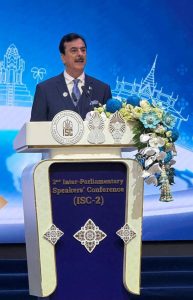
According to Iran’s state-run IRNA news agency, around 600 domestic and international guests from 40 countries, including Iraq, Pakistan, Turkey, Lebanon and Afghanistan, are attending the conference.
The conference will continue through Sunday, with events in Tehran, Qom and Mashhad, as well as four specialized meetings in West Azerbaijan, Kordestan, Golestan and Razavi Khorasan provinces.
White House press secretary Karoline Leavitt said Thursday there are no negotiations happening between the US and Iran right now.
“No negotiations are happening right now and this will continue until the president feels that maybe they come to the table in a meaningful way. We have not seen that yet,” Leavitt told Fox News.
The press secretary said the US is focused on putting economic pressure on Iran, an effort the White House has dubbed “Operation Economic Outcast.” She added that the president “continues to retain all options on the table.”
“We’ve had Operation Epic Fury to destroy their military. Now we have Operation Economic Outcast to destroy their economy,” Leavitt added.
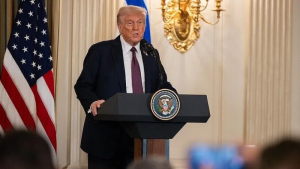
US President Donald Trump said the United States is not talking with Iran as Washington focuses on punishing Tehran economically, vowing to penalize countries that do business with the Islamic Republic.
“We don’t want to speak to them. We’re not looking to meet or anything,” Trump tells reporters in the Oval Office.
When asked if he would punish Russia for continuing to do business with Iran, Trump responds: “It depends. So far, I think Russia’s behaved quite well, having to do with the Strait of Hormuz, and you have to understand: for everything they do, we do also. You know, somebody was saying about China. What about China? We hear they’re spying. We spy on them too.”
Then when asked if he will sanction Chinese banks for doing business with Iran, Trump says: “Who said I’m not? You don’t know if I’m doing it… I don’t have to announce everything, do I?”
Qatar and Iran discussed a proposed phased framework that includes establishing a temporary joint shipping corridor with Oman through the Strait of Hormuz, Qatar’s foreign ministry says during a visit to Tehran by Qatar’s prime minister.
Qatari Prime Minister Sheikh Mohammed bin Jassim Al Thani visited Iran on Thursday, where he met with Foreign Minister Abbas Araghchi and discussed the emerging Hormuz agreement between Oman and Iran.