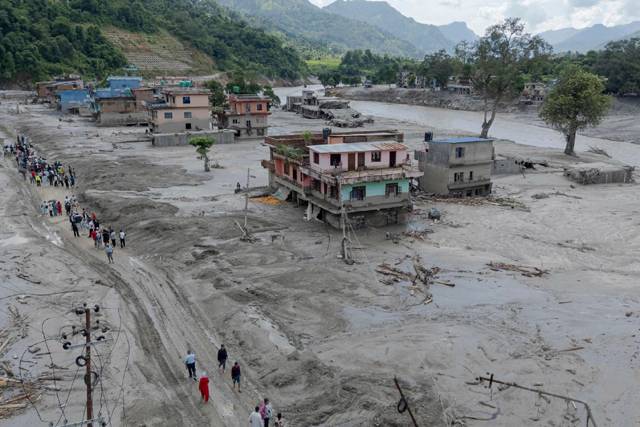
KATHMANDU, Nepal – Rescuers pulled out survivors caked in dark brown mud and helicopters lifted stranded people to safety Friday, as Nepal and China raced to respond to catastrophic flash floods that killed nearly 600 people and left almost 2,500 missing.
Rescue teams were put on high alert for more flooding from a new lake that formed high up on the Himalayan mountains after the initial floods on Wednesday. Experts warned that the lake, created after a glacier collapse that triggered the floods, was starting to overflow.
Nepal’s army was deployed to help rescue more than 100 people believed trapped inside a tunnel at a hydropower plant located in the country’s worst-hit district. Like elsewhere in the disaster zone, their work was complicated by thick layers of mud that covered the site.
The floods have killed 579 in Nepal, the country’s disaster-management authority said Friday. Nepali police later put the number of deaths at 553. There was little information on survivors on the Chinese side, where the death toll rose to five Friday as state media showed evacuations of villages and leaders’ efforts to direct the relief response.
More than 3,700 people have been rescued in Nepal so far. Meanwhile, the number of people who were unaccounted for in the country nearly doubled to 1,924 as more local residents were added to the tally. China’s state media previously said 558 people were missing on the Chinese side. Hundreds of the missing are foreigners in the area to work, trek or make a pilgrimage to a sacred peak.
Authorities warn of flooding from a new lake
Nepali police issued a fresh alert Friday after receiving information that a dam on the Tibet side had burst. Security personnel and rescue and relief workers were told to stay on high alert and immediately move to a safe location if necessary.
It was unclear if the dam bursting is related to flooding concerns over the lake that formed after the initial flash floods. Chinese broadcaster CCTV said the newly formed lake, located more than 10 kilometers (6 miles) from Gyirong Port, the hard-hit border crossing with Nepal, sits at an elevation of 2,950 meters (9,680 feet.)
Nepali and Chinese authorities earlier warned of more flooding from the lake, which was already overflowing. Rescue workers heading to the disaster zone were ordered to stop temporarily Friday due to concern the lake would release more torrents of water and debris, and people in potentially affected areas were urged to move to safer ground.
Some 680 rescuers eventually reached the hardest-hit area at Gyirong by foot and via rafts. Some were dropped down from drones flown to the area, CCTV footage showed.
Authorities in Nepal have been giving regular updates on the dead and missing from the devastating floods, but there remains uncertainty over them and the expectation they could rise much further.
In their latest update, the country’s national disaster agency said that 579 people had died, with 1,924 people missing, including 517 foreign nationals. This is a jump of nearly 1,000 missing from the previous update. Nepal police said earlier Friday that at least 547 people have died, and that 1,473 people are injured.
Later, monitoring data from the Chinese Ministry of Water Resources showed that the lake had dwindled in size. The water level dropped by 10 meters (32 feet) from the high point on Thursday morning, the state broadcaster said.
Nepali police spokesperson Abi Narayan Kafle told The Associated Press that the rescue operation was continuing.
Prime Minister Muhammad Shehbaz Sharif on Friday held a telephone conversation with Balendra Shah, Prime Minister of Nepal and conveyed heartfelt condolences on the tragic loss of lives and widespread devastation caused by the recent flashfloods and landslides in Nepal.
During the telephone call, the prime minister expressed complete solidarity with the Nepali leadership and people on behalf of the Government and people of Pakistan. He also offered whatever possible assistance was required at this difficult time.
The prime minister also conveyed to his Nepali counterpart that Pakistan was dispatching emergency relief assistance to Nepal in order to help with the relief efforts.
Prime Minister Balendra Shah thanked the PM Shehbaz Sharif for the telephone call and expression of solidarity and support in the wake of the natural calamity. He also expressed gratitude for the generous offer of assistance made by Pakistan.