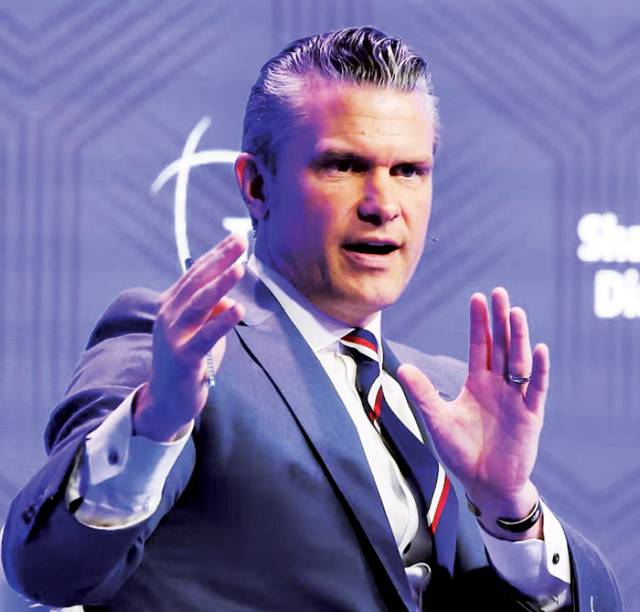
SINGAPORE/Dubai/Tehran – US Defense Secretary Pete Hegseth said on Saturday that Washington and Islamabad are developing what he described as a “true friendship,” pointing to the roles of Pakistan’s Army Chief, Field Marshal Asim Munir, and Prime Minister Shehbaz Sharif in facilitating peace negotiations.
Speaking at the 2026 Shangri-La Dialogue in Singapore, Hegseth made the comments while answering a question about India’s long-range missile systems, which are capable of reaching parts of Europe and the United States.
He noted that although he referenced India in his answer, he could just as easily have highlighted Pakistan, particularly the contributions of its military and political leadership to ongoing peace negotiations.
Hegseth added that this was a “somewhat unexpected development” and emphasised what he called a growing friendship between the United States and Pakistan, describing it as significant.
He also pointed to the US president’s role in helping facilitate peace efforts between India and Pakistan, both of which he noted are nuclear-armed nations.
The US is ready to restart attacks on Iran if a deal cannot be reached, Defense Secretary Pete Hegseth said on Saturday, as negotiators from Washington and Tehran worked to bridge major differences blocking an agreement.
“Our ability to recommence if necessary…we are more than capable,” Hegseth said in Singapore.
“Our stockpiles are more than suited for that, both there and around the globe, so we’re in a very good place,” he added.
As US President Donald Trump is still withholding any announcement on whether a possible peace deal has been reached with Iran, Defense Secretary Pete Hegseth told an international forum on Saturday that the “status as of right now is that any deal will be a good deal.”
Yesterday, Trump met with advisers in the White House Situation Room, where they discussed a tentative agreement that would open the Strait of Hormuz and start nuclear talks with Iran.
And in Tehran, there’s been little official reaction to the demands made by Trump on Friday for the tentative agreement.
The US military is ready to resume combat in the Gulf if required and is more strongly placed to do so than on day one of the conflict, according to US Defense Secretary Pete Hegseth.
“We’re focused on being postured and prepared to re-engage if we have to,” Hegseth said during a visit to Singapore on Saturday, but US President Donald Trump would prefer not to.
The president’s goal was that Iran must not be capable of having a nuclear weapon, Hegseth said, and “those goal posts haven’t shifted at all.”
He said that the Iranians “are coming in our direction. The talks have been productive. I think they know where it needs to go.”
“They want to say that they control the strait (of Hormuz) but we do,” Hegseth added.
Trump is being patient in making sure any peace pact with Iran ensures that it will not acquire a nuclear weapon, Hegseth said in a question-and-answer session after a speech to the Shangri-La Dialogue in Singapore.
“I had a chance to talk to President Trump this morning. He wanted me to reiterate how patient he is in ensuring that with America undertaking this kind of historic endeavor, any deal will be a good one, a great one, and he’s patient in the pursuit of that,” Hegseth said.
“If Iran doesn’t want to make a great deal that ensures they don’t get a nuclear weapon,” then Iran can “deal with” the US military, Hegseth said.
Asked later by a reporter about his comment that “any deal will be a good deal,” Hegseth responded: “I love the disingenuous questions from the disingenuous press. I said it will be a good deal.”
The US defense chief said American forces are fully prepared to resume hostilities if so ordered, and that weapons stockpiles are enough to get the job done.
US War Secretary Pete Hegseth said the naval blockade on Iran remains in place and warned Tehran that Washington is ready to use military force again if diplomacy fails to produce a deal preventing Iran from obtaining a nuclear weapon.
“The blockade is very much still in place,” Hegseth said in Singapore, adding that the Strait of Hormuz had come up repeatedly in talks with US partners.
He said any eventual outcome, whether through agreement or continued pressure, must leave the Strait of Hormuz open and free of tolls.
“Once a deal is had or not, depending on the choice they make, it will be an open strait, a toll-free strait that the entire world can use, which is the way that it should be,” Hegseth said.
Hegseth said Iran claims to control the waterway, but argued that US military pressure had shaped the negotiating dynamics.
Meanwhile, the US military has disabled another merchant vessel attempting to enter an Iranian port despite an American naval blockade, The Associated Press reported Saturday, citing a US official familiar with the operation. The Gambia-flagged bulk carrier Lian Star ignored repeated overnight warnings from US forces as it moved toward an Iranian port, the official said on condition of anonymity to discuss military operations.
US aircraft disabled the vessel in the Gulf of Oman, leaving it adrift, the official said, adding that American forces had not boarded the ship.
The incident brings to six the number of ships stopped by the US military while attempting to breach the blockade. One vessel was allowed to continue.