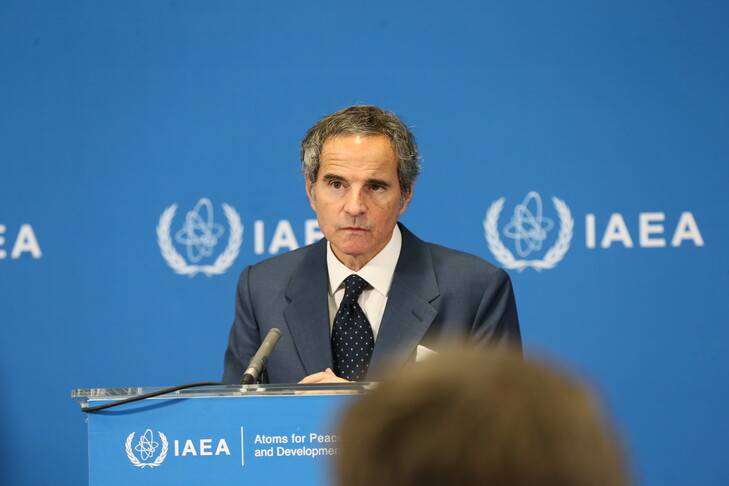
International Atomic Energy Agency (IAEA) Director General Rafael Grossi described Iran’s criticism of his handling of the country’s nuclear file as a “political reaction,” urging diplomacy and dialogue.
Speaking at a press conference Monday following a meeting of the IAEA Board of Governors in Vienna, Grossi responded to remarks by Iranian Foreign Ministry spokesman Esmaeil Baqaei, who had accused him of adopting a political and irresponsible approach and criticized him for not condemning US and Israeli attacks last June on Iran’s nuclear facilities.
“I have nothing to say. This is a political reaction, and the Iranian ambassador and the Iranian mission are in their right to have their view about all of this, about my reports. Obviously I do not share that view. My view is in my reports,” Grossi said.
“I think at the end of the day, this is something I have been repeating: There must be a political dialogue. There must be a diplomatic agreement. This is what we believe in and what we are trying to support,” he added.
Addressing questions about Iran’s nuclear activities, Grossi cautioned against drawing conclusions about whether Tehran was pursuing nuclear weapons, noting that the agency has lacked access to key facilities for nearly a year.
“We have never said that they were doing that,” he said, referring to allegations that Iran is developing a nuclear weapon.
He said the agency’s ability to assess the situation has been limited since inspectors lost access to crucial sites following the outbreak of the 12-day war between Iran and Israel nearly a year ago.
“What is important is to establish very clearly the fact that Iran is in full compliance with its obligations under the Non-Proliferation Treaty (NPT),” Grossi said, adding that such compliance would allow the agency to verify that there had been no diversion of nuclear material or other illicit activities.
Asked whether Washington and Tehran could reach an agreement on restrictions or nuclear material without a technical assessment by the IAEA, Grossi said they were free to negotiate any arrangement they chose but warned that an accord lacking verification would have little credibility.
“An agreement without proper verification is an illusion of an agreement. It’s a piece of paper, and you don’t know whether the terms of it are being complied with. So I think there is recognition that the IAEA must be playing a very, very important role,” he said.