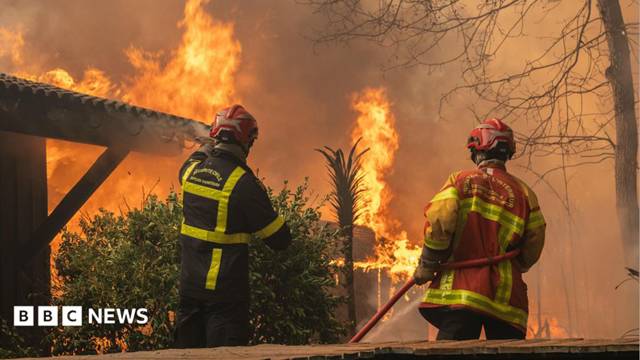
PARIS – More than 250,000 people have been evacuated in France and Spain as wildfires tear through southwest Europe. Fires have also erupted in parts of Italy and Scotland. Spanish Prime Minister Pedro Sanchez says this weekend presents a “window of opportunity” to tackle the wildfires, and weather conditions are becoming more favorable for emergency crews. Authorities in France deployed a huge military cargo plane to battle the flames and more international aid is on the way. The fires have spread thick smoke across parts of the continent, evacuations have snarled traffic, and the final stage of the Tour de France has been shortened.
The fires are fueled by climate change-driven heat waves. Hotter, drier weather has set the stage for fiercer fire seasons as it parches the landscape. An abnormally wet winter in Europe — with long-lasting rain and frequent storms in January and February — is likely a factor in the wildfires. The high moisture during winter would have spurred growth in grasses, brush and other vegetation. Then temperatures turned record-hot in Western Europe in May, just as France and Spain’s precipitation fell off a cliff, leading to drought. Because the rain stopped at the exact same time temperatures surged, the moist soils dried out at unprecedented speeds. This phenomenon is sometimes referred to as a “flash drought,” or one that takes hold very fast. Research shows the warming effect of climate pollution has significantly increased the frequency and extent of flash droughts in Europe. The hotter atmosphere acts like a dry sponge that greedily soaks up soil moisture, creating the drought that fuels wildfires. Raging wildfires have driven more than 250,000 people to evacuate from their homes in France and Spain. Europe is experiencing more wildfires than normal this summer after scorching temperatures dried out the vegetation so much that the landscape is like a tinderbox. After a record-hot summer across many parts of France and Spain, Mother Nature is finally providing some temporary relief.
Bordeaux, France, reached a high temperature Friday in the upper 30s Celsius (near 100 Fahrenheit), but dropped back to the upper 20s Saturday and is expected to be in the mid 20s on Sunday, providing relief to crews battling wildfires across the region. Winds will also improve, peaking at just 10 to 15 kph (under 10 mph) this weekend, giving crews a generous window to increase fire containment numbers. There is a chance of rain showers across portions of France and Spain this weekend. While the chances are low, any rainfall that reaches the affected areas could provide additional help in suppressing the fires.