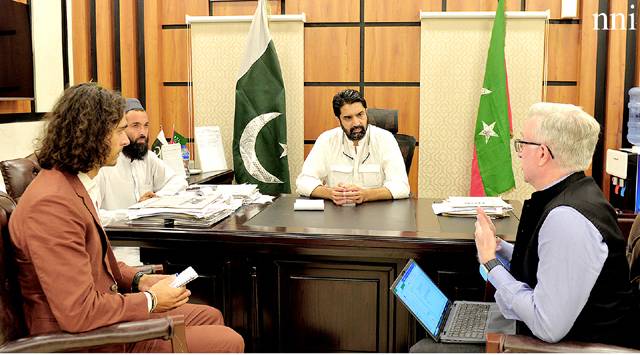
Peshawar – Khyber Pakhtunkhwa Minister for Public Health Engineering, Fazal Shakoor Khan, held an important meeting with a high-level delegation of the World Bank at his office. The delegation was led by Carlo Emidi and Robert Wrobel, while Project Director Adnan Ahmad also attended the meeting.
The meeting focused on the progress of the Khyber Pakhtunkhwa Rural Investment and Institutional Support Programme (KP-RIISP), a mega initiative being implemented in the merged districts.
Participants reviewed the overall progress of the programme, ongoing development schemes, effective utilization of funds, future implementation strategy, and measures to ensure the timely completion of projects.
The World Bank delegation was given a comprehensive briefing on the ongoing projects aimed at providing safe drinking water, modern sanitation services, improving rural infrastructure, and expanding access to essential public services across the merged tribal districts. Both sides agreed to further accelerate the pace of implementation so that local communities could benefit from these projects at the earliest.
The delegation appreciated the progress achieved under KP-RIISP, expressed satisfaction with the performance of the Public Health Engineering Department(PHED), and reaffirmed the World Bank’s commitment to continuing its support for the programme.
On the occasion, Fazal Shakoor Khan requested the World Bank to expand the scope of KP-RIISP beyond the merged tribal districts to include the settled districts of Khyber Pakhtunkhwa, enabling more communities across the province to benefit from improved water supply and modern sanitation services.
The meeting also included detailed discussions on climate resilience and flood mitigation in light of recent flood-related challenges.
The minister urged the World Bank to extend financial and technical support for the construction of flood protection embankments and other related mitigation projects, particularly in district Charsadda, to help minimize future flood risks and protect vulnerable communities. He said that providing safe drinking water and modern sanitation facilities to the people of the merged tribal districts remains a top priority of the Khyber Pakhtunkhwa government. He said that KP-RIISP would play a vital role in improving public health standards, expanding access to essential services, and bringing sustainable and long-term improvements to the lives of the people.
The meeting also emphasized the importance of ensuring timely completion of all projects, maintaining transparency, strengthening monitoring mechanisms, and implementing all activities in accordance with international standards.
The minister directed the concerned authorities to ensure that all development schemes are completed within the stipulated timeframe while maintaining the highest standards of quality and transparency to maximize public benefit.
Concluding the meeting, the minister reaffirmed the commitment of the current Khyber Pakhtunkhwa government to working closely with the World Bank and other development partners to further strengthen initiatives related to safe drinking water, sanitation, public infrastructure, and climate resilience, with the objective of achieving sustainable development and improving the quality of life for the people of the province.