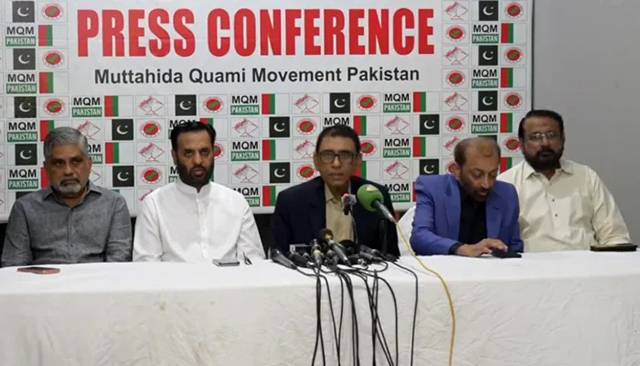
KARACHI – Muttahida Qaumi Movement-Pakistan (MQM-P) Chairman Khalid Maqbool Siddiqui on Sunday called for a grand national dialogue on the creation of new provinces and administrative units, arguing that Pakistan’s existing administrative structure no longer corresponds to its population, governance requirements and growing development challenges.
Addressing a press conference alongside senior party leaders Dr Farooq Sattar and Mustafa Kamal, Siddiqui said political parties should rise above partisan differences and develop consensus on administrative restructuring. “There is a need for a major national dialogue, and we are going to initiate it,” he said, adding that the MQM-P would approach political parties and other stakeholders to build agreement on the creation of new provinces where required.
Siddiqui said Pakistan had a population of around 30 million at independence in 1947 but now had roughly 250 million people, while the country continued to have only four provinces. He noted that successive governments had created numerous districts and divisions but avoided a broader debate on provincial reorganisation.
He argued that the existing provinces, originally formed largely along linguistic lines, had become too large to provide effective governance.
“The effects of not creating new provinces should also be discussed,” he said, maintaining that administrative boundaries should reflect population size and governance needs.
Siddiqui said Sindh was among the areas where the demand for additional administrative units was strongest, but rejected the perception that the proposal was aimed at dividing the province along ethnic lines.
He pointed out that the Constitution itself provides a mechanism for creating new provinces. “If it is considered an act of disloyalty, then why does the Constitution provide for it?” he asked.
The MQM-P chairman said the party had already introduced a constitutional amendment bill concerning the creation of provinces in the National Assembly. The bill, he said, had been referred to a standing committee but had not yet been taken up.
He said the MQM-P would continue pursuing the matter through political and constitutional channels and could approach the Supreme Court again if constitutional and legal obligations remained unfulfilled.
A major focus of the party’s campaign would also be Article 140-A of the Constitution, which requires provinces to establish local governments and devolve political, administrative and financial authority to elected representatives.
Siddiqui said the 18th Amendment was supported by the MQM-P partly to ensure that the benefits of devolution reached citizens at the grassroots level. He argued that provincial autonomy could not achieve its intended purpose without meaningful local government systems.
Mustafa Kamal said the creation of additional administrative units was not directed against Sindhis or any other ethnic group but was intended to give people greater control over their own affairs.
“Creating administrative units is not against Sindhis; it is for Sindhis,” he said.
Kamal argued that Karachi and Hyderabad represented a substantial share of Sindh’s population but lacked corresponding political and administrative authority. He said a new administrative arrangement could enable residents to elect governments capable of directly addressing problems involving water, sanitation, waste management and other civic services.
He also criticised the condition of public services in Karachi and rural Sindh, citing water shortages, open drains, road accidents, dog-bite incidents and other problems. He said residents of rural areas continued to face serious deprivation, including difficulties in accessing clean drinking water.
Kamal argued that the issue was not simply a shortage of financial resources but the concentration of authority at the provincial level.
He rejected the argument that the proposed restructuring would involve transferring territory between provinces.
“Not an inch of Sindh’s land is going into another province, and not an inch of another province is being brought into Sindh,” he said, describing the proposal as an administrative rather than territorial division.
Farooq Sattar said additional administrative units had become essential for Pakistan’s survival, development and stability. He argued that governance involving smaller units would bring decision-making closer to citizens and make elected representatives more accountable.
He suggested that existing divisions such as Larkana, Sukkur and Mirpur Khas could be converted into administrative units with their own elected leadership and institutions.
Sattar also criticised what he described as feudal and hereditary political structures, arguing that the concentration of political and administrative power had contributed to poor governance and deprivation.
“Those who practise hereditary politics” were, he said, among the major obstacles to improving governance in Sindh.
Siddiqui said the MQM-P would centre its future political demands and mobilisation around two issues: creation of new administrative units and implementation of Article 140-A.
The proposal has, however, encountered strong opposition from the Pakistan Peoples Party, which governs Sindh and is a key coalition partner of the Pakistan Muslim League-Nawaz.
Senior government figures have also stopped short of endorsing the proposal.
Interior Minister Mohsin Naqvi, whose earlier remarks about Pakistan’s “collapsed” governance structure triggered renewed debate over administrative reforms, later clarified that he was not issuing a criticism of the present government. He said the existing system would complete its constitutional term and that his remarks referred to the gradual erosion of administrative and institutional capacity over decades.
Prime Minister’s Adviser on Political Affairs Rana Sanaullah said the government had not formulated any plan to create new provinces. He said several proposals were being discussed publicly, ranging from 12 to 20 or more provinces, but questioned whether there was sufficient public demand for such restructuring. He said the PML-N leadership had not recently discussed the matter.
The proposal has nevertheless received support from some political quarters. Istehkam-e-Pakistan Party President Abdul Aleem Khan backed the creation of new provinces, including South Punjab and Bahawalpur, describing the issue as a national matter that should not be sacrificed for political expediency.
PTI Chairman Barrister Gohar Ali Khan also supported the idea of additional administrative units but stressed that any restructuring must be based on broad political consensus and carried out through the constitutional process, including the required two-thirds majority in the relevant assemblies.
The PPP, however, remains firmly opposed to the creation of new provinces in Sindh.
Sindh Information Minister Nasir Hussain Shah criticised the MQM-P’s demand, describing it as a product of political frustration and isolation. He said the party should focus on addressing public issues rather than seeking administrative changes.
Shah rejected the proposal to alter Sindh’s administrative structure and said the people of Karachi stood with the PPP and supported peace, development and stability.
With political positions sharply divided, the MQM-P’s proposed national dialogue is likely to bring the question of provincial restructuring back to the centre of Pakistan’s political debate.
At its core, the argument is no longer simply about creating more provinces. It is about whether Pakistan’s administrative structure, designed for a much smaller population, can continue to deliver effective governance in a country of roughly 250 million people.
The next challenge will be building the political consensus required to translate that debate into constitutional reform.