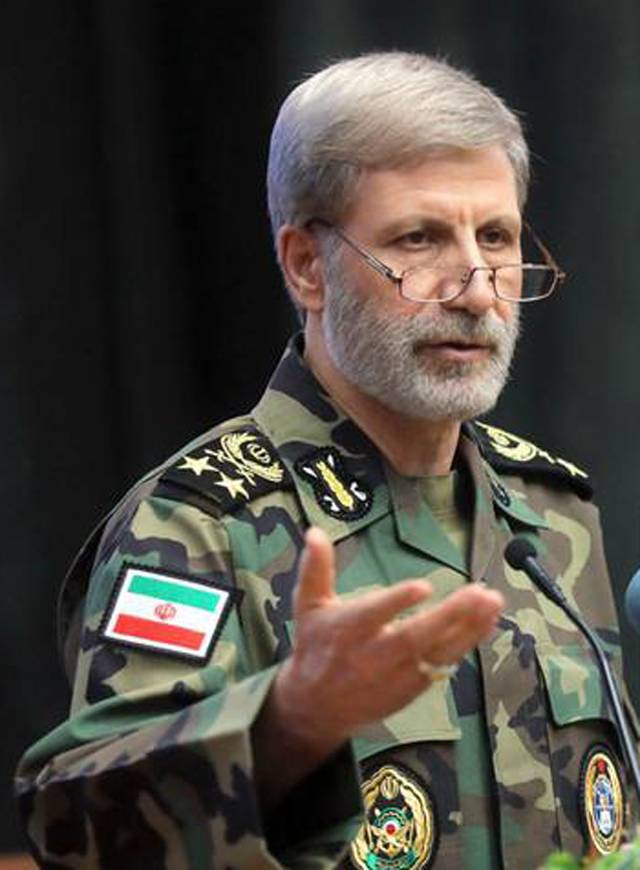
TEHRAN/Washington – Iran’s Army Chief Major General Amir Hatami on Sunday warned the United States against any attempt to claim control over the strategic Strait of Hormuz, saying Tehran would defend the waterway with all its strength.
“You are very wrong,” Hatami said, warning that even joking about annexing the strait would be a “massive mistake”. He described Hormuz as a “divine geopolitical capacity” for Iran and said it would not return to its previous status.
Speaking at a ceremony marking National Journalists’ Day, Hatami said activating Iran’s geopolitical leverage over the strait was necessary to remove the threat of war from the country. He also claimed that Iranian forces had struck the US aircraft carrier USS Abraham Lincoln at least once, temporarily grounding its fighter jets.
Hatami separately announced a financial reward for anyone who kills or captures a US soldier involved in an act of aggression against Iran. Under the scheme, he said, the person would receive five billion tomans, equivalent to about $30,000. Iranian women carrying out such an action would receive double the reward. He said the initiative had been launched following requests from citizens wishing to financially support Iran’s armed forces, with public crowdfunding being used to support defence operations. The announcement came as Iran’s Armed Forces General Staff vowed to continue resisting the United States and Israel until what it called the “complete defeat” of its enemies and the fulfilment of the Iranian people’s demands.
In a statement marking the anniversary of the return of Iranian prisoners of war following the 1980-88 Iran-Iraq War, the General Staff praised veterans and former prisoners, saying their experience represented resistance, self-reliance and national resilience.
The statement said the legacy of the war had been passed to a new generation that continued to resist US military power and foreign pressure. It also praised public support for the armed forces and pledged that the military would not retreat from what it described as the legitimate demands of the Iranian people and leadership.
Iranian parliament speaker and top negotiator Mohammad Bagher Ghalibaf, meanwhile, said Iran had achieved a “true victory” in its war with the United States, describing the Islamabad Memorandum of Understanding as a diplomatic victory.
President Masoud Pezeshkian also said the agreement with the United States had been reached with “dignity” and “strength”.
Iran has simultaneously been seeking to strengthen its position around the Strait of Hormuz. Parliament was due to examine a “Smart Management Plan” for the strategic waterway, along with legislation concerning foreign influence and international crimes.
Foreign Ministry spokesman Esmaeil Baghaei said Saturday that Iran had reached an agreement with Oman on a shipping route map for the Strait of Hormuz following weeks of technical negotiations.
The waterway remains a critical global energy route, and any prolonged disruption could have major consequences for international oil and shipping markets.
Iranian military officials have also made claims about the country’s military resilience following the recent conflict. An Islamic Revolutionary Guard Corps official said more than 85 per cent of the force’s air-defence production capacity remained undamaged during the war.
According to the official, missile and air-defence production had not fallen below pre-war levels despite attacks on military production infrastructure, while production in some areas had increased.
Meanwhile, tensions with neighbouring Gulf states have added another layer to the regional crisis.
Mohammad Baqerzadeh, commander of Iran’s Committee for the Search for Missing Persons, called on Qatar to allow an Iranian expert and fact-finding team into the country to investigate the fate of Iranian pilots whom Tehran says were captured by Qatari forces.
Doha said its search-and-rescue teams had recovered the remains of one pilot after Iranian aircraft violated Qatari airspace in March and failed to respond to repeated attempts at contact.
Qatar said it had contacted Iran to coordinate the handover of the remains and invited Tehran to examine details of the search operation. Iranian officials, however, accused Doha of repeatedly delaying the investigation.
Baqerzadeh also urged the International Committee of the Red Cross to intervene and said Kuwait was withholding information about four Iranians held there. Iran says the four were affiliated with the Revolutionary Guards and entered Kuwaiti waters because of a navigation problem, while Kuwait has accused them of suspected hostile activities.
In another significant development, Iran’s parliament approved a bill criminalising interviews and other communications with media outlets deemed hostile to the Islamic Republic, including US and Israeli media.
The bill, which still requires approval by the Guardian Council, would impose prison terms of six months to two years for prohibited interviews or participation in discussions. Contacts with other foreign media would require notification to the intelligence ministry.
The legislation would also tighten penalties for certain economic and security-related activities involving foreign entities and impose restrictions on some scientific cooperation with foreign institutions.
Separately, Saudi Arabia’s civil defence agency issued an alert warning of “potential danger” in the southern Jazan province along the border with Yemen, an area that has previously been targeted by Houthi rebels.
The warning adds to concerns that the wider regional confrontation could spread beyond the immediate US-Iran theatre.
With Tehran simultaneously hardening its rhetoric, strengthening its military posture and asserting greater control over Hormuz, the strategic waterway remains at the centre of the escalating confrontation.
Iran’s message is increasingly clear: it considers the strait a core instrument of national power and is prepared to use it as leverage against any future military threat.