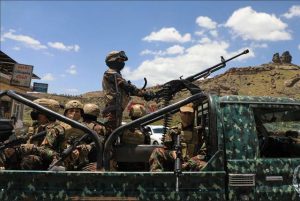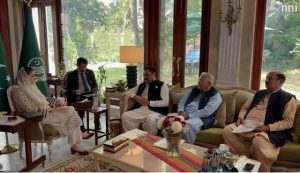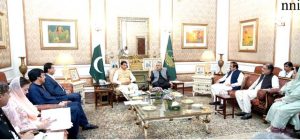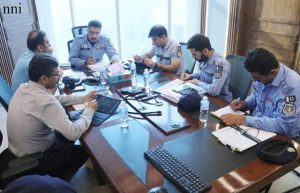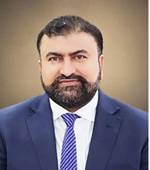
QUETTA – Balochistan Chief Minister Mir Sarfraz Bugti said Saturday that the fight against terrorism in Balochistan would continue until the last terrorist had been eliminated from the province, and that the civilian government and the military leadership were in full agreement on how to prosecute it.
“There is no ambiguity or confusion on this matter,” Bugti said, speaking by video link to anchors, senior journalists and representatives of the national media gathered at the Chief Minister’s Secretariat in Quetta. Security forces were operating under difficult conditions across the province, he said, and state institutions were working in close coordination against terrorism. He ruled out any negotiated settlement with terrorists.
“There will be no talks with those who take up arms against the state,” the chief minister said. No state in the world, he added, held dialogue with separatists.
His remarks came at the end of a long session with journalists, following a sequence of detailed provincial government briefings on security, missing persons, police and Counter Terrorism Department reform, development spending and the province’s mineral resources.
Bugti said terrorism was not a problem confined to Balochistan but a challenge facing Pakistan as a whole, and one that required a coordinated national response rather than a provincial one.
The Home Department briefing was delivered by Balochistan Home Secretary Muhammad Hamza Shafqaat, in a detailed and well-organized presentation covering counterterrorism, police reform, missing persons, extortion, the Safe City projects and law-enforcement capacity.According to the figures Shafqaat presented, the Commission of Inquiry on Enforced Disappearances has received 1,175 applications concerning missing persons since 2011.
Of those, 556 people were traced. The government said 506 of them had returned home safely, while the bodies of 50 were recovered. A further 337 cases were categorized as irrelevant, fake or incomplete and were deleted from the record, and production orders were issued in 101 cases.
That leaves 282 people still missing from the cases the commission has received, according to the presentation.
Bugti said the missing-persons issue had at times been presented by the national media and at other forums without the necessary context, producing what he described as an incomplete picture of the situation on the ground.
Shafqaat’s briefing also set out a significant expansion in the capabilities of the provincial police and the CTD. Officials said Rs10 billion had been allocated for CTD enhancement, and that the force had inducted two anti-drone systems, 18 SAVS devices and 76 drones. Around 3,000 personnel had been trained.
Officials said the additional equipment would give provincial formations greater capacity to carry out counterterrorism, surveillance and counter-drone operations.
The Home Department also reported 21 extortion cases entered in the provincial register, with FIRs registered in 13 of them. Seven regions had been affected. Officials linked some of the extortion activity to terrorist financing, and said mining businesses, contractors and other commercial interests were among those being targeted.
Bugti also addressed the political speculation surrounding his government, saying he was unaware of any agreement under which the provincial government would change hands after two and a half years.
Any decision on a change of government would be taken by the political leadership, he said, adding that he would continue serving the people of the province for as long as he remained in office.
On the administrative structure of Balochistan, Bugti said it was not possible to govern the whole of it effectively from Quetta. If new provinces were to be created within Balochistan, he said, they should be established on administrative rather than ethnic grounds.
On corruption, Bugti said he could not claim it had been eliminated, but maintained that it had declined compared with the past. The government was taking steps to enforce merit in educational institutions and in other provincial departments, he said.
Development projects were being completed in record time compared with previous years, he said, and the provincial government was trying to make its development spending more effective, more results-oriented and more responsive to what the public actually needed.
A separate presentation on the mineral sector laid out the scale of investment the provincial government expects as its major projects move toward development.
Officials said more than $15 billion in mining investment was projected for Chagai alone over the next seven years.
More than 80 minerals have been discovered across Balochistan, the presentation said, with over 20 currently in commercial production. The province has issued 2,147 mineral titles, and more than 300,000 people were described as associated with its mining industry.
Western Chagai alone was estimated to contain more than six billion tonnes of copper and gold resources, according to the presentation.
The government identified five principal mineral corridors running across the province: Chagai-Dalbandin, Muslim Bagh-Qila Saifullah-Zhob, Harnai-Loralai, Kharan-Washuk and Khuzdar-Lasbela.
Chagai was presented as the center of Balochistan’s strategic mineral potential, with deposits of copper, gold, silver and iron ore, and with the major projects — Reko Diq, Saindak and Siah Dik — all located there.
At Reko Diq, officials projected eventual annual output of around 400,000 tonnes of copper and 500,000 ounces of gold, with processing capacity reaching about 90 million tonnes a year by the end of the project’s second phase.
The ownership structure shown to journalists put Barrick Gold at 50 percent, Pakistani state-owned enterprises at 25 percent and the Balochistan government at 25 percent, including a 10 percent free-carried interest.
The Siah Dik copper project was estimated to contain 880 million tonnes of mineral resources, with planned annual processing capacity of 19.8 million tonnes. Investment in the project was put at approximately $2.04 billion.
Officials also drew attention to mineral resources outside Chagai, among them lead and zinc, antimony, manganese, chromite, iron ore, coal, barite, fluorite and marble, spread across different parts of the province.
Bugti said the provincial government wanted Balochistan’s mineral wealth to translate into greater economic benefit for the people who live above it.
Turning to the repatriation of foreign nationals, the chief minister said around 1.1 million Afghan refugees and other foreign nationals had been sent back to their countries from Balochistan.
Journalists were also briefed on the Provincial Action Plan, police reform, the merger of the Levies Force into the police, the Safe City projects and measures intended to improve coordination among law-enforcement agencies in the province.