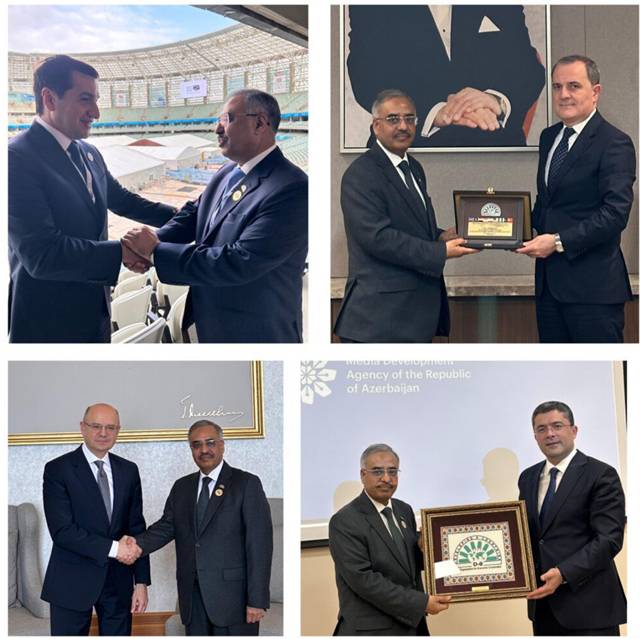
ISLAMABAD – Secretary-General of the D-8 Organization for Economic Cooperation Ambassador Sohail Mahmood undertook his first official visit to Azerbaijan since assuming office in January 2026, participating in the 13th Session of the World Urban Forum 13 and the D-8 High-Level Energy and Urban Dialogue held in Baku from May 17 to 20.
The visit, made at the invitation of Azerbaijani President Ilham Aliyev, underscored the growing cooperation between Azerbaijan and the D-8 bloc as well as the organization’s increasing focus on sustainable urbanization, renewable energy and climate resilience, said an official statement issued here yesterday. During the visit, Ambassador Sohail Mahmood attended high-level sessions of WUF13, jointly organized by the Government of Azerbaijan and the United Nations Human Settlements Programme under the theme “Housing the World: Safe and Resilient Cities and Communities.” The forum brought together heads of state, ministers, mayors, urban experts and development stakeholders from across the globe to deliberate on the future of inclusive and sustainable cities, with more than 40,000 participants registered for the event.
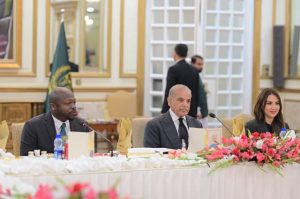
The successful hosting of WUF13 marked another major diplomatic milestone for Azerbaijan following its organization of COP29 in 2024, reinforcing the country’s expanding role as a global platform for multilateral dialogue on climate action, sustainable development and urban transformation. On the sidelines of the forum, the D-8 Secretariat organized a High-Level Energy and Urban Dialogue at the Azerbaijan Pavilion under the theme “Powering Sustainable Cities in the D-8 Region: Aligning Energy Transitions with Urban Development Agendas.” The dialogue brought together ministers, deputy ministers, mayors, senior officials, experts and development partners from D-8 member states to discuss the intersection of renewable energy, sustainable urbanization, smart infrastructure and climate resilience.
In his keynote address, Ambassador Sohail Mahmood stressed that urbanization and energy transition could no longer be treated as separate policy areas and must instead be viewed as interconnected development priorities. He observed that cities account for more than 80 percent of global GDP, nearly 70 percent of global energy consumption and over 70 percent of energy-related greenhouse gas emissions, making sustainable urban planning and clean energy transitions central to future development strategies.
Highlighting the collective strength of D-8 countries, the Secretary-General said the bloc’s combined population of 1.28 billion and GDP exceeding $5 trillion provided immense potential for shaping sustainable urban futures through renewable energy, strategic connectivity and youthful demographics. He also emphasized the need to bridge the financing gap for climate-smart infrastructure in developing countries by enhancing access to concessional finance, technology transfer and equitable international partnerships. He underlined that a “just transition” must remain people-centered, with particular attention to urban youth, low-income communities, green jobs and inclusive service delivery.
Ambassador Sohail Mahmood proposed a five-pronged framework for cooperation among D-8 member states, focusing on integrated urban energy planning, digital governance and smart technologies, stronger South-South cooperation, investment in climate-resilient infrastructure and coordinated positioning on international platforms. He suggested initiatives such as “Sustainable D-8 City of the Year,” “D-8 Green Capital,” and “D-8 Clean Energy Capital” to encourage innovation, recognize best practices and promote leadership in sustainable urban transformation across the D-8 region.
A key outcome of the visit was progress toward operationalizing three D-8 Centers of Excellence in Baku focusing on Energy and Climate, Transport, and Media. The centers are expected to serve as institutional platforms for policy dialogue, research collaboration, technical cooperation and capacity-building among member states in areas including renewable energy, connectivity, climate resilience and sustainable development.
During his stay in Baku, the D-8 Secretary-General also held a series of high-level meetings with senior Azerbaijani officials. In talks with Hikmat Hajiyev, Assistant to the President and Head of the Department of Foreign Policy Affairs, discussions focused on Azerbaijan’s expanding role within the D-8 framework and the organization’s future strategic direction. He also met Azerbaijani Foreign Minister Jeyhun Bayramov to discuss broader D-8–Azerbaijan cooperation, institutional reforms within the organization and preparations for the 12th D-8 Summit in Jakarta. The two sides exchanged views on enhancing the institutional and financial capacity of the D-8 Secretariat and Azerbaijan’s accession to key D-8 legal frameworks. In a separate meeting with Energy Minister Parviz Shahbazov, discussions centered on the establishment of the proposed D-8 Energy and Climate Center in Baku and preparations for the first meeting of D-8 Energy Ministers scheduled for June 1, 2026. The talks also explored cooperation in renewable energy investment, energy security, sustainable financing and climate resilience initiatives. The Secretary-General additionally met with Ahmad Ismayilov, Executive Director of Azerbaijan’s Media Development Agency (MEDIA), where discussions focused on operationalizing the Media Excellence Center and strengthening media cooperation among D-8 member states through professional exchanges, media literacy initiatives and joint communication platforms. According to the D-8 Secretariat, the visit reflected the high importance Azerbaijan attaches to its D-8 membership and highlighted the country’s growing contribution to the organization’s initiatives. The D-8 High-Level Energy and Urban Dialogue also provided an opportunity for member states to project a collective vision for sustainable development and practical regional cooperation in the areas of urban transformation and clean energy transition.