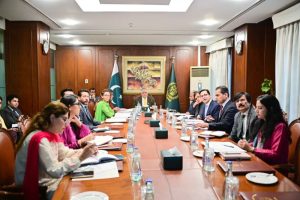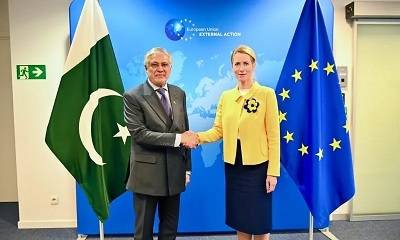
Kaja Kallas arrived in Pakistan on Monday to participate in the eighth session of the Pakistan-European Union Strategic Dialogue, the highest-level forum for structured engagement between the two sides.
According to the Foreign Office, Deputy Prime Minister and Foreign Minister Ishaq Dar and Ms Kallas will co-chair the dialogue in Islamabad.
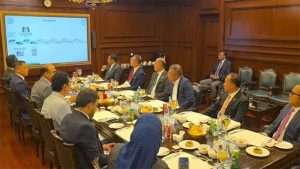
The EU’s top diplomat was received by Ishaq Dar upon her arrival. State-run broadcaster PTV News aired footage of her welcome at the Ministry of Foreign Affairs and meetings with officials.
During her visit, Ms Kallas, who also serves as vice president of the European Commission, is scheduled to meet Asif Ali Zardari, Shehbaz Sharif and Asim Munir.
In a statement, the EU said the dialogue would provide an opportunity to review bilateral relations under the Strategic Engagement Plan signed in 2019 and discuss avenues for further cooperation. A joint press conference by Ms Kallas and Mr Dar is also scheduled following the talks.
The Foreign Office said Pakistan attached great importance to its longstanding and multidimensional partnership with the European Union, which is based on shared interests, economic cooperation and support for multilateral engagement.
Ms Kallas is also expected to meet representatives of think tanks and academia as part of the EU’s broader engagement with policymakers, researchers and civil society stakeholders in Pakistan.
Her visit comes as Pakistan and the European Union continue cooperation in areas including trade, development, climate action, migration and regional stability, with both sides seeking to strengthen ties through regular high-level contacts and institutional dialogue.
The European Union remains Pakistan’s second-largest trading partner. Under the GSP+ arrangement, many Pakistani exports enjoy duty-free or preferential access to European markets.
Pakistan obtained GSP+ status in January 2014 after ratifying 27 international conventions and committing to their implementation. Since then, bilateral trade has expanded significantly, with exports to the EU more than doubling and overall trade volumes showing substantial growth.
Pakistani exports benefiting from the scheme include garments, bed linen, terry towels, hosiery, leather products, sports goods and surgical instruments.