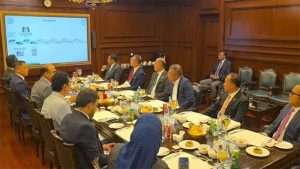
ISLAMABAD – Talks for concessions with Chinese IPPs under China Pakistan Economic Corridor (CPEC) are ongoing, but no breakthrough yet, said Power Minister Awais Leghari. While addressing a news conference here Sunday, Federal Minister for Power Division said that installed capacity of net-metering solar and off-grid solar is 31240 MW, and it is estimated to expand to 50,000 megawatts in 10 years despite a shift from the net-metering mechanism to net-billing.
Currently, the net-metering solar installed capacity is 12,296 MW, while off-grid solar installed capacity is 18944 MW, he said.
Leghari said that reforms in the power sector have delivered significant savings. He said renegotiated contracts with independent power producers (IPPs) would save Rs3.5 trillion over their lifetime, while reductions in distribution company losses generated savings of Rs193 billion and circular debt fell by Rs780 billion during FY2024-25. Replying a query regarding negotiations with Chinese IPPs for debt-reprofiling, the Minister said that CPEC-related IPPs were set up under a framework, and they’re seeking concessions in reprofiling, however, haven’t got sufficient results yet.
Rejecting the news regarding withdrawal of subsidy from protected consumers, the minister said that the government will not withdraw electricity subsidies for protected consumers. He said the number of protected consumers has more than doubled from 9.5 million four years ago to 21.5 million, while 29.57 million residential consumers (about 86pc of the total) continue to receive subsidized electricity. He said the subsidy bill for protected consumers has risen from Rs199 billion in FY2022 to Rs423 billion in FY2025-26, while total subsidies for residential and agricultural users now stand at Rs527 billion.
Leghari said the government has introduced a QR-code-based registration system to ensure assistance reaches only eligible consumers and that verified beneficiaries will continue to receive uninterrupted support. More than two million single-phase consumers have already completed registration.
According to Power Division data, electricity tariffs have declined across all consumer categories since March 2024, including a 31 percent reduction for protected consumers, 16pc for domestic users, 33pc for industrial consumers and 14pc for agricultural consumers. National average electricity rates have fallen by 20pc, the minister said.
The minister said Pakistan’s energy mix is steadily shifting toward cleaner and locally sourced power. Clean energy currently accounts for 55pc of generation and is projected to reach 90pc by 2035, while the share of local fuels is expected to rise from 74pc to 96pc, sharply reducing the country’s import bill.
Rejecting criticism of planned capacity additions, Leghari said Pakistan was aligning with international norms and focusing on least-cost generation sources such as hydropower, solar, wind and nuclear energy. He said rationalization of the national power plan had already removed more than 9,000 megawatts of proposed capacity additions, saving over $15 billion in investment costs and more than Rs 400 billion annually.
Regarding Neelum-Jhelum Hydropower Project, that it would take another year and a half or so in operationalization of the project.
The Minister said the government was encouraging, not discouraging, solarization. He said 8 gigawatts of distributed solar generation had been incorporated into the national energy plan, licensing requirements for solar projects up to 25 kilowatts had been abolished, and 90pc of household consumers would remain unaffected by changes from net metering to net billing.
Leghari said that ongoing reforms were delivering direct relief to consumers while improving the financial health of the power sector.
Awais Leghari further said that strict action had been taken against a Lahore Electric Supply Company (Lesco) line superintendent after Defence Minister Khawaja Asif complained of financial corruption.
The minister alleged, [Lesco] employees took Rs80,000 to repair the transformer.