DUBAI/Tehran/Washington – The United States bombarded Iran again on Monday after announcing the death of another American service member, and Iran retaliated with attacks on American allies Kuwait and Bahrain, home of the U.S. Navy’s 5th Fleet. Iran fired missiles at US allies Kuwait and Bahrain, and a tanker was struck in the Strait of Hormuz.
Even as the US and Iran inch closer to all-out war again, glimmers of hope appeared on the diplomatic front, as Iran’s interior minister traveled to Pakistan, a key mediator in the conflict, for talks.
The U.S. military said its service member was killed in Iraq on Saturday during the “controlled detonation” of a downed Iranian drone.
President Donald Trump took to social media on Monday to warn that “Every time Iran kills an American Soldier they will pay for that killing many times over!” Trump also said the latest strikes by the US hit Iran “very hard”, adding that the attacks were “in honour” of three US soldiers killed in recent days – two in Jordan, one in Iraq.
The U.S. military’s Central Command said its ninth straight night of airstrikes targeted “Iranian military command centers, air defense and coastal surveillance sites, maritime capabilities, missile and drone launch sites and communications networks.” Last week, the U.S. struck bridges and a tower at an Iranian port.
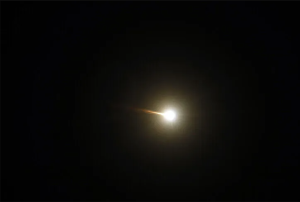
An explosive-laden drone has been shot down near Iraq’s al-Harir air base, which houses US forces, security sources told Reuters. There is no immediate reports of casualties or damage from the incident that was reported east of Erbil. The Jordanian military said three Iranian ballistic missiles launched at the country this evening were shot down by air defenses.
The interception and shootdown operation did not result in any casualties or material damage,” the military says in a statement carried by the official Petra news agency. Iran has targeted Jordan several times in recent days, during an escalation in the conflict with the United States.
Iran’s state-run IRNA news agency reported that the American strikes killed at least one person around Tabriz, a northwestern city about 520 kilometers (325 miles) from the capital, Tehran. Tabriz is believed to host underground missile bases run by Iran’s paramilitary Revolutionary Guard.
US strikes likely also hit Bandar Imam Khomeini in Khuzestan province, Sirik and Jask in Hormozgan province and Konarak and Chahbahar in Sistan and Baluchistan province, IRNA reported.
The British military’s United Kingdom Maritime Trade Operations center said Monday evening that a second ship had been attacked in the Strait of Hormuz, this one off the coast of the United Arab Emirates.
A new pressure point could emerge for world energy markets as Yemen’s Houthi rebels announced on Monday a maritime embargo against Saudi Arabia. The Houthis, who are backed by Iran, said they would block shipping between the Red Sea and the Gulf of Aden in response to an attack on Sanaa International Airport last week that they blamed on Saudi Arabia.
Iranian President Masoud Pezeshkian said Monday that his country was in a “full-scale war” with the United States and that Tehran should accept the repercussions of the conflict, even as mediators reportedly proposed a 10-day truce to deescalate the fighting.
“The reality is that today the Islamic Republic of Iran is engaged in a full-scale war,” Pezeshkian said, adding that “we must be realistic and accept the natural consequences of this resistance,” according to a statement.
Iran’s top negotiator Mohammad Bagher Ghalibaf doubled down on the sentiment, claiming that US military steps proved that Washington is not interested in ending the recent escalation with Tehran.
“Americans keep bringing new military equipment to the region and claim they want to stop the war,” said Ghalibaf on X. “They’ve bet on our intelligence being as low as their own IQ.”
“We’ve reached the stage of mastery in recognizing these American games, and on that basis, we’ve prepared ourselves,” he continued. “Actions must confirm claims, not contradict them.”
Israel’s security cabinet was set to meet on Monday in light of the conflict, according to Hebrew media reports. A US official likewise told the Washington Post on Monday that the US was making plans for a potential expansion of military operations against Iran, while noting that Washington was limited by low munitions stockpiles.
“The US is planning for a wider war,” the official said, adding that the US was sending more military aircraft to the Middle East, seemingly confirming Ghalibaf’s remarks.
According to the outlet, the Pentagon will be hamstrung by its insufficient stockpiles of air defense and long-range missiles. It will also be limited in its ability to bring more troops into the fight because of battle damage incurred during earlier combat against Iran.
“We do not have enough to safely sustain operations, and I don’t think the White House is aware of that,” the official warned.
A vessel operated by Greek shipping firm Dynacom caught fire after it was struck by an unknown projectile eight nautical miles northwest of Oman’s Kumzar overlooking the Strait of Hormuz, maritime security officials said on Monday.
Iran’s Revolutionary Guards force also said two oil tankers “exploded” and were immobilized after attempting to take what it called an unsafe southern route through the Strait of Hormuz. On Sunday, the Guards also pointed to two ships involved in an “accident” in the same area.
Separately, Bahrain’s civil aviation body claimed that Iran had targeted its air navigation systems with drones on Monday, though traffic remained unaffected. During the afternoon, Kuwait’s military said the Gulf country faced another Iranian missile and drone attack.
Iran has launched a series of attacks on Kuwait in the last 24 hours, saying it’s targeting US assets.
In neighboring Bahrain, air raid sirens also sounded, according to the island kingdom’s interior ministry.
Meanwhile, Iran’s Fars news agency reported that explosions were heard in Shiraz, in the southwest of the country.