
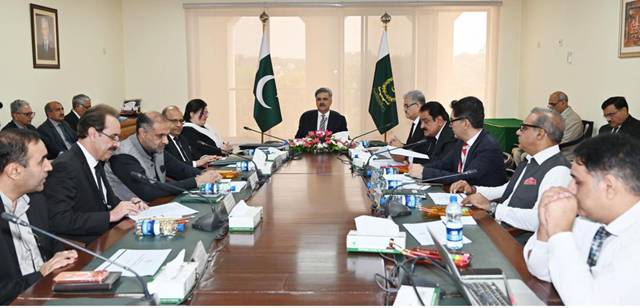
ISLAMABAD – Chief Justice of Pakistan on Friday chaired the 62nd meeting of the National Judicial Policy Making Committee (NJPMC), which highly appreciated the exceptional performance of the district judiciary in disposing of 1,467,675 time-bound cases between September 1, 2025 and July 31, 2026. The meeting, held at the Supreme Court of Pakistan, was attended by the Chief Justices of the Lahore, Peshawar and Sindh High Courts and the Registrar of the Islamabad High Court.
The Secretary Ministry of Law and Justice, Additional Secretary Ministry of IT and Telecom and Director General National Cyber Emergency Response Team also participated as special invitees. The Committee reviewed progress on decisions taken at its 61st meeting and unanimously resolved to strengthen institutional capacity, accelerate access to justice and ensure efficient and effective justice delivery.
The NJPMC considered progress on establishing a redressal mechanism for cases of enforced disappearances and directed the Ministry of Law and Justice to expedite finalization of the matter and submit a comprehensive report at its next meeting. It also considered the Draft National Judicial Reform Framework aligned with the World Justice Project (WJP) Rule of Law Index. The Secretariat was directed to circulate proposed indicators to all High Courts for their suggestions within 10 days.
The Committee decided that the finalized framework and indicators would be operationalized in phases, with the Rule of Law Tracker to become fully operational across all tiers by March 15, 2027. The Committee appreciated the efforts of the Secretariat and National Information Technology Board (NITB) in developing the National Rule of Law Index and Judicial Reforms Tracker Portal and directed comprehensive end-user and master-trainer programmes for its effective and sustainable utilization.The meeting also directed the Ministry of Law and Justice to make the Media and Strategic Communications Cell fully operational and prepare standard operating procedures for timely, accurate and coordinated dissemination of judicial data. Regarding performance evaluation under the WJP Rule of Law Index, the Committee directed the Ministry of Law and Justice to expedite hiring of an internationally reputed consultant with relevant expertise and international institutional linkages. The NJPMC also approved, in principle, the National Unified E-Filing and Electronic Judicial Record System for Courts in Pakistan. A committee comprising Registrars of all High Courts or their nominees from judicial and IT wings, along with representatives of provincial and Islamabad Bar Councils, will review and finalize standardized e-filing templates.
The pilot project will be launched in family cases at selected stations in each province and the Islamabad Capital Territory, covering Family Courts, District Courts, respective High Courts and the Supreme Court. The IT wings of the Supreme Court and High Courts were directed to jointly prepare functional requirements, national judicial data and Universal Case Identification Number (UCIN) standards, interoperability and security framework and the pilot implementation plan. The Director General NCERT was also directed to submit a cybersecurity framework and governance structure for the proposed Judicial Cyber Emergency Response Team (JCERT). The Committee appreciated the integration of 17 prioritized case categories into the National Judicial Analytics Dashboard (NJAD), including district-wise and category-wise drill-down and six-month trend analysis. High Courts were directed to ensure accuracy and completeness of data and hold monthly performance briefings focusing on disposal, pendency, backlog and emerging trends.
The NJPMC particularly commended the disposal of 1,467,675 time-bound cases against a pendency of 1,227,657 cases as of September 1, 2025. The Committee said the achievement reflected the effectiveness of clearly defined timelines, measurable targets and sustained institutional monitoring.


